


Discount function
In economics, a discount function is used in economic models to describe the weights placed on rewards received at different points in time. For example, if time is discrete and utility is time-separable, with the discount function f(t) having a negative first derivative and with ct (or c(t) in continuous time) defined as consumption at time t, total utility from an infinite stream of consumption is given by:
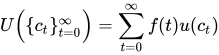
Total utility in the continuous-time case is given by:

provided that this integral exists.
Exponential discounting and hyperbolic discounting are the two most commonly used examples.
See also
[edit]References
[edit]- Shane Frederick & George Loewenstein & Ted O'Donoghue, 2002. "Time Discounting and Time Preference: A Critical Review", Journal of Economic Literature, vol. 40(2), pages 351-401, June.