


Desuspension
 | This article may need to be rewritten to comply with Wikipedia's quality standards. (May 2026) |
In topology, a field within mathematics, desuspension is an operation inverse to suspension.[1]
Definition
[edit]In general, given an n-dimensional space , the suspension has dimension n + 1. Thus, the operation of suspension creates a way of moving up in dimension. In the 1950s, to define a way of moving down, mathematicians introduced an inverse operation , called desuspension.[2] Therefore, given an n-dimensional space , the desuspension has dimension n – 1.


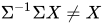
In general, . [citation needed]
Reasons
[edit]The reasons to introduce desuspension:
- Desuspension makes the category of spaces a triangulated category.
- If arbitrary coproducts were allowed, desuspension would result in all cohomology functors being representable.
See also
[edit]References
[edit]- ↑ Wolcott, Luke; McTernan, Elizabeth (2012). "Imagining Negative-Dimensional Space" (PDF). In Bosch, Robert; McKenna, Douglas; Sarhangi, Reza (eds.). Proceedings of Bridges 2012: Mathematics, Music, Art, Architecture, Culture. Phoenix, Arizona, USA: Tessellations Publishing. pp. 637–642. ISBN 978-1-938664-00-7. ISSN 1099-6702. Archived from the original (PDF) on 26 June 2015. Retrieved 25 June 2015.
- ↑ Margolis, Harvey Robert (1983). Spectra and the Steenrod Algebra. North-Holland Mathematical Library. North-Holland. p. 454. ISBN 978-0-444-86516-8. LCCN 83002283.
