


10-demicube
 | This article includes a list of general references but lacks sufficient corresponding inline citations. (August 2025) |
| Demidekeract (10-demicube) | ||
|---|---|---|
 Petrie polygon projection | ||
| Type | Uniform 10-polytope | |
| Family | demihypercube | |
| Coxeter symbol | 171 | |
| Schläfli symbol | {31,7,1} h{4,38} s{21,1,1,1,1,1,1,1,1} | |
| Coxeter diagram |     = =     | |
| 9-faces | 532 | 20 {31,6,1}  512 {38}  |
| 8-faces | 5300 | 180 {31,5,1}  5120 {37}  |
| 7-faces | 24000 | 960 {31,4,1}  23040 {36}  |
| 6-faces | 64800 | 3360 {31,3,1}  61440 {35}  |
| 5-faces | 115584 | 8064 {31,2,1}  107520 {34}  |
| 4-faces | 142464 | 13440 {31,1,1}  129024 {33}  |
| Cells | 122880 | 15360 {31,0,1}  107520 {3,3} |
| Faces | 61440 | {3}  |
| Edges | 11520 | |
| Vertices | 512 | |
| Vertex figure | Rectified 9-simplex  | |
| Symmetry group | D10, [37,1,1] = [1+,4,38] [29]+ | |
| Dual | ? | |
| Properties | convex | |
In geometry, a 10-demicube or demidekeract is a uniform 10-polytope, constructed from the 10-cube with alternated vertices removed. It is part of a dimensionally infinite family of uniform polytopes called demihypercubes.
E. L. Elte identified it in 1912 as a semiregular polytope, labeling it as HM10 for a ten-dimensional half measure polytope.
Coxeter named this polytope as 171 from its Coxeter diagram, with a ring on one of the 1-length branches, 


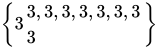
 and Schläfli symbol or {3,37,1}.
Acronym: hede[1]
Cartesian coordinates
[edit]Cartesian coordinates for the vertices of a demidekeract centered at the origin are alternate halves of the dekeract:
- (±1,±1,±1,±1,±1,±1,±1,±1,±1,±1)
with an odd number of plus signs.
Images
[edit] B10 Coxeter plane |
 D10 Coxeter plane. Vertices are colored by multiplicity: red, orange, yellow, green = 1,2,4,8. |
Related polytopes
[edit]A regular dodecahedron can be embedded as a regular skew polyhedron within the vertices in the 10-demicube, possessing the same symmetries as the 3-dimensional dodecahedron.[2]
References
[edit]- ↑ Klitzing, Richard. "x3o3o *b3o3o3o3o3o3o3o - hede".
- ↑ Deza, Michael; Shtogrin, Mikhael (2000). "Embedding the graphs of regular tilings and star-honeycombs into the graphs of hypercubes and cubic lattices". Advanced Studies in Pure Mathematics. Arrangements – Tokyo 1998. 27. Mathematical Society of Japan: 73–92[77]. doi:10.2969/aspm/02710073. ISBN 978-4-931469-77-8.
{{cite journal}}: CS1 maint: periodical has ISBN (link)
- H.S.M. Coxeter:
- H.S.M. Coxeter, Regular Polytopes, 1973, 3rd edition, Dover, New York, pp. 294–295, Table I (iii): Regular Polytopes, three regular polytopes in n dimensions (n ≥ 5), ISBN 0-486-61480-8
- Kaleidoscopes: Selected Writings of H.S.M. Coxeter, edited by F. Arthur Sherk, Peter McMullen, Anthony C. Thompson, Asia Ivić Weiss, Wiley-Interscience Publication, 1995, wiley.com, ISBN 978-0-471-01003-6
- (Paper 22) H.S.M. Coxeter, Regular and Semi-Regular Polytopes I, [Math. Zeit. 46 (1940) 380–407, MR 2,10]
- (Paper 23) H.S.M. Coxeter, Regular and Semi-Regular Polytopes II, [Math. Zeit. 188 (1985) 559–591]
- (Paper 24) H.S.M. Coxeter, Regular and Semi-Regular Polytopes III, [Math. Zeit. 200 (1988) 3–45]
- John H. Conway, Heidi Burgiel, Chaim Goodman-Strauss, The Symmetries of Things, 2008, Chapter 26, p. 409, Hemicubes: 1n1, ISBN 978-1-56881-220-5
- Norman Johnson Uniform Polytopes, Manuscript (1991)
- N.W. Johnson: The Theory of Uniform Polytopes and Honeycombs, Ph.D. (1966)
- Klitzing, Richard. "10D uniform polytopes (polyxenna) x3o3o *b3o3o3o3o3o3o3o - hede".
External links
[edit]- Olshevsky, George. "Demienneract". Glossary for Hyperspace. Archived from the original on 4 February 2007.
- Multi-dimensional Glossary
| Family | An | Bn | I2(p) / Dn | E6 / E7 / E8 / F4 / G2 | Hn | |||||||
|---|---|---|---|---|---|---|---|---|---|---|---|---|
| Regular polygon | Triangle | Square | p-gon | Hexagon | Pentagon | |||||||
| Uniform polyhedron | Tetrahedron | Octahedron • Cube | Demicube | Dodecahedron • Icosahedron | ||||||||
| Uniform polychoron | Pentachoron | 16-cell • Tesseract | Demitesseract | 24-cell | 120-cell • 600-cell | |||||||
| Uniform 5-polytope | 5-simplex | 5-orthoplex • 5-cube | 5-demicube | |||||||||
| Uniform 6-polytope | 6-simplex | 6-orthoplex • 6-cube | 6-demicube | 122 • 221 | ||||||||
| Uniform 7-polytope | 7-simplex | 7-orthoplex • 7-cube | 7-demicube | 132 • 231 • 321 | ||||||||
| Uniform 8-polytope | 8-simplex | 8-orthoplex • 8-cube | 8-demicube | 142 • 241 • 421 | ||||||||
| Uniform 9-polytope | 9-simplex | 9-orthoplex • 9-cube | 9-demicube | |||||||||
| Uniform 10-polytope | 10-simplex | 10-orthoplex • 10-cube | 10-demicube | |||||||||
| Uniform n-polytope | n-simplex | n-orthoplex • n-cube | n-demicube | 1k2 • 2k1 • k21 | n-pentagonal polytope | |||||||
| Topics: Polytope families • Regular polytope • List of regular polytopes and compounds • Polytope operations | ||||||||||||