


Delivery Performance
 | This article contains instructions or advice. (August 2024) |
Delivery performance (DP) is a broadly used standard KPI measurement in supply chains to measure the fulfillment of a customer's demand to the wish date.[1] Following the nomenclature of the DR-DP-Matrix three main approaches to measure DP can be distinguished:


- Type of measurement: volume (V)/singular(S)
- Type of view: on time (T)/ delivery (D)
Volume/on time
[edit]Formula
[edit]If ()

- =

Else
- NULL
Demand:= customers wish c:= product identifier p:= Time period e.g. a day, a week, a month ...
The cumulation over a period and a group of product identifiers c is done as follows:
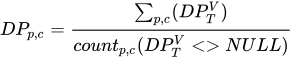
whereas p is determined by demand period
Singular/delivery and singular/on time
[edit]Singular case definition
[edit]To fit to the needs of the environment, the granularity of a singular case () has to be defined. In general a singular case is described by a n-Tuple consisting of a set of the following order and delivery details:

- order number
- customer identifier
- product identifier
- wish date of customer
- confirmed date of supplier
- ship to information
- delivery date
- delivery note number
Formula
[edit]- After a singular case has been delivered to the customer its DP is measured as follows:
- If (wish date = arrival date) then
- DPsingular case=1
- else
- DPsingular case=0
- If (wish date = arrival date) then
arrival date = delivery date + transit time
By cumulating the results of singular cases over a certain period p and, if necessary, additional criteria c (e.g. customer, product, ...) the delivery performance is calculated as follows:
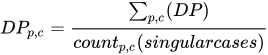
whereas p is determined by the arrival date
- After a period has elapsed all singular cases with wish date within period are considered and their DP is measured as follows:
- If (wish date = arrival date) then
- DRsingular case=1
- else
- DRsingular case=0
- If (wish date = arrival date) then
arrival date = delivery date + transit time
By cumulating the results of singular cases over a certain period p and, if necessary, additional criteria c (e.g. customer, product, ...) the delivery performance is calculated as follows:
whereas p is determined by the first confirmed date
Result
[edit]0%≤≤100%

References
[edit]See also
[edit]
 | This standards- or measurement-related article is a stub. You can help Wikipedia by adding missing information. |
 | This logistics-related article is a stub. You can help Wikipedia by adding missing information. |