


Continuity in probability
In probability theory, a stochastic process is said to be continuous in probability or stochastically continuous if its distributions converge whenever the values in the index set converge. [1][2]
Definition
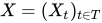
[edit]Let be a stochastic process in . The process is continuous in probability when converges in probability to whenever converges to .[2]


Examples and Applications
[edit]Feller processes are continuous in probability at . Continuity in probability is a sometimes used as one of the defining property for Lévy process.[1] Any process that is continuous in probability and has independent increments has a version that is càdlàg.[2] As a result, some authors immediately define Lévy process as being càdlàg and having independent increments.[3]

References
[edit]- 1 2 Applebaum, D. "Lectures on Lévy processes and Stochastic calculus, Braunschweig; Lecture 2: Lévy processes" (PDF). University of Sheffield. pp. 37–53.
- 1 2 3 Kallenberg, Olav (2002). Foundations of Modern Probability (2nd ed.). New York: Springer. p. 286.
- ↑ Kallenberg, Olav (2002). Foundations of Modern Probability (2nd ed.). New York: Springer. p. 290.