


Conic constant

In geometry, the conic constant (or Schwarzschild constant,[1] after Karl Schwarzschild) is a quantity describing conic sections, and is represented by the letter K. The constant is given by where e is the eccentricity of the conic section.

The equation for a conic section with apex at the origin and tangent to the y axis is

or alternately
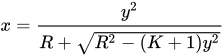
where R is the radius of curvature at x = 0.
This formulation is used in geometric optics to specify oblate elliptical (K > 0), spherical (K = 0), prolate elliptical (0 > K > −1), parabolic (K = −1), and hyperbolic (K < −1) lens and mirror surfaces. When the paraxial approximation is valid, the optical surface can be treated as a spherical surface with the same radius.
References
[edit]- ↑ Rakich, Andrew (2005-08-18). Sasian, Jose M; Koshel, R. John; Juergens, Richard C (eds.). "The 100th birthday of the conic constant and Schwarzschild's revolutionary papers in optics". Novel Optical Systems Design and Optimization VIII. 5875. International Society for Optics and Photonics: 587501. Bibcode:2005SPIE.5875....1R. doi:10.1117/12.635041. S2CID 119718303.
- Smith, Warren J. (2008). Modern Optical Engineering, 4th ed. McGraw-Hill Professional. pp. 512–515. ISBN 978-0-07-147687-4.
 | This geometry-related article is a stub. You can help Wikipedia by adding missing information. |