


Complete field
In mathematics, a complete field is a field equipped with a metric and complete with respect to that metric. A field supports the elementary operations of addition, subtraction, multiplication, and division, while a metric represents the distance between two points in the set. Basic examples include the real numbers, the complex numbers, and complete valued fields (such as the p-adic numbers).
Definitions
[edit]Field
[edit]A field is a set with binary operations and (called addition and multiplication, respectively), along with elements and such that for all , the following relations hold:[1]


- has a solution
- and
- has a solution for









Complete metric
[edit]A metric on a set is a function , that is, it takes two points in and sends them to a non-negative real number, such that the following relations hold for all :[2]




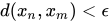
A sequence in the space is Cauchy with respect to this metric if for all there exists an such that for all we have , and a metric is then complete if every Cauchy sequence in the metric space converges, that is, there is some where for all there exists an such that for all we have . Every convergent sequence is Cauchy, however the converse does not hold in general.[2][3]




Constructions
[edit]Real and complex numbers
[edit]The real numbers are the field with the standard Euclidean metric , and this measure is complete.[2] Extending the reals by adding the imaginary number satisfying gives the field , which is also a complete field.[3]


p-adic
[edit]The p-adic numbers are constructed from by using the p-adic absolute value


where Then using the factorization where does not divide its valuation is the integer . The completion of by is the complete field called the p-adic numbers. This is a case where the field is not algebraically closed. Typically, the process is to take the separable closure and then complete it again. This field is usually denoted [4]


References
[edit]- ↑ Hungerford, Thomas W. (2014). Abstract Algebra: an introduction (Third ed.). Boston, MA: Brooks/Cole, Cengage Learning. pp. 44, 49. ISBN 978-1-111-56962-4.
- 1 2 3 Folland, Gerald B. (1999). Real analysis: modern techniques and their applications (2nd ed.). Chichester Weinheim [etc.]: New York J. Wiley & sons. pp. 13–14. ISBN 0-471-31716-0.
- 1 2 Rudin, Walter (2008). Principles of mathematical analysis (3., [Nachdr.] ed.). New York: McGraw-Hill. pp. 47, 52–54. ISBN 978-0-07-054235-8.
- ↑ Koblitz, Neal. (1984). P-adic Numbers, p-adic Analysis, and Zeta-Functions (Second ed.). New York, NY: Springer New York. pp. 52–75. ISBN 978-1-4612-1112-9. OCLC 853269675.
See also
[edit]- Completion (algebra) – In algebra, completion w.r.t. powers of an ideal
- Complete topological vector space – Structure in functional analysis
- Hensel's lemma – Theorem on polynomial roots modulo prime powers
- Henselian ring – Local ring in which Hensel's lemma holds
- Compact group – Topological group with compact topology
- Locally compact field
- Locally compact quantum group
- Locally compact group – Type of topological group in mathematics
- Ordered topological vector space
- Ostrowski's theorem – On all absolute values of rational numbers
- Topological abelian group
- Topological field – Algebraic structure with addition, multiplication, and division
- Topological group – Group that is a topological space with continuous group operations
- Topological module
- Topological ring
- Topological semigroup
- Topological vector space – Vector space with a notion of nearness