


Collectionwise Hausdorff space
In mathematics, in the field of topology, a topological space is said to be collectionwise Hausdorff if given any closed discrete subset of , there is a pairwise disjoint family of open sets with each point of the discrete subset contained in exactly one of the open sets.[1]

Here a subset being discrete has the usual meaning of being a discrete space with the subspace topology (i.e., all points of are isolated in ).[nb 1]


Properties
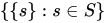
[edit]- Every collectionwise normal space is collectionwise Hausdorff. (This follows from the fact that given a closed discrete subset of , every singleton is closed in and the family of such singletons is a discrete family in .)


- Metrizable spaces are collectionwise normal and hence collectionwise Hausdorff.
Remarks
[edit]- ↑ If is T1 space, being closed and discrete is equivalent to the family of singletons being a discrete family of subsets of (in the sense that every point of has a neighborhood that meets at most one set in the family). If is not T1, the family of singletons being a discrete family is a weaker condition. For example, if with the indiscrete topology, is discrete but not closed, even though the corresponding family of singletons is a discrete family in .


References
[edit]- ↑ Tall, Franklin (1976). "The density topology". Pacific Journal of Mathematics. 62 (1): 275–284. doi:10.2140/pjm.1976.62.275.Definition 3.4