


Cochleoid

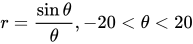


In geometry, a cochleoid is a snail-shaped curve similar to a strophoid which can be represented by the polar equation


or the parametric equations

The cochleoid is the inverse curve of Hippias' quadratrix.[1]
Notes
[edit]References
[edit]- J. Dennis Lawrence (1972). A catalog of special plane curves. Dover Publications. p. 192. ISBN 0-486-60288-5.
- Cochleoid in the Encyclopedia of Mathematics
- Liliana Luca, Iulian Popescu: A Special Spiral: The Cochleoid. Fiabilitate si Durabilitate - Fiability & Durability no 1(7)/ 2011, Editura "Academica Brâncuşi", Târgu Jiu, ISSN 1844-640X
- Roscoe Woods: The Cochlioid. The American Mathematical Monthly, Vol. 31, No. 5 (May, 1924), pp. 222–227 (JSTOR)
- Howard Eves: A Graphometer. The Mathematics Teacher, Vol. 41, No. 7 (November 1948), pp. 311–313 (JSTOR)
External links
[edit]
Wikimedia Commons has media related to Cochleoid.
- cochleoid at 2dcurves.com
- Weisstein, Eric W. "Cochleoid". MathWorld.
 | This geometry-related article is a stub. You can help Wikipedia by adding missing information. |