


Closed range theorem
In the mathematical theory of Banach spaces, the closed range theorem gives necessary and sufficient conditions for a closed densely defined operator to have closed range.
The theorem was proved by Stefan Banach in his 1932 Théorie des opérations linéaires.
Statement
[edit]Let and be Banach spaces, a closed linear operator whose domain is dense in and the transpose of . The theorem asserts that the following conditions are equivalent:


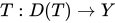


- the range of is closed in
- the range of is closed in the dual of




Where and are the null space of and , respectively.


Note that there is always an inclusion , because if and , then . Likewise, there is an inclusion . So the non-trivial part of the above theorem is the opposite inclusion in the final two bullets.





Corollaries
[edit]Several corollaries are immediate from the theorem. For instance, a densely defined closed operator as above has if and only if the transpose has a continuous inverse. Similarly, if and only if has a continuous inverse.


Sketch of proof
[edit]Since the graph of T is closed, the proof reduces to the case when is a bounded operator between Banach spaces. Now, factors as . Dually, is


Now, if is closed, then it is Banach and so by the open mapping theorem, is a topological isomorphism. It follows that is an isomorphism and then . (More work is needed for the other implications.)


Further reading
[edit]References
[edit]- Banach, Stefan (1932). Théorie des Opérations Linéaires [Theory of Linear Operations] (PDF). Monografie Matematyczne (in French). Vol. 1. Warszawa: Subwencji Funduszu Kultury Narodowej. Zbl 0005.20901. Archived from the original (PDF) on 11 January 2014. Retrieved 11 July 2020.
- Yosida, K. (1980), Functional Analysis, Grundlehren der Mathematischen Wissenschaften (Fundamental Principles of Mathematical Sciences), vol. 123 (6th ed.), Berlin, New York: Springer-Verlag.
Banach space topics | |
|---|---|
| Types of Banach spaces | |
| Banach spaces are: | |
| Function space Topologies | |
| Linear operators | |
| Operator theory | |
| Theorems |
|
| Analysis | |
| Types of sets |
|
| Subsets / set operations | |
| Examples | |
| Applications | |


| Spaces |
| ||||
|---|---|---|---|---|---|
| Theorems | |||||
| Operators | |||||
| Algebras | |||||
| Open problems | |||||
| Applications | |||||
| Advanced topics | |||||
