


Chinese monoid
In mathematics, the Chinese monoid is a monoid generated by a totally ordered alphabet with the relations cba = cab = bca for every a ≤ b ≤ c. An algorithm similar to Schensted's algorithm yields characterisation of the equivalence classes and a cross-section theorem. It was discovered by Duchamp & Krob (1994) during their classification of monoids with growth similar to that of the plactic monoid, and studied in detail by Julien Cassaigne, Marc Espie, Daniel Krob, Jean-Christophe Novelli, and Florent Hivert in 2001.[1]
The Chinese monoid has a regular language cross-section

and hence polynomial growth of dimension .[2]

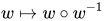
The Chinese monoid equivalence class of a permutation is the preimage of an involution under the map where denotes the product in the Iwahori-Hecke algebra with .[3]


See also
[edit]References
[edit]- ↑ Cassaigne, Julien; Espie, Marc; Krob, Daniel; Novelli, Jean-Christophe; Hivert, Florent (2001), "The Chinese monoid", International Journal of Algebra and Computation, 11 (3): 301–334, doi:10.1142/S0218196701000425, ISSN 0218-1967, MR 1847182, Zbl 1024.20046
- ↑ Jaszuńska, Joanna; Okniński, Jan (2011), "Structure of Chinese algebras.", J. Algebra, 346 (1): 31–81, arXiv:1009.5847, doi:10.1016/j.jalgebra.2011.08.020, ISSN 0021-8693, S2CID 119280148, Zbl 1246.16022
- ↑ Hamaker, Zachary; Marberg, Eric; Pawlowski, Brendan (2017-05-01). "Involution words II: braid relations and atomic structures". Journal of Algebraic Combinatorics. 45 (3): 701–743. arXiv:1601.02269. doi:10.1007/s10801-016-0722-6. ISSN 1572-9192. S2CID 119330473.
- Duchamp, Gérard; Krob, Daniel (1994), "Plactic-growth-like monoids", Words, languages and combinatorics, II (Kyoto, 1992), World Sci. Publ., River Edge, NJ, pp. 124–142, MR 1351284, Zbl 0875.68720
.svg) | This combinatorics-related article is a stub. You can help Wikipedia by adding missing information. |
 | This abstract algebra–related article is a stub. You can help Wikipedia by adding missing information. |