


Cheeger bound
In mathematics, the Cheeger bound is a bound of the second largest eigenvalue of the transition matrix of a finite-state, discrete-time, reversible stationary Markov chain. It can be seen as a special case of Cheeger inequalities in expander graphs.
Let be a finite set and let be the transition probability for a reversible Markov chain on . Assume this chain has stationary distribution .


Define

and for define

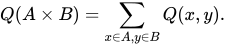
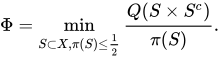
Define the constant as

The operator acting on the space of functions from to , defined by


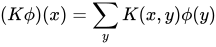
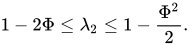
has eigenvalues . It is known that . The Cheeger bound is a bound on the second largest eigenvalue .



Theorem (Cheeger bound):
See also
[edit]References
[edit]- Cheeger, Jeff (1971). "A Lower Bound for the Smallest Eigenvalue of the Laplacian". Problems in Analysis: A Symposium in Honor of Salomon Bochner (PMS-31). Princeton University Press. pp. 195–200. doi:10.1515/9781400869312-013. ISBN 978-1-4008-6931-2.
- Diaconis, Persi; Stroock, Daniel (1991). "Geometric Bounds for Eigenvalues of Markov Chains". The Annals of Applied Probability. 1 (1). Institute of Mathematical Statistics: 36–61. doi:10.1214/aoap/1177005980. ISSN 1050-5164. JSTOR 2959624. Retrieved 2024-04-14.
 | This statistics-related article is a stub. You can help Wikipedia by adding missing information. |