Cloudflare fetched the original article and streamed it through HTMLRewriter to apply an entirely new visual system without rebuilding the source page.
Plot of the Chebyshev rational functions for n = 0, 1, 2, 3, 4 for 0.01 ≤ x ≤ 100, log scale.
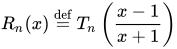
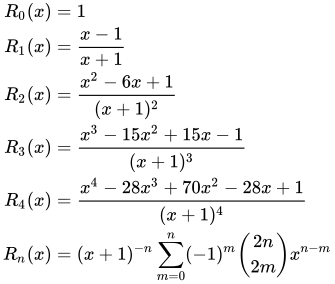
In mathematics, the Chebyshev rational functions are a sequence of functions which are both rational and orthogonal. They are named after Pafnuty Chebyshev. A rational Chebyshev function of degree n is defined as:
Many properties can be derived from the properties of the Chebyshev polynomials of the first kind. Other properties are unique to the functions themselves.
Plot of the absolute value of the seventh-order (n = 7) Chebyshev rational function for 0.01 ≤ x ≤ 100. Note that there are n zeroes arranged symmetrically about x = 1 and if x0 is a zero, then 1/x0 is a zero as well. The maximum value between the zeros is unity. These properties hold for all orders.
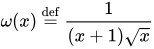
Defining:
The orthogonality of the Chebyshev rational functions may be written:
where cn = 2 for n = 0 and cn = 1 for n ≥ 1; δnm is the Kronecker delta function.