


Characteristic subgroup
 | This article includes a list of general references but lacks sufficient corresponding inline citations. (August 2026) |
In group theory, a characteristic subgroup is a subgroup that is mapped to itself by every automorphism of the parent group.[1][2] Because every conjugation map is an inner automorphism, every characteristic subgroup is normal; though the converse is not true. Examples of characteristic subgroups include the commutator subgroup and the center of a group.
Definition
[edit]A subgroup of a group is called a characteristic subgroup if for every automorphism of , one has ; then write H char G.


This is equivalent to the stronger condition for every automorphism of , because implies the reverse inclusion .


Basic properties
[edit]Given , every automorphism of induces an automorphism of the quotient group , which yields a homomorphism .


If has a unique subgroup of a given index, then is characteristic in .
Related concepts
[edit]Normal subgroup
[edit]A subgroup of that is invariant under all inner automorphisms is called normal; sometimes called an invariant subgroup.
Since and a characteristic subgroup is invariant under all automorphisms, every characteristic subgroup is normal. However, not every normal subgroup is characteristic. Here are several examples:

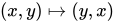
- Let be a nontrivial group, and let be the direct product. Then the subgroups and are both normal, but neither is characteristic. In particular, neither of these subgroups is invariant under the automorphism , that switches the two factors.


- For a concrete example of this, let be the Klein four-group. Since this group is abelian, every subgroup is normal; however, every permutation of the non-identity elements is an automorphism of , so the subgroups of order are not characteristic. Formally, . If for example and is the automorphism switching and , then is not contained in .


- In the quaternion group of order 8, each of the cyclic subgroups of order 4 is normal, but none of these are characteristic. However, the subgroup, , is characteristic, since it is the only subgroup of order 2.

- If is even, the dihedral group of order has subgroups of index , all of which are normal. One of these is the cyclic subgroup, which is characteristic. The other two subgroups are dihedral; these are permuted by an outer automorphism of the parent group, and are therefore not characteristic.


Strictly characteristic subgroup
[edit]A strictly characteristic subgroup, or a distinguished subgroup, is one which is invariant under surjective endomorphisms. For finite groups, surjectivity of an endomorphism implies injectivity, so a surjective endomorphism is an automorphism; thus, strictly characteristic is equivalent to characteristic. This is not the case for infinite groups.
Fully characteristic subgroup
[edit]For an even stronger constraint, a fully characteristic subgroup (also, fully invariant subgroup) of a group , is a subgroup H ≤ G that is invariant under every endomorphism of (and not just every automorphism):
- ∀φ ∈ End(G): φ(H) ≤ H.
Every group has itself (the improper subgroup) and the trivial subgroup as two of its fully characteristic subgroups. The commutator subgroup of a group is always a fully characteristic subgroup.[3][4]
Every endomorphism of induces an endomorphism of , which yields a map End(G) → End(G/H).
Verbal subgroup
[edit]An even stronger constraint is verbal subgroup, which is the image of a fully invariant subgroup of a free group under a homomorphism. More generally, any verbal subgroup is always fully characteristic. For any reduced free group, and, in particular, for any free group, the converse also holds: every fully characteristic subgroup is verbal.
Transitivity
[edit]The property of being characteristic or fully characteristic is transitive; if is a (fully) characteristic subgroup of , and is a (fully) characteristic subgroup of , then is a (fully) characteristic subgroup of .

- H char K char G ⇒ H char G.
Moreover, while normality is not transitive, it is true that every characteristic subgroup of a normal subgroup is normal.
- H char K ⊲ G ⇒ H ⊲ G
Similarly, while being strictly characteristic (distinguished) is not transitive, it is true that every fully characteristic subgroup of a strictly characteristic subgroup is strictly characteristic.
However, unlike normality, if H char G and is a subgroup of containing , then in general is not necessarily characteristic in .
- H char G, H < K < G ⇏ H char K
Containments
[edit]Every subgroup that is fully characteristic is certainly strictly characteristic and characteristic; but a characteristic or even strictly characteristic subgroup need not be fully characteristic.
The center of a group is always a strictly characteristic subgroup, but it is not always fully characteristic. For example, the finite group of order , Sym(3) × , has a homomorphism taking to , which takes the center, , into a subgroup of Sym(3) × 1, which meets the center only in the identity.


The relationship amongst these subgroup properties can be expressed as:
- Normal ⇐ Characteristic ⇐ Strictly characteristic ⇐ Fully characteristic ⇐ Verbal
Examples
[edit]Finite example
[edit]Consider the group (the group of order 12 that is the direct product of the symmetric group of order 6 and a cyclic group of order 2). The center of is isomorphic to its second factor . Note that the first factor, , contains subgroups isomorphic to , for instance ; let be the morphism mapping onto the indicated subgroup. Then the composition of the projection of onto its second factor , followed by , followed by the inclusion of into as its first factor, provides an endomorphism of under which the image of the center, , is not contained in the center, so here the center is not a fully characteristic subgroup of .



Cyclic groups
[edit]Every subgroup of a cyclic group is characteristic.
Subgroup functors
[edit]The derived subgroup (or commutator subgroup) of a group is a verbal subgroup. The torsion subgroup of an abelian group is a fully invariant subgroup.
Topological groups
[edit]The identity component of a topological group is always a characteristic subgroup.
See also
[edit]Notes
[edit]- ↑ Dummit & Foote (2003), p. 135.
- ↑ Lang (2002).
- ↑ Scott (1964), pp. 45–46.
- ↑ Magnus, Karrass & Solitar (2004), pp. 74–85.
References
[edit]- Dummit, David S.; Foote, Richard M. (2003) [1991]. Abstract Algebra (3rd ed.). Hoboken, NJ: John Wiley & Sons. ISBN 978-0-471-43334-7.
- Lang, Serge (2002) [1965]. Algebra. Graduate Texts in Mathematics. Vol. 211 (3rd ed.). New York: Springer. ISBN 978-0-387-95385-4.
- Magnus, Wilhelm; Karrass, Abraham; Solitar, Donald (2004) [1966]. Combinatorial Group Theory (reprint of 1976 2nd ed.). Mineola, NY: Dover. ISBN 0-486-43830-9.
- Scott, W. R. (1964). Group Theory. Englewood Cliffs, NJ: Prentice Hall. Zbl 0126.04504.