


Cellular decomposition
In geometric topology, a cellular decomposition G of a manifold M is a decomposition of M as the disjoint union of cells (spaces homeomorphic to n-balls Bn).
The quotient space M/G has points that correspond to the cells of the decomposition. There is a natural map from M to M/G, which is given the quotient topology. A fundamental question is whether M is homeomorphic to M/G. Bing's dogbone space is an example with M (equal to R3) not homeomorphic to M/G.
Definition
[edit]Cellular decomposition of is an open cover with a function for which:


- Cells are disjoint: for any distinct , .
- No set gets mapped to a negative number: .
- Cells look like balls: For any and for any there exists a continuous map that is an isomorphism and also .




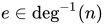



A cell complex is a pair where is a topological space and is a cellular decomposition of .

See also
[edit]References
[edit]- Daverman, Robert J. (2007), Decompositions of manifolds, AMS Chelsea Publishing, Providence, RI, p. 22, arXiv:0903.3055, ISBN 978-0-8218-4372-7, MR 2341468