


Cartesian monoid
A Cartesian monoid is a monoid, with additional structure of pairing and projection operators. It was first formulated by Dana Scott and Joachim Lambek independently.[1]
Definition
[edit]A Cartesian monoid is a structure with signature where and are binary operations, , and are constants satisfying the following axioms for all in its universe:



- Monoid
- is a monoid with identity
- Left Projection
- Right Projection
- Surjective Pairing
- Right Homogeneity
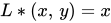
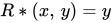


The interpretation is that and are left and right projection functions respectively for the pairing function .


References
[edit]- ↑ Statman, Rick (1997), "On Cartesian monoids", Computer science logic (Utrecht, 1996), Lecture Notes in Computer Science, vol. 1258, Berlin: Springer, pp. 446–459, doi:10.1007/3-540-63172-0_55, MR 1611514.