


Bull graph
| Bull graph | |
|---|---|
 The bull graph | |
| Vertices | 5 |
| Edges | 5 |
| Radius | 2 |
| Diameter | 3 |
| Girth | 3 |
| Automorphisms | 2 (Z/2Z) |
| Chromatic number | 3 |
| Chromatic index | 3 |
| Properties | Planar Unit distance |
| Table of graphs and parameters | |
In the mathematical field of graph theory, the bull graph is a planar undirected graph with 5 vertices and 5 edges, in the form of a triangle with two disjoint pendant edges.[1]
It has chromatic number 3, chromatic index 3, radius 2, diameter 3 and girth 3. It is also a self-complementary graph, a block graph, a split graph, an interval graph, a claw-free graph, a 1-vertex-connected graph and a 1-edge-connected graph.
Bull-free graphs
[edit]A graph is bull-free if it has no bull as an induced subgraph. The triangle-free graphs are bull-free graphs, since every bull contains a triangle. The strong perfect graph theorem was proven for bull-free graphs long before its proof for general graphs,[2] and a polynomial time recognition algorithm for Bull-free perfect graphs is known.[3]
Maria Chudnovsky and Shmuel Safra have studied bull-free graphs more generally, showing that any such graph must have either a large clique or a large independent set (that is, the Erdős–Hajnal conjecture holds for the bull graph),[4] and developing a general structure theory for these graphs.[5][6][7]
Chromatic and characteristic polynomial
[edit]

The chromatic polynomial of the bull graph is . Two other graphs are chromatically equivalent to the bull graph.
Its characteristic polynomial is .

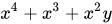
Its Tutte polynomial is .
References
[edit]- ↑ Weisstein, Eric W. "Bull Graph". MathWorld.
- ↑ Chvátal, V.; Sbihi, N. (1987), "Bull-free Berge graphs are perfect", Graphs and Combinatorics, 3 (1): 127–139, doi:10.1007/BF01788536, S2CID 44570627.
- ↑ Reed, B.; Sbihi, N. (1995), "Recognizing bull-free perfect graphs", Graphs and Combinatorics, 11 (2): 171–178, doi:10.1007/BF01929485, S2CID 206808701.
- ↑ Chudnovsky, M.; Safra, S. (2008), "The Erdős–Hajnal conjecture for bull-free graphs", Journal of Combinatorial Theory, Series B, 98 (6): 1301–1310, doi:10.1016/j.jctb.2008.02.005.
- ↑ Chudnovsky, M. (2008), The structure of bull-free graphs. I. Three-edge paths with centers and anticenters (PDF).
- ↑ Chudnovsky, M. (2008), The structure of bull-free graphs. II. Elementary trigraphs (PDF).
- ↑ Chudnovsky, M. (2008), The structure of bull-free graphs. III. Global structure (PDF).