


Breit frame
In particle physics, the Breit frame (also known as infinite-momentum frame or IMF) is a frame of reference used to describe scattering experiments of the form , that is experiments in which particle scatters off particle , possibly producing particles in the process.[1] The frame is defined so that the particle A has its momentum reversed in the scattering process.


Another way of understanding the Breit frame is to look at the elastic scattering . The Breit frame is defined as the frame in which . There are different occasions when Breit frame can be useful, e.g., in measuring the electromagnetic form factor of a hadron, is the scattered hadron; while for deep inelastic scattering process, the elastically scattered parton should be considered as . It is only in the latter case the Breit frame gets related to infinite-momentum frame.

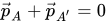
It is named after the American physicist Gregory Breit.[2]
See also
[edit]References
[edit]- ↑ Griffiths, David (1987). Introduction to elementary particles. New York: Wiley. p. 102. ISBN 978-0-471-60386-3.
- ↑ Hughes, Vernon; Iachello, Francesco; Kusnezov, Dimitri (2001). The Gregory Breit Centennial Symposium: Yale University, USA. Singapore River Edge, N.J: World Scientific. p. 9. ISBN 978-981-02-4553-5.
 | This classical mechanics–related article is a stub. You can help Wikipedia by adding missing information. |