


Bell diagonal state

| Part of a series of articles about |
| Quantum mechanics |
|---|
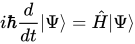
Bell diagonal states are a class of bipartite qubit states that are frequently used in quantum information and quantum computation theory.[1]
Definition
[edit]The Bell diagonal state is defined as the probabilistic mixture of Bell states:




In density operator form, a Bell diagonal state is defined as

where is a probability distribution. Since , a Bell diagonal state is determined by three real parameters. The maximum probability of a Bell diagonal state is defined as .



Properties
[edit]1. A Bell-diagonal state is separable if all the probabilities are less or equal to 1/2, i.e., .[2]

2. Many entanglement measures have a simple formulas for entangled Bell-diagonal states:[1]
Relative entropy of entanglement: ,[3] where is the binary entropy function.


Entanglement of formation: ,where is the binary entropy function.



3. Any 2-qubit state where the reduced density matrices are maximally mixed, , is Bell-diagonal in some local basis. Viz., there exist local unitaries such that is Bell-diagonal.[2]



References
[edit]- 1 2 Horodecki, Ryszard; Horodecki, Paweł; Horodecki, Michał; Horodecki, Karol (2009-06-17). "Quantum entanglement". Reviews of Modern Physics. 81 (2): 865–942. arXiv:quant-ph/0702225. Bibcode:2009RvMP...81..865H. doi:10.1103/RevModPhys.81.865. S2CID 260606370.
- 1 2 Horodecki, Ryszard; Horodecki, Michal/ (1996-09-01). "Information-theoretic aspects of inseparability of mixed states". Physical Review A. 54 (3): 1838–1843. arXiv:quant-ph/9607007. Bibcode:1996PhRvA..54.1838H. doi:10.1103/PhysRevA.54.1838. PMID 9913669. S2CID 2340228.
- ↑ Vedral, V.; Plenio, M. B.; Rippin, M. A.; Knight, P. L. (1997-03-24). "Quantifying Entanglement". Physical Review Letters. 78 (12): 2275–2279. arXiv:quant-ph/9702027. Bibcode:1997PhRvL..78.2275V. doi:10.1103/PhysRevLett.78.2275. hdl:10044/1/300. S2CID 16118336.