


Analytically irreducible ring
In algebra, an analytically irreducible ring is a local ring whose completion has no zero divisors. Geometrically this corresponds to a variety with only one analytic branch at a point.
Zariski (1948) proved that if a local ring of an algebraic variety is a normal ring, then it is analytically irreducible. There are many examples of reduced and irreducible local rings that are analytically reducible, such as the local ring of a node of an irreducible curve, but it is hard to find examples that are also normal. Nagata (1958, 1962, Appendix A1, example 7) gave such an example of a normal Noetherian local ring that is analytically reducible.
Nagata's example
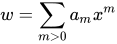
[edit]Suppose that K is a field of characteristic not 2, and K [[x,y]] is the formal power series ring over K in 2 variables. Let R be the subring of K [[x,y]] generated by x, y, and the elements zn and localized at these elements, where
- is transcendental over K(x)
- .
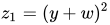

Then R[X]/(X 2–z1) is a normal Noetherian local ring that is analytically reducible.
References
[edit]- Nagata, Masayoshi (1958), "An example of a normal local ring which is analytically reducible", Mem. Coll. Sci. Univ. Kyoto. Ser. A Math., 31: 83–85, MR 0097395
- Nagata, Masayoshi (1962), Local rings, Interscience Tracts in Pure and Applied Mathematics, vol. 13, New York-London: Interscience Publishers
- Zariski, Oscar (1948), "Analytical irreducibility of normal varieties", Ann. of Math., 2, 49 (2): 352–361, doi:10.2307/1969284, JSTOR 1969284, MR 0024158
- Zariski, Oscar; Samuel, Pierre (1975) [1960], Commutative algebra. Vol. II, Berlin, New York: Springer-Verlag, ISBN 978-0-387-90171-8, MR 0389876
 | This commutative algebra-related article is a stub. You can help Wikipedia by adding missing information. |