Amphipappus
| Amphipappus | |
|---|---|
 | |
Scientific classification  | |
| Kingdom: | Plantae |
| Clade: | Tracheophytes |
| Clade: | Angiosperms |
| Clade: | Eudicots |
| Clade: | Asterids |
| Order: | Asterales |
| Family: | Asteraceae |
| Subfamily: | Asteroideae |
| Tribe: | Astereae |
| Subtribe: | Solidagininae |
| Genus: | Amphipappus Torr. & A.Gray |
| Species: | A. fremontii |
| Binomial name | |
| Amphipappus fremontii Torr. & A.Gray | |
| Synonyms[1] | |
| |
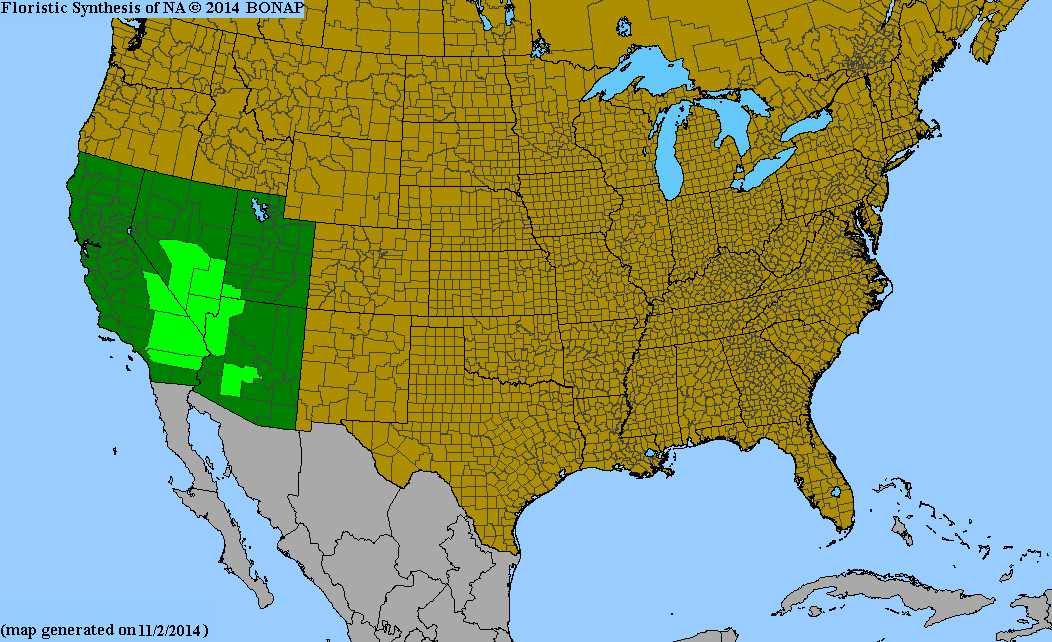
Amphipappus is a North American genus in the family Asteraceae. It is native to desert regions of the southwestern United States, in southern California, southern Nevada, Arizona, and southeastern Utah.[2][3]
There is only one known species Amphipappus fremontii. It is a shrub up to 60 cm (23.5 in) tall. The flower heads are yellow and have both ray florets and disc florets. Its rounded clumps are scattered about dry, rocky areas.[4]
The species takes its scientific epithet, fremontii from John C. Frémont,[5] and is known commonly by the names chaffbush or eytelia (in honor of artist Carl Eytel).[6][7]
References
[edit]- ↑ "Amphipappus fremontii Torr. & A.Gray ex A.Gray — The Plant List". www.theplantlist.org.
- ↑ "Biota of North America Program 2014 county distribution map". Archived from the original on 2015-05-18. Retrieved 2015-05-17.
- ↑ "Amphipappus fremontii Calflora". www.calflora.org. Archived from the original on 2021-04-11. Retrieved 2021-07-26.
- ↑ "Amphipappus in Flora of North America @ efloras.org". www.efloras.org. Archived from the original on 2015-09-24. Retrieved 2015-05-17.
- ↑ Charters, Michael L. "Botanical Names: F". California Plant Names: Latin and Greek Meanings and Derivations. Sierra Madre, CA. Archived from the original on 20 September 2009. Retrieved 24 September 2009.
- ↑ Morhardt, Sia; Morhardt, J. Emil (2004). California Desert Flowers: an Introduction to Families, Genera, and Species. University of California Press. p. 44. ISBN 978-0520240032.
- ↑ Jaeger, Edmund C. (1978). Desert Wild Flowers. Stanford, California: Stanford University Press. p. 322. ISBN 978-0804703659. LCCN 41022485. OCLC 631689191. Archived from the original on 2021-07-26. Retrieved 2020-10-04. LCC QK938.D4 J23
External links
[edit]- berkeley.edu – Jepson Manual Treatment
- United States Department of Agriculture Plants Profile
- Calphotos Photo gallery, University of California
 Media related to Amphipappus at Wikimedia Commons