


Alpha factor
The α-factor is a dimensionless quantity used to predict the solid–liquid interface type of a material during solidification. It was introduced by physicist Kenneth A. Jackson in 1958. In his model, crystal growth with larger values of α is smooth, whereas crystals growing at smaller α (below the threshold value of 2) have rough surfaces.[1][2]
Method
[edit]According to John E. Gruzleski in his book Microstructure Development During Metalcasting (1996):
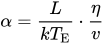
where is the latent heat of fusion; is the Boltzmann constant; is the freezing temperature at equilibrium; is the number of nearest neighbours an atom has in the interface plane; and is the number of nearest neighbours in the bulk solid.


As , where is the molar entropy of fusion of the material,


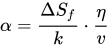
According to Martin Glicksman in his book Principles of Solidification: An Introduction to Modern Casting and Crystal Growth Concepts (2011):
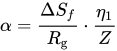
where is the universal gas constant. is similar to previous, always < 1.[4]


References
[edit]- ↑ Bennema, P. (1993). "Morphology of crystals determined by alpha factors, roughening temperature, F faces and connected nets". Journal of Physics D: Applied Physics. 26 (8B): B1–B6. doi:10.1088/0022-3727/26/8b/001.
- ↑ Uhlmann, Don; Fratello, Vincent (2022). "Kenneth A. Jackson (1930–2022)". National Academy of Engineering. Retrieved 2024-04-01.
- ↑ Gruzleski, John E. (1996). Microstructure Development During Metalcasting.
- ↑ Glicksman, Martin (2011). Principles of Solidification: An Introduction to Modern Casting and Crystal Growth Concepts.
 | This condensed matter physics-related article is a stub. You can help Wikipedia by adding missing information. |