Basic Terminology and Notation
[edit]Here we introduce some notations, being used in this article.
 — The set of bits.
Let us take all sets of form  . For such a set A we define the "zero element":

;

for

.
We define  as a set of bytes, and
  as a set of words.
For  with
with 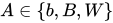 and
and  we define a padding operator:

.
Conversion operator
[edit]Conversion operator  makes a conversion between elements
 ![{\displaystyle Z,F_{2}[T],b^{\ast },B^{\ast },W^{\ast }}](https://wikimedia.org/api/rest_v1/media/math/render/svg/c35e25f92de94c93e61028f1d0853c129cdf3f0c) .
.
Encryption Key Pair
[edit]The encryption scheme employs two key types:
ACE public key:  .
.
ACE private key: 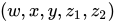 .
.
For a given size parameter  , such that
  , key components are defined as:
 — a 256-bit prime number.
 — a m-bit prime number, such that
  .
.
 — elements
 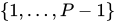 (whose multiplicative order modulo divides ).
 — elements
 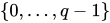 .
.
 — elements
  with
with  and
and  , where
  and
and  .
.
Algorithm. Key Generation for ACE encryption scheme.
Input: a size parameter , such that .
Output: a public/private key pair.
- Generate a random prime , such that
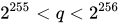 .
.
- Generate a random prime ,
 , such that
 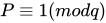 .
.
- Generate a random integer
 , such that
 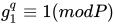 .
.
- Generate random integers
 and
and 
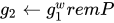
- Compute the following integers in
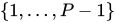 :
:
,
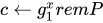
,
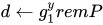
,
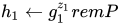
,
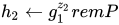
.
- Generate random byte strings
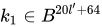 and
and 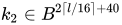 , where
  and
and  .
.
- Return the public key/private key pair

Ciphertext Representation
[edit]A ciphertext of the ACE encryption scheme has the form
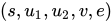
,
where the components are defined as:
 — integers from (whose multiplicative order modulo divides ).
 — element
  .
.
 — element .
 we call the preamble, and — the cryptogram. If a cleartext is a string consisting of
  байт, then the length of is equal to
  .
.
We need to introduce the function  , which maps a ciphertext to its byte-string
representation, and the corresponding inverse function  . For the integer , word string
  , integers
  , and byte string
  ,
,

.
For integer , byte string  , such that
  ,
,
![{\displaystyle CDecode(l,\psi ){\stackrel {\mathrm {def} }{=}}(I_{B^{\ast }}^{W^{\ast }}({\Bigl [}\psi {\Bigr ]}_{0}^{16}),I_{B^{\ast }}^{Z}({\Bigl [}\psi {\Bigr ]}_{16}^{16+l}),I_{B^{\ast }}^{Z}({\Bigl [}\psi {\Bigr ]}_{16+l}^{16+2l}),I_{B^{\ast }}^{Z}({\Bigl [}\psi {\Bigr ]}_{16+2l}^{16+3l}),{\Bigl [}\psi {\Bigr ]}_{16+3l}^{L(\psi )})\in W^{4}\times Z\times Z\times Z\times B^{\ast }}](https://wikimedia.org/api/rest_v1/media/math/render/svg/03a79f952531c75a4cb655c8659a6aa5ec1f7ac6)
.
Algorithm. ACE asymmetric encryption operation.
input: public key and byte string  .
.
Output: byte string — ciphertext  of
of  .
.
- Generate
 at random.
- Generate the ciphertext preamble:
- Generate at random.
- Compute
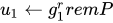 ,
, 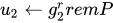 .
.
- Compute
 ; note that
  .
.
- Compute
 .
.
- Compute the key for the symmetric encryption operation:
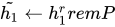 ,
, 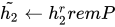 .
.- Compute
 .
.
- Compute cryptogram
 .
.
- Encode the ciphertext:

.
- Return .
Before starting off the symmetric encryption process, the input message is divided into blocks  , where each of the block, possibly except the last one, is of 1024 bytes. Each block is encrypted by the stream cipher. For each encrypted block
  16-byte message authentication code is computed. We get the cryptogram

.

.
Note that if  , then
  .
.
Algorithm. ACE asymmetric encryption process.
Input: 

Output:  ,
,  .
.
- If
 , then return
  .
.
- Initialize a pseudo-random generator state:

- Generate the key
 :
: 
.
 .
.- While
 , do the following:
 .
.- Generate mask values for the encryption and MAC:
 .
. .
.
- Encrypt the plaintext:
![{\displaystyle enc\leftarrow {\Bigl [}M{\Bigr ]}_{i}^{i+r}\oplus mask_{e}}](https://wikimedia.org/api/rest_v1/media/math/render/svg/0f8f3fabcf461aa26d078b0c8480718c08490a10) .
.
- Generate the message authentication code:
- If
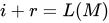 , then
  ; else
  .
.
 .
.
- Update the ciphertext:
 .
.
 .
.
- Return .
Algorithm. ACE decryption process.
Input: public key and corresponding private key , byt e string .
Output: Decrypted message  .
.
- Decrypt the ciphertext:
- If
 , then return
  .
.
- Compute:

;
note that , where .
- Verify the ciphertext preamble:
- If
 or
or  or
or  , then return .
- If
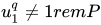 , then return .
 .
.- If
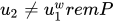 , then
  .
.
- Compute
 ; note that
 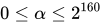 .
.
- If
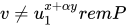 , then .
- If
 , then return .
- Compute the key for the symmetric decryption operation:
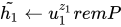 ,
, 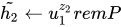 .
.- Compute
 .
.
- Compute
 ;note that
  can return .
- Return .
Algorithm. Decryption operation .
Input: 
Output: Decrypted message .
- If
 , then return .
- Initialize a pseudo-random generator state:
- Generate the key :

.
 .
.- While
 , do the following:
 .
.- If
 , then return .
- Generate mask values for the encryption and MAC:
- .
- .
- Verify the message authentication code:
- If
 , then
  ; else
  .
.
![{\displaystyle mac\leftarrow AXUHash(k_{AXU},lastBlock,{\Bigl [}e{\Bigr ]}_{i}^{i+r})\in W^{4}}](https://wikimedia.org/api/rest_v1/media/math/render/svg/5f65db2fa6d5f8e52723299070e4a3eff5ded3ee) .
.- If
![{\displaystyle {\Bigl [}e{\Big ]}r_{i+r}^{i+r+16}\neq I_{W^{\ast }}^{B^{\ast }}(mac\oplus mask_{m})}](https://wikimedia.org/api/rest_v1/media/math/render/svg/a18e19082c760c22a5e0800b19a6b8d9d2c96156) , then return .
, then return .
- Update the plaintext:
![{\displaystyle M\leftarrow M||({\Bigl [}e{\Bigr ]}_{i}^{i+r})\oplus mask_{e})}](https://wikimedia.org/api/rest_v1/media/math/render/svg/dab1f7145b998610f7100e6a94fcdf988554ee59) .
.
 .
.
- Return .
The signature scheme employs two key types:
ACE Signature public key:  .
.
ACE Signature private key:  .
.
For the given size parameter , such that , key components are defined the following way:
 —
—  -bit prime number with
  — is also a prime number.
— -bit prime number with  — is also a prime number.
 —
—  and has either or
  bit.
bit.
 — elements
  (quadratic residues modulo ).
 — 161-bit prime number.
 — element
 — elements
  .
.
— elements  .
.
Algorithm. Key generation for the ACE public-key signature scheme.
Input: size parameter , such that .
Output: public/private key pair.
- Generate random prime numbers
 , such that and — is also a prime number, and
,

, и

,
where
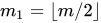 and
and 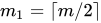 .
.
- Set
 .
.
- Generate random prime number , где
 .
.
- Generate random
 , taking into account
 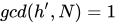 and
and  , and compute
  .
.
- Generate random
 and compute
  .
.
- Generate random byte strings
 , and
, and  .
.
- Return public key/private key pair

.
Signature Representation
[edit]The signature in the ACE signature scheme has the form 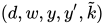 , where the components are defined the following way:
 — element
  .
.
 — integer, such that
  .
.
 — elements .
 — element ;note that
  , where — message being signed.
We need to introduce the  function, which maps a signature into its byte string representation, and the corresponding inverse function
  . For integer , byte string
  , integers
 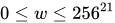 and
and  , and byte string
  ,
,

.
For integer , byte string  , where
  ,
,
![{\displaystyle CSecode(l,\sigma ){\stackrel {\mathrm {def} }{=}}({\Bigl [}\sigma {\Bigr ]}_{0}^{64},I_{B^{\ast }}^{Z}({\Bigl [}\sigma {\Bigr ]}_{64}^{85}),I_{B^{\ast }}^{Z}({\Bigl [}\sigma {\Bigr ]}_{85}^{85+l}),I_{B^{\ast }}^{Z}({\Bigl [}\sigma {\Bigr ]}_{85+l}^{85+2l}),{\Bigl [}\sigma {\Bigr ]}_{85+2l}^{L(\sigma )})\in B^{64}\times Z\times Z\times Z\times B^{\ast }}](https://wikimedia.org/api/rest_v1/media/math/render/svg/7b9da10ec5c5017b9db158078fbe0f7d55cfdef3)
.
Signature Generation Process
[edit]Algorithm. ACE Signature Generation Process.
Input: public key and corresponding private key and byte string ,  .
.
Output: byte string — digital signature .
- Perform the following steps to hash the input data:
- Generate a hash key
 at random, such that
  .
.
- Compute
 .
.
- Select
 at random, and compute
 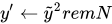 .
.
- Compute
 .
.
- Generate a random prime ,
 , and its certificate of correctness
  :
:  . Repeat this step until
  .
.
- Set
 ; note that
  .
.
- Compute
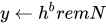 , where
,
and where 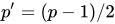 and
and 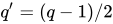 .
.
- Encode the signature:

.
- Return


![{\displaystyle F_{2}[T]}](https://wikimedia.org/api/rest_v1/media/math/render/svg/76e452838ced0113f025e5c31774ba0f26eae308)






![{\displaystyle r\in F_{2}[T]}](https://wikimedia.org/api/rest_v1/media/math/render/svg/9565964d1c289ec8d2201a9a85fca215c02ac29d)


![{\displaystyle A,f\in F_{2}[T],f\neq 0}](https://wikimedia.org/api/rest_v1/media/math/render/svg/a55214ef544515c9ed65fc428d1587697f3219d8)


