


Talk:Tic-tac-toe/Archive 1
 | This is an archive of past discussions about Tic-tac-toe. Do not edit the contents of this page. If you wish to start a new discussion or revive an old one, please do so on the current talk page. |
| Archive 1 |
origin
We need to add information about the origin of this game.
opening moves
The opening move with the least number of drawing replies is in one of the corners. After this move has been made, the opener can force a win if the opponent takes any square other than the centre one, as shown in the above game.
I have removed this description just after the first example since it did not make much sense as to how it is "The opening move with the least number of drawing replies" and why is the next example not equivalent in that sense.
name of the article
Why is the article named "tic-tac-toe" instead of "noughts and crosses". The article itself states that not only do more english speaking countries call it noughts and crosses (only the US calls it tic-tac-toe), but also that noughts and crosses pre-dates tic-tac-toe as a name for it. — Preceding unsigned comment added by 121.44.93.25 (talk) 10:12, 25 August 2011 (UTC)
Because the USA owns the internet. — Preceding unsigned comment added by 92.40.110.229 (talk) 17:39, 1 June 2013 (UTC)
- For what it is worth, google has 22 times as many hits for "tic tac toe" as for "noughts and crosses"..--Nø (talk) 19:18, 1 June 2013 (UTC)
Variations
No mention is made to "Tres en Raya" as a variation. Also, the false assertion that "Tic-Tac-Toe" is called "Tres en Raya" in Spain is made. In fact, in Spain "Tic-Tac-Toe" as such is virtually unknown (I believe the vast majority of people in Spain would not even know how to play a game of Tic-Tac-Toe). "Tres en Raya" is a very different game, where each player only has three X's or O's. It is played with markers, not pencil and paper, and after the third move each player must move one of his three markers to another free square on the board. —Preceding unsigned comment added by 77.209.116.133 (talk) 21:49, 25 March 2008 (UTC)
Moves player O "must" make???
"The second player, whom we shall designate "O," must respond to X's opening mark in such a way as to avoid the forced win. Player O must always respond to a corner opening with a center mark, and to a center opening with a corner mark."
To my way of thinking, both of these lead to an automatic loss for O. Am I missing something - I haven't deleted this excerpt from the page yet.
- If X leads corner and O follows with center - then X will play opposite corner and be guaranteed a fork next move.
- If X leads center and O follows with corner - then X will again play opposite corner and be guaranteed a fork next move.
- The only effective response to an X lead in center or corner is edge. —Preceding unsigned comment added by 130.216.91.18 (talk) 02:51, 14 February 2008 (UTC)
In your first example, X is not garanteed a fork because O can go on any side forcing X to block it, passing up the fork.
In the second case, O can do the same by going in a third corner, again forcing X to go between the two O's to block it.
DAF (talk) 17:55, 26 June 2008 (UTC)
Actually he is correct. It is impossible for O to win, unless X makes an illogical move. — Preceding unsigned comment added by 75.57.207.194 (talk) 19:03, 11 October 2012 (UTC)
26,830/765 or 23,129/827 ?
The current page says:
"the 765 essentially different positions (the state space complexity), or the 26,830 possible games [...]"
But http://www.genetic-programming.org/sp2003/Hochmuth.pdf gives:
"while there are a total of 23,129 possible Tic-Tac-Toe games to be played in long train rides, the number of unique situations is in fact only 827", quoting Steve Schafer's 2002 "How many games of Tic-Tac-Toe are there?" The URL given is no longer valid (and I couldn't find it on www.archive.org), but I think it may be now at http://www.sinc.sunysb.edu/Class/phi365/tic_tac_toe.html .
Whether it's 765 or 827 unique positions, surely it would be trivial to create a smallish lookup table to find the "next move" (after doing a search on rotations/translations) - what am I overlooking?
Mike Hamilton 12:52, 21 November 2006 (UTC)
- See the discussion topic "Number of Unique Games". After sorting out a bug, my program agrees with the article's 765 games when taking account of symmetries. James Lednik (talk) 13:53, 7 March 2008 (UTC)
Four draw positions
When I was doodling one day I established to myself that there are only four possible draw positions in tictactoe, including inversions and rotations of the four.
They are:
OXO OXO XOX XOO
XOX OXX OXX OXX
XOX XOO OXO XXO
Two questions. Is this relevent enough to include in the article, and more importantly, am I right?
- No, there are only 3 - your third and fourth positions are the same except for a reflection - or is that not allowed? Incidentally your second game has more 0s than Xs, unlike the others. Ignoring symmetry but assuming X goes first, there are 16 possible draw positions (4 of first type 1, 4 of second type 2 and 8 of third/fourth type). --Henrygb 15:38, 11 Oct 2004 (UTC)
Alternative names
I have removed most of the section Alternative names, as this is an encyclopedia, not a dictionary. Here's the enitre paragraph as it looked before my edit:
Alternative names
- Jǐngzìhyóusìh (井字遊戲, "the game in the character 井") (Chinese - Taiwan)
- Tic-tac-toe, tick-tat-toe, or tit-tat-toe (English - USA)
- Noughts and crosses or naughts and crosses (English - United Kingdom, Ireland, Australia)
- X's and O's (English - Ireland)
- Ta-te-ti, Tres en raya, Gato, Michi, La vieja, Equis cero (Spanish)
- Tris or Filetto (Italian)
- Morpion (French)
- Boter, kaas en eieren ("butter, cheese and eggs") (Dutch)
- Kruisje, Nulletje ("Little Cross, Little Zero") (Dutch)
- Kryds og bolle (Danish)
- Luffarschack, (literally "tramp chess"), Tripp trapp trull (Swedish)
- Ristinolla ("cross-zero") (Finnish)
- Jätkänshakki ("workman's chess") (Finnish)
- Trips-traps-trull (Estonian)
- X şi zero (Romanian)
- Jogo do galo - Cock´s game (Portuguese - Portugal)
- Jogo da velha - Old lady´s game (Portuguese - Brazil)
- Τρίλιζα (Greek)
- Zero kata (Hindi)
- Phool aur chaukadi (Hindi)
- Maru batsu (円伐, "circle strike") (Japanese)
- Sanmoku narabe (三目並べ, "three in a row") (Japanese)
- Морски шах ("sea chess") (Bulgarian)
- Kółko i krzyżyk ("circle and cross") (Polish)
- Крестики-нолики ("crosses and zeroes") (Russian)
- Tripp trapp tresko, or Tre på rad (“Three in a row”) (Norwegian)
- /iks-miks-driks/ (Yiddish and Modern Hebrew)
- /iks-igul/ ("Ax(letter)-Circle") (Modern Hebrew language)
- أكس أو ("X O") (Arabic)
- Mylla ("Mill") (Icelandic)
- Piškvorky (Czech, Slovak)
Sometimes, the names of the games Tic-tac-toe (where players keep adding "pieces") and Three Men's Morris (where pieces start to move when the first four have been placed) are confused.
Niels Ø 13:35, 30 September 2005 (UTC)
And here we go again (sorry about special characters; see this edit):
- Kringetjies en Kruisies (South Africa)
- Kaat koot or Zero-kata (Hinglish - India)
- Katam kataa (Hindi - India)
- Ix Igul (X Circle) (Israel)
- Kata kuti (Bangladesh and West Bengal)
- Phulli Gola (Marathi)
- Tee-taa-toe (Jamaica)
- X si O (Romania)
- Amoba (Hungary)
- Luffarschack (Sweden)
- Jogo do Galo (meaning "Rooster's Game") (Portugal)
- Jogo da Velha (meaning "Old Lady's Game") (Brazil)
- Tris, filetto, crocetta e pallino, cerchi e croci, or tria (Italy)
- Kólko i krzyzyk (a circle and a cross) (Poland)
- Boter, kaas en eieren (Butter, cheese, and eggs) (Netherlands)
- Morpion (France)
- Tres en raya (Spain, Bolivia and Ecuador)
- Gato (Chile, México and Costa Rica)
- Iks-Oks (Serbia and Montenegro)
- Križic-kružic (a circle and a cross) (Croatia)
- Kaat kar ya Zero Pa (UPunjabi - Pakistan)
- Michi (Perú)
- Križci in krožci (crosses and circles) (Slovenia)
- ????????-?????? (crosses and zeroes) (Russia)
- ?????? ??? (sea chess) (Bulgaria)
- Ta-Te-Ti (Argentina and Uruguay)
- ??????a (Triliza) (Greece)
- X ?i Zero (Romania)
- X O (Iran, Egypt, Arabic Speaking Countries)
- Cüz (Turkey)
- Bondesjakk (Farmer's chess) (Norway)
- La Vieja (Venezuela)
- Piškvorky (Czech Republic and Slovakia)
- Triqui (Colombia)
- Bicho Chocha (XO) or Gato (cat) (Mexico)
- ???? (Iran)
- Ristinolla(cross-zero) or Jätkänshakki((Finland)
- Equis Cero (XO) (Dominican Republic)
- Trips-traps-trull (Estonia)
- X Mix Drix (Israel)
- Kryds og Bolle (Cross and buns) (Denmark)
- Deppenschach (Idiot's chess) (Austria)
- Croa-Zero (Vietnam)
- Cross-Zero (Vietnam)
- ???? (circle-cross), ????? (Hong Kong)
- Mylla (mill) (Iceland)
- Desas (Sausages) (Latvia)
--Noe (talk) 09:26, 15 August 2008 (UTC)
I object to the synonym "rock paper scissors" in the lede. Deleted. No relation without citation ! Alanf777 (talk) 04:06, 15 March 2013 (UTC)
Strategy
The strategy as described in the article does not guarantee a draw when used by player two, and fails to win against sub-optimal play in lines that result from an opening move in the corner of the board. Mikebell 04:09, 15 November 2005 (UTC)
I find this too brief: Triangle: Make sure you are playing as a triangle, and the opponent as a star. That should be explained. —Preceding unsigned comment added by 79.201.218.72 (talk) 19:47, 23 May 2011 (UTC)
The bottom of the strategy section has problems, needs fixing. The bullet starting with "If X plays center" is followed by sub-bullet "If O takes center". But if X has played center, that option is no longer available to O. --Pekoebrew (talk) 23:40, 7 September 2012 (UTC)
mnk games
The mnk class of games and the fact that tic tac toe is an instance of that class should probably get a more substantial mention than in the intro paragraph to tic tac toe variations. (meta) As a Wikinoob, I don't know if this is the right forum to discuss opinions about content / direction of the article changes like this. Someone will have to correct me if this isn't how it's done. Mikebell 04:15, 15 November 2005 (UTC)
Chickens
The article says that Las Vagas casinos have tic-tac-toe-playing chickens. Is that true? I didn't see any last time I was in Vegas. I have played tic-tac-toe agaisnt a chicken, but taht was 30 years ago at a county fair.
- I have seen chickens that are presented as playing Tic Tac Toe at carnivals. There is a common cheat which is used. The chicken is trained to peck at a light, and has a Tic Tac Toe board in its pen which is mediated through a computer. It is actually the computer which is playing the game, and the chicken is just pecking at the Tic Tac Toe square which has a light illumninated by the computer. The chicken sees the light (you don't) and pecks at the square selected by the computer. Kmorford 03:16, 1 March 2006 (UTC)
- Sorry, that was a mistake - the chickens-at-casinos are in Atlantic City. DS 12:22, 12 June 2006 (UTC)
Chaos and order
A great variant of Tic Tac Toe is a game called "chaos and order" (or is it "order and chaos"?) It is played on a six by six board with players alternating placing either a single X or a single O on the board at a time. The first player plays the part of order, and wants to get five in a row of either Xs or Os. The second player plays the part of chaos, and wants to completely fill the board with out having any instances of five in a row of either Xs or Os. Either player can play either an X or an O in any unfilled space on the board when it is his or her turn. With perfect play, I suspect that order can always win, but I do not know that with certainty. The game is complex enough that there are good opportunities to win for both sides. Kmorford 03:25, 1 March 2006 (UTC)
Cat
Is there any explanation to why a game that is tied is said to have gone to the cat? 204.9.144.52 19:10, 14 March 2006 (UTC)
- The only reason I can think of is that tac spelled backward is cat. I have been unable to find any answer to this question.(74.60.0.215 22:32, 14 June 2007 (UTC))
horrible book @ first link position
I've removed the link to the Tic Tac Toe PDF book that was first in external links. That book is terrible. It makes several fundamental errors. How long was that link there? I shudder to think of all the players who have been misinformed by clicking that link. Yikes. 69.142.21.24 05:39, 7 April 2006 (UTC)
Need more content
We need a history and geography of tic-tac-toe. Zaslav 11:40, 22 June 2006 (UTC)
CheckLines
Several months ago, I bought a copy of Tri-ang CheckLines through eBay. I may eventually get round to making a Wikipedia page about it. DFH 18:57, 27 July 2006 (UTC)
Strip tic-tac-toe exists!
It was taken off as mistaken vandalism. Lies. Here are my sources which show that it clearly exists despite 16th century prudery:
So people need to relax, take a chill pill and get out more.
- The latter link is about a computer game with no evidence that it's ever played for real. The former one is a discussion board and seems completely irrelevant. And: "The game is usually played while drinking a bottle of absinth or smoking crack" looks like complete nonsense to me. - Mike Rosoft 08:34, 30 July 2006 (UTC)
Errors
Wrong "example game" picture! "O" more than "X", but "X" starts!
Now you can compare it with russian version of this page.
Yes, someone should substitute a new picture -- there are 5 "O's" in the picture, which is impossible if "X" starts, which is the usual convention and that given in the article. Krakatoa 17:29, 4 October 2007 (UTC)
- Hi Krakatoa,
- Even I noticed the same error in the picture. This needs to be rectified as soon as possible. Any "WIKIPEDIAN", please do the needful at your earliest and oblige. Amit Munje (talk) 14:01, 3 May 2008 (UTC)
Strategy error
I implemented the strategy as listed on this page and it failed. Here is the log. Note how after the first move of the AI there is no choice anymore. So the first move is wrong. It should be in the center. That means before point 5 or 6 (I believe it does not matter) there has to be inserted: "Get the middle field, if it is free". Having it at the bottom of that paragraph is not enough, since the above list is supposed to be a complete strategy. Here is the log:
Player starts.
x..
...
...

AI makes a move.
xo.
...
...

Player makes a move.
xo.
...
x..

AI makes a move.
xo.
o..
x..

Player makes a move.
xo.
o..
x.x

AI makes a move.
xo.
oo.
x.x

Player makes a move.
xo.
o..
xxx
Multidimensional Tic Tac Toe
I'm not sure if this should be included here, but Tic Tac Toe can be extrapolated to any number of dimensions by multiplying the number of boards by 3 each time. For example, normal 2 dimensional contains one board, 3D has 3 boards (already mentioned on the page), 4D (listed as 9 board tic tac toe here) contains 9 boards, 5D contains 27 boards, etc. While anything above 4D contains much more time writing out the boards than playing in my experience, it might be an interesting side note. The number of possible lines to win on an nth dimensional board, T(n) is 8T(n-1) - 15T(n-2) where T(0) = 0, T(1) = 1. Origin415 04:00, 10 January 2007 (UTC)
- Although there is a 4D game that can be played using 9 2D boards, the "9 board tic tac toe" described in this article is entirely different (and more interesting to play, I'd say). 75.36.182.157 01:25, 9 April 2007 (UTC)
Actually, I think it would be preferable to increase the size of the board by 1 for each increase in dimension. Otherwise the game becomes more trivial. So a 3d tic tac toe game should be on a 4x4x4 board and a 4d game should be a 5^4 grid etc. some sort of mathematical analysis would be helpful here. (which I am not providing) but needless to say with a 3x3x3 board it can be easily seen the first player to move can have a certain victory with an appropriate play and without any chance of the 2nd player stopping him.
I Jimmy Kerl wrote an early computer 4d game in the early 90s. I am not aware of any others that were available this early, but there are certainly many versions of computer 4d tic tac toe today. — Preceding unsigned comment added by 2602:306:CD4B:4CE0:21D4:8C3B:3FDC:ACBC (talk) 03:15, 18 June 2013 (UTC)
History
Does anyone know the history behind the game? I believe it would be a wonderful addition to the article. Yurimxpxman 17:29, 15 March 2007 (UTC)
Why is it called Tic-Tac-Toe in the US, no one has explained this. Naughts and Crosses it quite self-explanatory, Tic-Tac-Toe aint. Can any anyone add to the etymology of this phrase.
Names of X and O
While reading Hollywood Squares I was struck by the catchphrases "Circle takes square" and "X takes square". Am I to infer that in America, O is "circle" rather than "nought" ("zero") or "oh", and X is "ex" rather than "cross"? jnestorius(talk) 14:13, 28 April 2007 (UTC)
- While X is generally said as "ex" in America, O is generally said as "oh". I have only heard O said as "circle" on Hollywood Squares.--RLent 19:59, 12 June 2007 (UTC)
Boardgamegeek.com
It seems like this article should mention that tic-tac-toe holds the honor of the lowest rated game on boardgamegeek.com or at least it should have a link to its spot on boardgamegeek in the external links. --72.200.78.136 19:33, 27 May 2007 (UTC)
- That really says more about boardgamegeek than about tic-tac-toe. — Gwalla | Talk 22:00, 1 June 2007 (UTC)
External links
Do we even need links to online & downloadable versions? It's a spam magnet. — Gwalla | Talk 22:00, 1 June 2007 (UTC)
I have a site I'd like add to external links. www.PrintableGames.org - It offers free game sheets to parents and teachers etc. And note it does feature Tic-tac-toe. So I'd like some feed back. Let me know what you all think about adding this site. Thanks! Jayoe (talk) 13:04, 23 February 2009 (UTC)
- This site fails the first criteria of WP:LINKSTOAVOID ("Any site that does not provide a unique resource beyond what the article would contain if it became a Featured article."); the only information this site has about tic-tac-toe is a printable sheet of 3x3 game grids, and the article already explains that tic-tac-toe is played on a 3x3 grid. It adds nothing. --McGeddon (talk) 13:15, 23 February 2009 (UTC)
- It offers a PDF of the game which the article does NOT making it a unique resource! More feed back would be appreciated. Jayoe (talk) 15:57, 23 February 2009 (UTC)
- The article already describes (and illustrates) the 3x3 grid that the game is played on. That exact same image in PDF format is not a "unique resource" - we don't gain anything by linking to a proprietary-format image of something that's already in the article.
- If this article was about a complex piece of machinery, and you wanted to link to a PDF of public domain blueprints that were too dense to display in the article, then that would be fine, but this is just a 3x3 tic-tac-toe grid. --McGeddon (talk) 20:14, 24 February 2009 (UTC)
Why the link to my article www.iqflash.com/tic-tac-toe-siverman-article.shtml is spam? Are you dared? —Preceding unsigned comment added by Serge31416 (talk • contribs) 11:27, 5 March 2009 (UTC)
- Perhaps you should explain the purpose of the link.--Noe (talk) 15:25, 5 March 2009 (UTC)
- Wikipedia guidelines say that any site that does not provide a unique resource beyond what the article would contain if it became a Featured article, should not be linked. (See: External links) Is your site unique? If it has any material that is relevant to the article, then that material should be included in the article, without being linked to a commercial product. ♦ Jongleur100 ♦ talk 17:20, 5 March 2009 (UTC)
Play centre higher priority than play opposite corner
Although playing the opposite corner makes it easier to block forks, playing the centre makes it easier to play 3-in-a-row. The "win" criteria is higher than "block fork".
This order follows the source, which has been shown to have perfect play.AbcXyz 16:33, 26 August 2007 (UTC)
Computer game versus video game
I've changed the reference to "first known computer game" to "first known video game". Computers had been playing games before 1952, e.g. Christopher Strachey's draughts programme on the Manchester Mark 1 in 1951. OXO, in 1952, is thought to be the first game to output onto a video display (e.g. cathode ray tube), which is what makes it notable, so we should draw the distinction. gothick 22:01, 15 November 2007 (UTC)
Removed a line
The best play leads to a unavoidable victory by player one, all he has to do is play at the corners (unlike the second example, where a clear case of wrong play is shown). --Taraborn (talk) 10:11, 20 December 2007 (UTC)
Best Play
I am fairly certain that if both players play perfectly, all games will end in a draw. This contradicts the following:
"Players soon discover that best play leads to a victory of the first player. Hence, tic-tac-toe is most often played by very young children; when they have discovered an unbeatable strategy they move on to more sophisticated games such as dots and boxes."
Of course, this is just based on my memories since I am neither a tic-tac-toe aficionado, nor a game theory expert...so I could be wrong. —Preceding unsigned comment added by 74.130.23.77 (talk) 23:12, 21 December 2007 (UTC)
- No, you're right. It is a draw. 24.226.77.23 (talk) 03:51, 27 June 2008 (UTC)
Now a much more interesting question is the same idea true on a 3d 4x4x4 board and or a 4d 5^4 grid? — Preceding unsigned comment added by 2602:306:CD4B:4CE0:21D4:8C3B:3FDC:ACBC (talk) 03:18, 18 June 2013 (UTC)
Number of Unique Games
(Update: resolved. My program had a bug, the numbers in the article are correct)
I have written a program which solves Tic-Tac-Toe completely, and accounts for all symmetries.
In the article it states that there are 138 unique games divided by:
- 91 games are won by X;
- 44 games are won by O;
- 3 games are a draw.
However, my program shows that there are 133 unique games.
- 87 games are won by X;
- 43 games are won by O;
- 3 games are a draw.
My program also showed that there are 744 game states discounting symmetric game states, not 765 as reported in the article.
If the numbers I found are correct, hopefully it will help lead to a change in the article. James Lednik (talk) 20:27, 6 March 2008 (UTC)
- I also wrote a program, which produced the following output: http://www.fieggen.com/software/TicTacToeGames.csv
- You can easily load this file into a spreadsheet, then examine or sort the results and cross-check them with your own results. From this, you should be able to determine either:
- Which of my 138 outcomes are incorrect or are symmetrical duplicates, or
- Whether there was a bug in your program.
- If the former, you could post a follow-up indicating which of my 138 unique games should be discounted.
- If the latter, and assuming you can fix the bug, you could then re-check whether your 744 game states now also tallies with the 765 calculated by myself and others. Ian Fieggen (talk) 21:59, 6 March 2008 (UTC)
- Thanks for the rapid reply and information Ian. I'll report back what I find. James Lednik (talk) 05:48, 7 March 2008 (UTC)
- It was a bug in my code :). Your data lead me to pinpoint a case where the program would skip valid moves. I now get the exact numbers reported in the article: 765 states, 138 games, 91 wins for X, 44 wins for O, and 3 draws. Thanks! James Lednik (talk) 07:23, 7 March 2008 (UTC)
- I'm glad you got it sorted out. :-)
- Mind you, on further looking at that section's text, "Possible games" is not really the ideal wording. It should perhaps read "Possible outcomes", as there can often be several possible games that lead to the same outcome. I'm doing some further calculations before I re-word this section. Ian Fieggen (talk) 23:57, 7 March 2008 (UTC)
Further to the above, I've now created a separate section titled "Number of possible games", which defines the numbers in more detail. Hopefully this hasn't complicated it TOO much! It could run the risk of delving too deeply (like some of the external links). Ian Fieggen (talk) 04:02, 8 March 2008 (UTC)
- That might be a bit too much for this article, but maybe not. I think it's interesting info (I'd read it), we'll see what others think.
- In my program I was able to graph out all the states of Tick Tac Toe, with the connections between them. I still have not developed a good way to sort out the (very complex) resulting graph in a manner that is both visually appealing and reveals info about the game, as was my original intent, but I may go back and work on it sometime.
- Thanks again for the help. James Lednik (talk) 20:56, 13 March 2008 (UTC)
I concur with the stated number of games (without removing symmetries) and the number of outcomes (with symmetries removed). I quibble that these numbers should be presented in the same viewpoint (either with symmetries removed or without symmetries removed).
There are 26,830 possible games (counted with symmetries removed) if the game does not end until a player makes three in a row or the board is full. This is less than 255,168/8 because it counts two games as equivalent whenever the players face the same set of decisions at each move. For example, if you number the board 123 across the top, then 456 in the second row and 789 in the third row, then the game 1,2,3,5,6,9 is symmetrically equivalent to 3,2,1,5,6,9 at every single move --- even though they are not related by a simple rotation or reflection of the board.
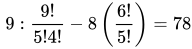
The number of outcomes is 958 if you don't remove the symmetries (corresponding to the 138 outcomes with symmetries removed). The number of game-ending positions after 5,6,7,8, and 9 positions is 128, 148, 444, 168, and 78, where 16 of the 78 positions after 9 moves are draws and the other 62 are wins for X.
I'm not going to edit the page, because I'd just be citing my own work. Mathrec (talk) 21:25, 22 July 2009 (UTC)
I could corroborate your findings. I too found 958 unique outcomes of a tic tac toe game if symmetries are not removed using brute force combinatorics.




Wargames a "cult" film?
Why is Wargames called a cult film? It was a big budget blockbuster. 76.168.64.243 (talk) 07:44, 30 April 2008 (UTC)
- Agree. Let's just remove "cult" from a NPOV standpoint. Ian Fieggen (talk) 23:42, 30 April 2008 (UTC)
Nonnotable details
I think that the Lucky Charms event and the random link to a tictactoe game on this article should be removed. The Lucky Charms event is extremely trivial and unencyclopedic. Also, this article already has enough links to playing tictactoe as it is, we don't need another. For now, I'm removing it until you can prove me wrong, or get another opinion. Artichoker (talk) 22:40, 2 June 2008 (UTC)
Well the Lucky Charms version is listed as a variation as that is what it is. You say it is unnotable? To whom? I see you are American and this promotion was in the UK (and over 10 years ago at least), so people like you would not have seen it in all probability. As for this and the link, why remove them? They're not really doing any harm are they? Why not remove one of the other links for playing Tic Tac Toe? I'll tell you, because, like the one I have added they are doing no harm.
As mentioned before there is a catagory for variations, so the Lucky Charms thing fits in well there. Who are you really to say that it is "extremely trivial and unencyclopedic"? I have just listed another version like the subheading says, nothing else.
There are no real rules to say that these can not be added as I'm sure you already know. --Cexycy (talk) 22:52, 2 June 2008 (UTC)
- Even then it is trivial; it was an event from a cereal company involving the game tictactoe. Was there any significant coverage of it?
- Yes, the link is doing harm: Wikipedia is not a mirror or a repository of links, images, or media files. And since this one was added last, it should be removed. The reader does not gain anything from another external link to a site where you can play tictactoe. Artichoker (talk) 23:06, 2 June 2008 (UTC)
As I said before the Lucky Charms thing is just a variation. nothing more, which is doing no harm.
And no the link is not doing any harm either. It is just one lousy little link and the others are not quite the same as it exactly, if you have a look you will see. The reader does not come to any harm looking at this.
With all due respects, I just think you're going over the top here. --Cexycy (talk) 23:14, 2 June 2008 (UTC)
- Let me repeat: Wikipedia is not a mirror or a repository of links, images, or media files. Excuses like "it's just one little link" don't work. The Lucky charms thing is not a variation, it is an irrelevant event, and compromises the notability of the article, per WP:NOT. Artichoker (talk) 23:36, 2 June 2008 (UTC)
Chicken mechanism
My change was reverted clarifying that chickens playing tic-tac-toe are advised by a computer program. This claim is reflected in the Chicken section above and in the reference stated. The revert comment was "no it isn't" (advised by a computer program). Could you (or anyone) please show evidence countering mine? -Verdatum (talk) 16:27, 11 June 2008 (UTC)
- Please read the reference provided in the article here. The article never says that the chicken is advised by a computer program. Until consensus is reached, the original revision should stay, so please do not revert my edit until we have discussed this. Thanks, Artichoker[talk] 16:53, 11 June 2008 (UTC)
- Reverting a revert (once) is not uncommon per WP:BOLD et al. Mostly just an action to insure discussion takes place; all is well. Anyway, from the article, "It's not because Ginger the Chicken plays tic-tac-toe. It's amazing that some people think she -- it -- actually does.", "The fickle fowl pecks behind the screen, in secret, and a green 'O' appears on the game board.", and "One guy lost, then stood back to watch. After a couple of rounds he said to his companion, 'Oh, it's a computer. The chicken's not really playing tic-tac-toe.' Even a dim bulb flickers in Las Vegas.". I realize it isn't explicitly stated, but the obvious implication of the entire article is that the chicken is not playing. So again, I ask for evidence that the chicken is actually trained to play independently. -Verdatum (talk) 20:14, 11 June 2008 (UTC)
- Okay, fair enough. Also, I just read the above section on the talk page here. Go ahead and revert it back now. Artichoker[talk] 20:17, 11 June 2008 (UTC)
- I actually did some more investigation. A researcher at Google Answers (man I miss that thing) did a good job of compiling information on the phenomena. The only authoritative source implying the chicken is trained to play tic-tac-toe (as opposed to just training it to peck) is this Bunky Boger, who has an obvious conflict of interest and incentive to exaggerate about the chicken's abilities. I'll revert in a couple days if no one else has issues. -Verdatum (talk) 20:33, 11 June 2008 (UTC)
- Okay, fair enough. Also, I just read the above section on the talk page here. Go ahead and revert it back now. Artichoker[talk] 20:17, 11 June 2008 (UTC)
- Reverting a revert (once) is not uncommon per WP:BOLD et al. Mostly just an action to insure discussion takes place; all is well. Anyway, from the article, "It's not because Ginger the Chicken plays tic-tac-toe. It's amazing that some people think she -- it -- actually does.", "The fickle fowl pecks behind the screen, in secret, and a green 'O' appears on the game board.", and "One guy lost, then stood back to watch. After a couple of rounds he said to his companion, 'Oh, it's a computer. The chicken's not really playing tic-tac-toe.' Even a dim bulb flickers in Las Vegas.". I realize it isn't explicitly stated, but the obvious implication of the entire article is that the chicken is not playing. So again, I ask for evidence that the chicken is actually trained to play independently. -Verdatum (talk) 20:14, 11 June 2008 (UTC)
O's task?
"Once the opening is completed, O's task is to follow the above list of priorities in order to force the draw, or else to gain a win if X makes a weak play."
this is any player's task.. not just O's.. —Preceding unsigned comment added by 217.132.100.17 (talk) 16:27, 14 October 2008 (UTC)
History again
Does anyone know how old Tic-tac-toe is? I recently took this picture : http://commons.wikimedia.org/wiki/File:Tictac.jpg at the Mayan ruins in Chichen Itza, Mexico. It looks remarkably like a completed game of TTT. What do other people think? ♦ Jongleur100 ♦ talk 11:40, 29 January 2009 (UTC)
- As I see it, it has the wrong number of Xs. To alternate, Xs and Os shouldn't occur with a difference of 3. Kdammers (talk) 12:17, 7 April 2009 (UTC)
why does x always play first. For it to be fair x and o should alternate on who gets the first move or o will always end up losing( assuming equal skill and multiple games played) and getting angry. —Preceding unsigned comment added by 66.131.254.207 (talk) 08:14, 17 May 2009 (UTC)
- You're wrong, it is possible to win or draw no matter who goes first, if you know the perfect strategy. Avindratalk / contribs 18:05, 26 November 2010 (UTC)
Incorrect data?
Hello all, I'm a student of the IT-university of Copenhagen (Denmark). I'm working with artificial intelligens, and testing my AIs on games like tictactoe. Either I've misread the article, or some of the data might be a bit off. Anyway, here's what I got: Games, which ends with a winner: 209,088. Games total (win and draws) 255,168. Games, which ends with a draw: 46,080.
If you need verification, I can upload my java code somewhere. —Preceding unsigned comment added by 91.101.5.61 (talk) 20:07, 20 May 2009 (UTC)
- The article said "...there are 255,168 possible games...46,080 finished games are drawn..." in May 2009,, which agrees with your numbers --Rumping (talk) 15:45, 16 December 2009 (UTC)
Possible board layouts.
The article currently says "Simplistically, there are 362,880 (ie. 9!) ways of placing Xs and Os on the board". In fact, the amount of possible layouts is 59049 (1·310), since the board is basically a 9-digit number in base 3, being each value one of the three possible states of a given cell. --uKER (talk) 10:33, 8 November 2009 (UTC)
- I don't know why you wrote 59049 (1·310) rather than 19683 (39), and even then I am not sure I agree that you can have 5 Xs and 2 Os as a layout. 9! is presumably the number of ways of each player moving in turn without checking whether somebody has already won. --Rumping (talk) 10:51, 16 December 2009 (UTC)
- The statement refers to the total number of possible board layouts, disregarding game mechanics. --uKER (talk) 12:28, 16 December 2009 (UTC)
- That doesn't explain 59049 (1·310) rather than 19683 (39) --Rumping (talk) 15:35, 16 December 2009 (UTC)
Removed Mathematical Calculations
The mathematical calculations for this game have been removed due to a lack of reference, proof,or explanation as to how the calculations were made. While I respect the work of genius by the wikipedian who wrote the computer program above, it unfortunately falls under the original research section of the Wikipedia rules, unless the program writer cites a peer-reviewed journal, credible book or external website, or other place his work is cited. I don't think an output listing alone w/o full explanation (and/or discloure of the soruce code) counts as credible refrencing.
Rename?
Shouldn't it be Tic-Tac-Toe and not tic-tac-toe? I'm positive that everyone else spells it this way. Avindra talk / contribs 22:07, 3 August 2010 (UTC)
Who goes first?
It seems that the world is split in terms of whether O plays first, X plays first or there's no standard. As a child, I was taught that O plays first.
But the external links are slanted towards X having first move, albeit varying in whether they claim it's a basic rule, what usually happens in practice or just a wlog assumption for mathematical analysis.
Still, there ought to be something we can find online about the whole debate, but I can't seem to find anything apart from this.
Moreover, it seems odd that the "X moves first" rule seems to have caught on and yet we call the game "noughts and crosses" not "crosses and noughts" - I don't suppose anyone here can find anything on how that happened? -- Smjg (talk) 23:47, 13 September 2010 (UTC) (post was lost in previous edit, but re-added by--Nø (talk) 07:48, 22 September 2010 (UTC)
- Well, that depends on the language, for example in Russian the game is called "crosses-noughts" (without "and"), but I in childhood was taught there is no rule. - 89.110.14.218 (talk) 23:31, 5 January 2015 (UTC)
Yes everything is true Nkalane (talk) 14:55, 22 June 2018 (UTC)
Nkalane Nkalane (talk) 14:55, 22 June 2018 (UTC)
Another strategy error
Quoting the article "Player O must always respond to a corner opening with a center mark". This clearly false, for if Player X responds in the opposite corner he wins. Here is the position.
. . X
. 0 .
X . .
Now Player X has two opportunities to create a fork, namely moves a and b below.
a . X
. O .
X . b
The correct move for O is to play in another corner.
—Preceding unsigned comment added by 129.175.5.43 (talk) 16:10, 26 November 2010 (UTC)
No, you missed something. Player O moves after figure 1. Player O can move to one of the side spots like this now:
. . X
O O .
X . .
Now, if Player X decides to fork:
. . X
O O .
X . X
Then Player O can just win:
. . X
O O O
X . X
Avindratalk / contribs 18:02, 26 November 2010 (UTC)
the move for o (centre then side) above is the only valid means of preventing a loss as x can force a win if o goes in any corner: x goes in space 1,1:
if o takes the centre and then a non-forcing move they loose as explained above
if o takes the opposite corner (3,3) then x can take 3,1, forcing o to block in 3,2. x then takes 1,3 forcing a fork (as they can win on 2,2 or 1,2). This can also be played the opposite way round (x taking 1,3 first)
if o takes a different corner (3,1) then x can take 3,3 forcing o to play 2,2. x can then play 1,3 creating a fork (as they can win on 1,2 or 2,1).
therefore x can always force a win — Preceding unsigned comment added by 165.120.146.48 (talk) 14:45, 22 September 2018 (UTC)
On O's second move
I wrote my program based on the article. The guy who played it hadn't read the article ☺ and played a side-center followed by the adjacent side center. It looked like this
---
-OX
-X-
Of the six moves available to O, 3 are bad and 3 are good. A second move for O to a side center is in the bad group. It looks to me that the best move for O here is lower right, though lower left and upper right also force the draw. My program lost ;-( JMOprof (talk) 13:18, 11 April 2012 (UTC)
The "Strategy" section
I have removed the strategy section of this article because that was only a guide of how to prevent forks, how to block forks, and how to respond to moves; such guides are not permitted as per WP:NOTGAMEGUIDE and WP:GAMETRIVIA. — Forgot to put name (talk) 08:29, 3 February 2013 (UTC)
- Think about it ... a slippery slope ... Many many chess articles involve "how to" advices. (Will you remove *all* chess "best move" recommendations!?) Ihardlythinkso (talk) 13:58, 3 February 2013 (UTC)
- Read WP:NOTGAMEGUIDE and WP:GAMETRIVIA again. It clearly mentions that concepts and "walkthroughs" are not permitted. I think your argument is WP:OTHERSTUFFEXISTS which is not a good argument. — Forgot to put name (talk) 05:53, 4 February 2013 (UTC)
- I'm familiar w/ those policies. And I wasn't making an argument [for keeping the material], I was inquiring if you'd thought this through. (And, you answered. Good.) Ihardlythinkso (talk) 06:53, 4 February 2013 (UTC)
- User:Forgot, I agree the way the material was written makes it seem inconsistent with WP:NOTAGAMEGUIDE; however, I'm not sure it really is (game guide), and, subtle editing could change that aspect easily enough. The fact that "best move" recommendations fill up chess articles, is not a comparison you can knock down as "not a good argument" by simply referencing WP:OTHERSTUFFEXISTS. (Have you read that essay? It supports consistency over all WP articles. It cautions against invalid comparisons being used as argument, and in this case, comparing to chess articles containing best move recommendations, isn't invalid. The chess articles and the nature of their contents has been around a long time; the WP:OTHERSTUFFEXISTS essay respects precedent in addition to consistency. Have you read that essay in detail? I have.) Ihardlythinkso (talk) 08:03, 8 February 2013 (UTC)
- Read WP:NOTGAMEGUIDE and WP:GAMETRIVIA again. It clearly mentions that concepts and "walkthroughs" are not permitted. I think your argument is WP:OTHERSTUFFEXISTS which is not a good argument. — Forgot to put name (talk) 05:53, 4 February 2013 (UTC)
- You are taking these rules too far. Tic Tac Toe, like Chess and many other classic games, is of academic interest, particularly in the artificial intelligence field. I have been writing a Tic Tac Toe AI for one my classes, and the strategy section was very helpful. This is not the sort of knowledge that is only of interest to a select number of enthuiasts, and it is not the sort of thing you can look up on a publisher's website (because tictactoe does not have a publisher). I am going to revert your change. Linkminer (talk) 05:59, 8 February 2013 (UTC)
- And furthermore, both of the policies that you just cited are intended to apply to VIDEO GAMES. Linkminer (talk) 06:08, 8 February 2013 (UTC)
- I also feel the removal of content here was heavy-handed. (I noticed some time ago too, as you mention, the refs to video games in those policies ... I'd always assumed this was an oversight or omission, but, thinking about it now ... that would mean quite big oversights/omissions! Those policies s/ probably clarify what they don't apply to.) Anyway, I support the content restoration you've done. Ok, Ihardlythinkso (talk) 08:17, 8 February 2013 (UTC)
- And furthermore, both of the policies that you just cited are intended to apply to VIDEO GAMES. Linkminer (talk) 06:08, 8 February 2013 (UTC)
The first diagram includes errors, and is erroneously labeled as "Optimal strategy for player X if starting in middle." instead of starting in the corner. As an example of its errors, look at the left side entry, which erroneously shows X on the top as the "optimal" move. The optimal second move after O on the side should actually be X in the top right corner, forcing one block with O in top center and followed by forking X in bottom right corner. This entire diagram should be removed, due to these problems.136.181.195.29 (talk) 19:06, 19 January 2023 (UTC)
"Initiative in start game"?
Since June 16, 2011, there has been a figure labeled "Initiative in start game" that is unreferenced within the body of the article and has essentially no information on the image page itself. What exactly is it showing? I think it has something to do with the relative strength of certain moves, but that's just a stab in the dark. While typing this out, I think I figured it out. It is the number of directions you can win from any square. This should probably be added to the caption.72.179.171.130 (talk) 23:18, 15 August 2014 (UTC)
xkcd graphic
A graphic similar to the on appearing the xkcd site originally appeared in Ian Stewart's "Mathematical Recreations" section of Scientific American http://www.ncbi.nlm.nih.gov/pubmed/10914406 Which in turn was based on "Fractal Images of Formal Systems," The Journal of Philosophical Logic 26: 181-222, 1997 http://www.pgrim.org/fractal/index.html It was certainly popularized by xkcd who deserves credit for that. — Preceding unsigned comment added by 129.49.17.164 (talk • contribs) 17:32, 8 December 2014
Other variants
- Other variants, which were deleted in January 2015, include:-
- A more complex variant can be played on boards utilising higher dimensional space, most commonly 4 dimensions in a 3×3×3×3 board. In such games the aim is to fill up the board and get more rows of three in total than the other player or to play with 4 people and get 1 row of 3.
- In Nine board tic-tac-toe, nine Tic-tac-toe boards are themselves arranged in a 3×3 grid. The first player's move may go on any board; all moves afterwards are placed in the empty spaces on the board corresponding to the square of the previous move (that is, if a move were in the upper-left square of a board, the next move would take place on the upper-left board). If a player cannot move because the indicated board is full, the next move may go on any board. Victory is attained by getting 3 in a row on any board. This makes the game considerably longer and more involved than Tic-tac-toe, with a definite opening, middle game and endgame.
- Super tic-tac-toe is played like Nine board tic-tac-toe except that the game does not end when a player wins a game on one of the small boards. Instead, the position of the small board where that player won is marked on a 3×3 grid, and a player wins when they form 3-in-a-row on that grid.
- In Tic-Tac-Chess, players play a game of chess and Tic-tac-toe simultaneously. When a player captures an opponent's piece, the player can make a play on the Tic-tac-toe board regardless if the other player has not yet made a play. The first person to get 3 Xs or Os in a row wins the game. This makes for a much more defensive game of chess.
- Two players fill out a 3×3 grid with numbers one through nine in order of priority. They then compare their grids and play Tic-tac-toe by filling in the squares by the priority they listed before.
- In the 1970s, there was a two player game made by Tri-ang Toys & Games called Check Lines, in which the board consisted of eleven holes arranged in a geometrical pattern of twelve straight lines each containing three of the holes. Each player had exactly five tokens and played in turn placing one token in any of the holes. The winner was the first player whose tokens were arranged in two lines of three (which by definition were intersecting lines). If neither player had won by the tenth turn, subsequent turns consisted of moving one of one's own tokens to the remaining empty hole, with the constraint that this move could only be from an adjacent hole.
- Toss Across is a Tic-tac-toe game where players throw bean bags at a large board to mark squares.
- Star Tic Tac Toe is Tic-tac-toe game where it is played with checkers like movable pieces on 3×3 board. Each player gets 3 pieces.The players move the pieces into empty cells until someone wins. This adds dynamism. In addition each player gets a special piece marked with a star. The stars can be swapped. This adds surprise.
- Mojo, Mojo Too and Mojo 2 is a Tic-tac-toe game played on a 3×3 board with original and unique movable pieces and pawns – the latter is played for points. The players move the pieces and pawn(s) onto empty positions until someone wins.
- The object of the fictional D'ni game of Gemedet is to get six balls in-a-row in a 9×9×9 cube grid.
- The object of the fictional game Squid-Tac-Toad is to get four (or five) pieces in-a-row on a 4×4 or 5×5 checkerboard grid.
- Some children play where getting a Y formation also counts as a win. This effectively guarantees a win, since all of the game scenarios feature some form of Y formation.
- Another variation on Tic-tac-toe is played on a larger grid (say 10×10) where the object is to get 5 in a row. The increased amount of space creates a greater complexity.
- There is a variation on Tic-tac-toe that is popular in Vietnam, in which the player has to get 5 in a row to win the game. Each player takes turns to mark "x" or "o" on the board. The strategy is to not only block the opponent, but create chances for yourself to form 5 in a row in any direction. The board is unlimited and has no boundary until one wins. See Go-moku
- The game can also be varied by limiting the number of pieces and then allowing movement. The three-a-side then becomes Three Men's Morris (see Nine Men's Morris).
- Memory tic-tac-toe is played with the same rules as standard Tic-tac-toe. However, instead of marking moves on a piece of paper, the games is played verbally, with each player calling out which locations they take. The most used naming convention is referring to the locations as points as their corresponding cardinal and ordinal points with ″center" referring to the middle piece. In addition to the standard win condition, an optional lose condition may be implemented for a player that "re-touches" an already occupied square. Due to both players trying to keep all the board positions in memory, it may be useful for a third person keep track of the game on paper out of view of the players.
Earliest reference for noughts and crosses
Hi,
The article states 1864 as the earliest reference in print for "noughts and crosses". Here's one from 1843: https://books.google.com/books?id=RvAKAAAAIAAJ&dq=noughts%20and%20crosses&pg=PA341#v=onepage&q=noughts%20and%20crosses&f=false Battling McGook (talk) 22:48, 3 May 2015 (UTC)
Move Vocabulary
Is it possible to call Move each player's turn? Because it's not like chess, we don't really move anything, we only write signs (glyph) on board or put some figure on it…
What is the specific TTT vocabulary to call this change of state?
I also want to link this discussion about cat's game / tie situation.
http://english.stackexchange.com/questions/155621/why-is-a-tie-in-tic-tac-toe-called-a-cats-game — Preceding unsigned comment added by 2A01:E34:EF23:5C50:C46F:458D:BCEE:5A29 (talk) 09:08, 30 June 2015 (UTC)
External links modified
Hello fellow Wikipedians,
I have just added archive links to one external link on Tic-tac-toe. Please take a moment to review my edit. If necessary, add {{cbignore}} after the link to keep me from modifying it. Alternatively, you can add {{nobots|deny=InternetArchiveBot}} to keep me off the page altogether. I made the following changes:
- Added archive https://web.archive.org/20070824200126/http://www.rci.rutgers.edu:80/~cfs/472_html/Intro/TinkertoyComputer/TinkerToy.html to http://www.rci.rutgers.edu/~cfs/472_html/Intro/TinkertoyComputer/TinkerToy.html
When you have finished reviewing my changes, please set the checked parameter below to true to let others know.
This message was posted before February 2018. After February 2018, "External links modified" talk page sections are no longer generated or monitored by InternetArchiveBot. No special action is required regarding these talk page notices, other than regular verification using the archive tool instructions below. Editors have permission to delete these "External links modified" talk page sections if they want to de-clutter talk pages, but see the RfC before doing mass systematic removals. This message is updated dynamically through the template {{source check}} (last update: 5 June 2024).
- If you have discovered URLs which were erroneously considered dead by the bot, you can report them with this tool.
- If you found an error with any archives or the URLs themselves, you can fix them with this tool.
Cheers.—cyberbot IITalk to my owner:Online 19:21, 1 January 2016 (UTC)
When X plays edge first, the best first move of O
| 1 | 2 | 3 |
| 4 | 5 | 6 |
| 7 | 8 | 9 |
When X plays edge (like 2) first, the best first move of O is taking a corner, not the center. (since if O take a corner as first move, O has a higher property to win)
In this article, we assume O is a perfect player (except the first move) (for example, X2 -> O1 -> X9 -> O4 -> X7 -> O8 -> X3 will not happen, since X can take 5 or 6 to win) but X only take a random empty position.
If X takes 2 as first move, and O takes the center (5) as first move, the following will happen:
When X takes 1 as second move:
- X2 -> O5 -> X1 -> O3 -> X7 -> O4 -> X6 -> O8 (9) -> X9 (8), this game will be draw.
When X takes 4 as second move:
- X2 -> O5 -> X4 -> O1 -> X9 -> O3 (6, 7, 8) -> X7/8 (7/8, 3/6, 3/6) -> O8/7 (8/7, 6/3, 6/3) -> X6 (3, 8, 7), this game will be draw.
- X2 -> O5 -> X4 -> O3 (7) -> X7 (3) -> O1 -> X9 -> O8 (6) -> X6 (8), this game will be draw.
When X takes 7 as second move:
- X2 -> O5 -> X7 -> O1 -> X9 -> O8 -> X3 (6) -> O6 (3) -> X4, this game will be draw.
- X2 -> O5 -> X7 -> O3 -> X1 -> O4 -> X6 -> O8 (9) -> X9 (8), this game will be draw.
- X2 -> O5 -> X7 -> O3 -> X4 -> O1 -> X9 -> O8 -> X6, this game will be draw.
- X2 -> O5 -> X7 -> O3 -> X6 -> O1 (4, 8, 9) -> X8/9 (8/9, 1/4, 1/4) -> O9/8 (9/8, 4/1, 4/1) -> X4 (1, 9, 8), this game will be draw.
- X2 -> O5 -> X7 -> O3 -> X8 -> O9, then O can take 1 or 6 to win.
- X2 -> O5 -> X7 -> O3 -> X9 -> O8 -> X1 (4) -> O4 (1) -> X6, this game will be draw.
- X2 -> O5 -> X7 -> O4 -> X6 -> O3 -> X8 (9) -> O9 (8) -> X1, this game will be draw,
- X2 -> O5 -> X7 -> O4 -> X6 -> O9 -> X1 -> O3 -> X8, this game will be draw.
- X2 -> O5 -> X7 -> O6 -> X4 -> O1 -> X9 -> O8 -> X3, this game will be draw.
When X takes 8 as second move:
- X2 -> O5 -> X8 -> O1 -> X9 -> O7, then O can take 3 or 4 to win.
Thus, the win property of O is .

( = "X takes 7 or 9 as second move", when X take 7 (9) as second move, O should take 3 (1) as second move, = "X takes 8 as third move (when X takes 7 (9) as second move and O takes 3 (1) as second move)", = "X takes 8 as second move")


However, if O takes 1 as first move, the following will happen:
When X takes 3 as second move:
- X2 -> O1 -> X3 -> O4 -> X7 -> O5, then O can take 6 or 9 to win.
When X takes 4 as second move:
- X2 -> O1 -> X4 -> O5 -> X9 -> O3 (6, 7, 8) -> X7/8 (7/8, 3/6, 3/6) -> O8/7 (8/7, 6/3, 6/3) -> X6 (3, 8, 7), this game will be draw.
- X2 -> O1 -> X4 -> O6 (8) -> X3 (7) -> O5 -> X9 -> O7 (3)/8 (6) -> X8 (6)/7 (3), this game will be draw.
- X2 -> O1 -> X4 -> O6 (8) -> X3 (7) -> O7 (3) -> X5/8 (6) -> O8 (6)/5 -> X9, this game will be draw,
- X2 -> O1 -> X4 -> O6 (8) -> X3 (7) -> O8 (6) -> X5/7 (3) -> O7 (3)/5 -> X9, this game will be draw.
- X2 -> O1 -> X4 -> O6 (8) -> X5 -> O8 (6) -> X3/7 -> O7/3 -> X9, this game will be draw.
- X2 -> O1 -> X4 -> O6 (8) -> X7 (3) -> O9, then O can take 3 (7) or 5 to win.
- X2 -> O1 -> X4 -> O6 (8) -> X8 (6) -> O5 -> X7 (3)/9 -> O9/7 (3) -> X3 (7), this game will be draw.
- X2 -> O1 -> X4 -> O6 (8) -> X9 -> O5 -> X7 (3)/8 (6) -> O8 (6)/7 (3) -> X3 (7), this game will be draw.
- X2 -> O1 -> X4 -> O6 (8) -> X9 -> O7 (3) -> X5/8 (6) -> O8 (6)/5 -> X3 (7), this game will be draw.
- X2 -> O1 -> X4 -> O6 (8) -> X9 -> O8 (6), then this game can only be draw.
When X takes 5 as second move:
- X2 -> O1 -> X5 -> O8 -> X3 -> O7, then O can take 4 or 9 to win.
- X2 -> O1 -> X5 -> O8 -> X4 -> O6 -> X3 (7) -> O7 (3) -> X9, this game will be draw.
- X2 -> O1 -> X5 -> O8 -> X6 -> O4 -> X7 -> O3 -> X9, this game will be draw,
- X2 -> O1 -> X5 -> O8 -> X7 -> O3 -> X4 (6) -> O6 (4) -> X9, this game will be draw.
- X2 -> O1 -> X5 -> O8 -> X9 -> O3 -> X4 (6) -> O6 (4) -> X7, this game will be draw.
- X2 -> O1 -> X5 -> O8 -> X9 -> O4 -> X7 -> O3 -> X6, this game will be draw.
- X2 -> O1 -> X5 -> O8 -> X9 -> O6 -> X3 (7) -> O7 (3) -> X4, this game will be draw.
- X2 -> O1 -> X5 -> O8 -> X9 -> O7 -> X4 -> O6 -> X3, this game will be draw.
When X takes 6 as second move:
- X2 -> O1 -> X6 -> O7 -> X4 -> O5, then O can take 3 or 9 to win.
When X takes 7 as second move:
- X2 -> O1 -> X7 -> O5 -> X9 -> O8 -> X3 (6) -> O6 (3) -> X4, this game will be draw.
- X2 -> O1 -> X7 -> O8 -> X3 -> O5 -> X9 -> O6 -> X4, this game will be draw.
- X2 -> O1 -> X7 -> O8 -> X4 -> O3 -> X5 (6) -> O6 (5) -> X9, this game will be draw.
- X2 -> O1 -> X7 -> O8 -> X5 -> O3 -> X4 (6) -> O6 (4) -> X9, this game will be draw.
- X2 -> O1 -> X7 -> O8 -> X6 -> O3 (4, 5, 9) -> X4/5 (3/9, 9, 5) -> O5/4 (9/3, 3, 4) -> X9 (5, 4, 3), this game will be draw.
- X2 -> O1 -> X7 -> O8 -> X9 -> O3, then this game can only be draw,
- X2 -> O1 -> X7 -> O8 -> X9 -> O5 -> X3 (6) -> O6 (3) -> X4, this game will be draw.
- X2 -> O1 -> X7 -> O8 -> X9 -> O6 -> X3 (5) -> O5 (3) -> X4, this game will be draw.
When X takes 8 as second move:
- X2 -> O1 -> X8 -> O5 -> X9 -> O7, then O can take 3 or 4 to win.
When X takes 9 as second move:
- X2 -> O1 -> X9 -> O5 -> X3 -> O6 -> X4 -> O7 (8) -> X8 (7), this game will be draw,
- X2 -> O1 -> X9 -> O5 -> X4 -> O3 (6, 7, 8) -> X7/8 (7/8, 3/6, 3/6) -> O8/7 (8/7, 6/3, 6/3) -> X6 (3, 8, 7), this game will be draw.
- X2 -> O1 -> X9 -> O5 -> X6 -> O3 -> X7 -> O8 -> X4, this game will be draw,
- X2 -> O1 -> X9 -> O5 -> X7 -> O8 -> X3 (6) -> O6 (3) -> X4, this game will be draw.
- X2 -> O1 -> X9 -> O5 -> X8 -> O7, then O can take 3 or 4 to win.
- X2 -> O1 -> X9 -> O7 -> X4 -> O5 -> X3 -> O6 -> X8, this game will be draw,
- X2 -> O1 -> X9 -> O7 -> X4 -> O6 -> X5 (8) -> O8 (5) -> X3, this game will be draw.
- X2 -> O1 -> X9 -> O8 -> X3 -> O6 -> X5 (7) -> O7 (5) -> X4, this game will be draw.
- X2 -> O1 -> X9 -> O8 -> X4 -> O3 -> X5 (6) -> O6 (5) -> X7, this game will be draw.
- X2 -> O1 -> X9 -> O8 -> X4 -> O5 -> X3 (6) -> O6 (3) -> X7, this game will be draw.
- X2 -> O1 -> X9 -> O8 -> X4 -> O6, then this game can only be draw.
- X2 -> O1 -> X9 -> O8 -> X5 -> O3 -> X4 (6) -> O6 (4) -> X7, this game will be draw,
- X2 -> O1 -> X9 -> O8 -> X5 -> O4 -> X7 -> O3 -> X6, this game will be draw.
- X2 -> O1 -> X9 -> O8 -> X5 -> O6 -> X3 (7) -> O7 (3) -> X4, this game will be draw.
- X2 -> O1 -> X9 -> O8 -> X5 -> O7 -> X4 -> O6 -> X3, this game will be draw.
Thus, the win property of O is .

( = "X takes 3, 6 or 8 as second move", = "X takes 4 as second move", when X takes 4 as second move, O should take 6 or 8 as second move, = "X takes 7 (3) as third move (when X takes 4 as second move and O takes 6 (8) as second move)", = "X takes 5 as second move", = "X takes 3 as third move (when X takes 5 as second move)", = "X takes 9 as second move", when X takes 9 as second move, O should take 5 as second move, = "X takes 8 as third move (when X takes 9 as second move and O takes 5 as second move)")

If O takes 7 as first move, the following will happen:
When X takes 1 as second move:
- X2 -> O7 -> X1 -> O3 -> X5, then X can take 8 or 9 to win.
When X takes 3 as second move:
- X2 -> O7 -> X3 -> O1 -> X4 -> O9, then O can take 5 or 8 to win.
When X takes 4 as second move:
- X2 -> O7 -> X4 -> O9 -> X8 -> O5, then O can take 1 or 3 to win.
When X takes 5 as second move:
- X2 -> O7 -> X5 -> O8 -> X9 -> O1 -> X4 -> O6 -> X3, this game will be draw.
When X takes 6 as second move:
- X2 -> O7 -> X6 -> O9 -> X8 -> O5, then O can take 1 or 3 to win.
When X takes 8 as second move:
- X2 -> O7 -> X8 -> O5 -> X3 -> O1, then O can take 4 or 9 to win.
When X takes 9 as second move:
- X2 -> O7 -> X9 -> O1 -> X4 -> O5 -> X3 -> O6 -> X8, this game will be draw.
- X2 -> O7 -> X9 -> O1 -> X4 -> O6 -> X5 (8) -> O8 (5) -> X3, this game will be draw.
Thus, the win property of O is .

( = "X takes 3, 4, 6 or 8 as second move")
Besides, both and are greater than . (although if O takes 7 as first move, O may be lose, when and only when X takes 1 as second move, the property is only ) Thus, the best first move of O (when X plays edge first) is a corner, not the center! — Preceding unsigned comment added by 101.9.98.209 (talk) 17:10, 7 October 2016 (UTC)

Work in progress: Combinatorics
The section "Combinatorics" had a number of issues - sources, spelling, formatting, at least - and I think the lay reader is better served by having the section removed from the article until it is in a more polished state. PLEASE do not move all of it back "as is", but perhaps some parts of it were fairly OK; I'm not sure. Anyway, here is what I removed. Feel free to edit it here on the talk page, or discuss changes below.
Combinatorics

Despite its apparent simplicity, Tic-tac-toe requires detailed analysis to determine even some elementary combinatory facts, the most interesting of which are the number of possible games and the number of possible positions. A position is merely a state of the board, while a game usually refers to the way a terminal position is obtained.
Naive counting leads to 19,683 possible positions (39 since each of the nine spaces can be X, O or blank), and 362,880 (i.e., 9!) possible games (different sequences for placing the Xs and Os on the board). However, two matters much reduce these numbers:
- The game ends when three-in-a-row is obtained.
- If X starts, the number of Xs is always either equal to or exactly 1 more than the number of Os.
The complete analysis is further complicated by the definitions used when setting the conditions, like board symmetries. Consider a board with the nine positions named as follows:
| a | b | c |
| d | e | f |
| g | h | i |
Possible symmetry are
- Identity (a)(b)(c)(d)(e)(f)(g)(h)(i) 39
- 90 deg Rotation Clockwise(acig)(bfhd)(e) 39
- 180 deg Rotation Clockwise (ai)(bh)(ig)(fd)(e) 35
- 270 deg Rotation Clockwise(acig)(bdhf)(e) 39
- Reflection respect the vertical axe (ac)(df)(gi)(b)(e)(h) 36
- Reflection respect the horizontal axe (ac)(df)(gi)(b)(e)(h) 36
- Reflection respect 45 deg the one trough (gec) (ai)(bf)(dh)(e)(c)(g) 36
- Reflection respect 135 deg the one trough (aei) (cg)(db)(hf)(a)(e)(1) 36
Because those symmetries plus the identity acting on the positions of the TIC-TAC-TOE are a permutation Group we can use the Polya method to enumerate the equivalent states, by the Orbit formula we have than that the number of orbits (the different 3-coloring pattern of our Tic-Tac-Toe board) is 2862 non symmetrical equivalents states. But many of them are not possible boards, according to the rules of the game. In the early 1960s Donald Michie proved that his M.e.n.a.c.e.,a Machine Educable Noughts And Crosses Engine, coud learn play tic tac toe with only 304 MatchBoxes so we need some euristic to reduce useful states. Since the X start first, we will have always a number of O in ours boards equals to the numbers of X or to X-1 (when is time to play for O), different numbers of symbols reefers to ILLEGALS boards. We also check for boards with 2 tris because of course the match will stop early, or we are at the end of the game if the X realize 2 tris.
| Without symmetric reductions | With reduction by symmetry | furter info |
|---|---|---|
| 19683 | Overall Primary 2862 | Example |
| Valid Boards 5868 | Primary Valid 820 | Symmetric 16821 |
| MIDDLEGAME 4520 | Primary middlegame 627 | Box for player X 338, Box for Player O 289 |
| WINNING 1332 | Primary Winning "X" 129 "O" 61 | |
| DRAW 16 | Primary Draw 3 | |
| ILLEGAL 13815 | Primary illegal 2042 | Simmetrical Illigal 11773 |
In a computer simultaion of the MENACE the final states (winnings & draws) doesn’t need any board-allocation because only the previous state should contain the beads to lead the move, we have to allocate boxes only for the 627 Middle game states and because X will choose only when it’s up to him to move we will need 338 Box for the player X and 289 for the player O. Analyzing the following table we can improve little further because we can easily found some illegal states and some unnecessary ones.
| Level | Board | X wins | O wins | Draw |
|---|---|---|---|---|
| 0 X | 1 | 0 | 0 | 0 |
| 1 O | 3 | 0 | 0 | 0 |
| 2 X | 12 | 0 | 0 | 0 |
| 3 O | 38 | 0 | 0 | 0 |
| 4 X | 108 | 0 | 0 | 0 |
| 5 O | 153 | 21 | 0 | 0 |
| 6 X | 183 | 21* | 21 | 0 |
| 7 O | 95 | 58 | 15** | 0 |
| 8 X | 34 | 23* | 23 | 0 |
| 9 -- | 0 | 6 | 2** | 3 |
No winnings games for player X at level 6 and 8 *
No winnings games for player O at level 7 and 9 **
But already included into the winning set so no boards to eliminate,
We coud eliminate the 34 boards of the level 8 because in that case X have no choose but has only one possible move.
We have now the 304 MatchBoxes of the original M.E.N.A.C.E.
Best opening move is misleading / wrong
The article currently says:
"Player X can win or force a draw from any of these starting marks; however, playing the corner gives the opponent the smallest choice of squares which must be played to avoid losing[16]. This makes the corner the best opening move for X, when the opponent is not a perfect player."
This is based on a reference to Gardner (16) but his work does not exactly show why this is so, and either way, I have published an article which tends to disagree. Furthermore, Gardners work refers to "rational" players, which I understand to be the opposite of "not a perfect player", and I am unsure why it says "not a perfect player" rather than "is a perfect player", or indeed why that phrase at the end of the paragraph is necessary or what it adds. Why is this even so?
As such I shall edit the article. My article is here: http://blog.maxant.co.uk/pebble/2018/04/07/1523086680000.html
Simplest strategy for X?
In case it deserves mention in the article, and assuming I didn't overlook it there, probably the simplest strategy for X is to start in the center (5 with the numbering in the article) and then answer each of O's moves "almost-opposite". So if O starts in 1, X replies with 6, if in 2 then 9, and so on. This strategy gradually rotates the play counterclockwise, thereby forcing O's every subsequent move; if O doesn't move where forced the game immediately ends with a win for X, otherwise after all 9 moves it ends with a draw.
I believe this strategy was used in the 1950s for a toy computer playing the game. As a freshman at Sydney University in 1962 I designed and built a machine out of some multipole relays and two telephone exchange stepping switches that implemented this strategy. This was the first computer of any kind that I ever had anything to do with, obviously not a stored-program computer of course. My first encounter with a stored program computer was two years later. Vaughan Pratt (talk) 01:54, 12 June 2018 (UTC)
Can’t this article just fit into another one &/ be renamed
Should this article be renamed to Xs & Os and or merged with 3 men merellus since it is only slightly different, XO just places stuff in a box while 3 men merellus allows moving about. Xs & Os (or Exes & Ohs) can just simply be a section of 3 Men Morris.
These are good solutions to the differing terms problem with the American term dominance currently on the article. Chocolateediter (talk) 21:04, 18 November 2020 (UTC)
or SOS (game) Chocolateediter (talk) 21:06, 18 November 2020 (UTC)
Tic tac toe
So we will be doing tic tac tor 86.9.134.224 (talk) 18:05, 3 May 2022 (UTC)
can i add unofficial versions of tic tac toe
just asking Some random editor from nowhere (talk) 19:24, 29 October 2022 (UTC)
- Only with in-depth publications in journals or books as references about them. See our prohibition on original research. —David Eppstein (talk) 20:13, 29 October 2022 (UTC)
Tic-Oat-Two
Add it 2A0B:F100:22:21B7:CDCA:F310:25E9:46F5 (talk) 14:44, 29 November 2022 (UTC)
Page WAY too long
The only useful sentence in this article:
"Players soon discover that the best play from both parties leads to a draw. Hence, tic-tac-toe is often played by young children who may not have discovered the optimal strategy."
All the other stuff is fluff and can never happen since only infants would fail to know how to get a draw.
Tic-Tac-Toe is basically a non game, or no better than a shell game. If a game is bound to end in a draw, is it a "game", nah. Tallard (talk) 20:22, 1 April 2023 (UTC)
Semi-protected edit request on 16 April 2023
 | This edit request to Tic-tac-toe has been answered. Set the |answered= parameter to no to reactivate your request. |
Remove hyphens after “universally” and “mentally”. These are adverbs and are not hyphenated before the words they modify. Misemefein (talk) 18:29, 16 April 2023 (UTC)


Semi-protected edit request on 9 June 2023
| This edit request to Tic-tac-toe has been answered. Set the |answered= parameter to no to reactivate your request. |
I need to add something on tic tac toe a variant of the game has been left off the list 11111s (talk) 21:04, 9 June 2023 (UTC)
 Not done: it's not clear what changes you want to be made. Please mention the specific changes in a "change X to Y" format and provide a reliable source if appropriate. JTP (talk • contribs) 21:15, 9 June 2023 (UTC)
An anecdote about nursing homes which may not belong in the article.
In nursing homes, if staff suspect dementia, a quick informal test is to play a game of Tic-Tac-Toe with the patient going 1st. If it ends in a draw, the staff figure that the resident is reasonable cognitively intact. If the resident looses, the staff arrange for proper cognitive tests, which always show dementia (cognitively intact adults playing Knots-And-Crosses always end in draws, without exceptions). The staff accompany this test with asking the patient to draw an analogue clock showing a specific time. If the resident fails either informal test, the formal test is just a formality because the staff know that the formal test will show dementia. — Preceding unsigned comment added by 73.189.192.219 (talk) 10:58, 9 March 2024 (UTC)
- Noughts and crosses, by the way. —Tamfang (talk) 19:13, 17 April 2024 (UTC)
How many games of Tic-tac-toe are there?
There are 9 possible squares on the first move. 8 on the second move, 7 on the third, and so on. That means there are 9! (362,880) games of tic-tac-toe. but are there really? Some games are over before every square is filled in. So, if you stop playing after someone win, you get rid of 107,712 games and end up with 255,168 games. But we can still keep going! A game that starts like this: X5-> O1-> X3-> O7 is the same as: X5-> O9-> X7-> O3. There are only 3 opening moves: 1. The center 2. The edge 3. The corner. If you choose 2 or 3, the symmetry of the board means that it doesn't matter which edge or corner you choose. So that rules out 223,272 games and end up with 31,896 games.
history section
reference for terni lapilli is broken 5.151.181.34 (talk) 09:59, 25 October 2024 (UTC)
Tick-oaT-Two
There is a variation of Tic-Tac-Toe created in a video by YouTuber OatsJenkins. He called the game Tick-oaT-Two & mentioned how he wanted it to be featured on the Tic-Tac-Toe Wikipedia page. Personally, I am not very good at writing articles, so can somebody please add a section for this? Zyxzer (talk) 04:58, 13 May 2025 (UTC)
- We have been through this many times already; check the past discussions and archives. Without published secondary sources, independent of OatsJenkins, we cannot include it here. —David Eppstein (talk) 06:46, 13 May 2025 (UTC)