


Talk:Solid torus
Add topic | This article is rated Stub-class on Wikipedia's content assessment scale. It is of interest to the following WikiProjects: | ||||||||||
| |||||||||||

Error: I think H1 of solid torus has to be Z^2 and not Z like mentioned in the article. — Preceding unsigned comment added by tagib (talk • contribs)
- You're mistaken: The word "solid" means this is not just the boundary, i.e. not just the 2-dimensional surface, but the interior. The fundamental group of the torus (as opposed to the fundamental group of the solid torus, is indeed Z2. But with the solid torus, if you have a path winding the short way once around the torus, you can shrink it to a point without leaving the space, since it doesn't need to stay on the boundary but can go through the interior. Michael Hardy (talk) 02:34, 30 December 2016 (UTC)
Punctuation!!
[edit]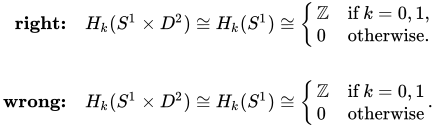
Notice where the period at the end of the sentence is in the "wrong" example. Apparently some people don't notice things like this. Michael Hardy (talk) 02:26, 30 December 2016 (UTC)
In four dimensions
[edit]The (non-solid) torus has a natural embedding into 4-dimensional space:
Is there a similar version for the solid torus? In particular, is it sufficient to insert r for one of the circles, as in?:
To me it is plausible that T3 = D × S = disk cross circle = solid torus. Even if that is sufficient, is that what is usually done, or is there another more accepted way?
And whether or not that is right, what do we call the 4-dimensional shape where we have inserted two radius variables?:
To me it is plausible that T4 = D × D and that that is topologically a convex, 4-dimensional ball in 4-dimensional space, but does it have a separate name?
I ask because it would be nice to have brief mention of these topics in this present article, assuming that there is consensus in the literature as to how to answer these questions. If you know about this or are willing to research about it, your edits to the article would be appreciated. —Quantling (talk | contribs) 17:24, 17 April 2025 (UTC)