


Solid torus

In mathematics, a solid torus is the solid formed by sweeping a disk around a circle.[1] As a topological space, it is homeomorphic to the Cartesian product of the disk and the circle,[2] endowed with the product topology.

A standard way to visualize a solid torus is as a toroid, embedded in 3-space. However, it should be distinguished from a torus, a surface which has the same visual appearance: the torus is the two-dimensional space on the boundary of a toroid, while the solid torus includes also the compact interior space enclosed by the torus. A solid torus is a torus plus the region inside the torus, with a non-zero volume. Real-world objects that approximate a solid torus include O-rings, non-inflatable lifebuoys, ring doughnuts, and bagels.
Topological properties
[edit]The solid torus is a connected, compact, orientable 3-dimensional manifold with boundary. The boundary is homeomorphic to , the ordinary torus.

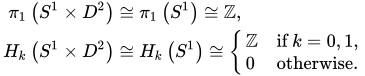
Since the disk is contractible, the solid torus has the homotopy type of a circle, .[3] Therefore the fundamental group and homology groups are isomorphic to those of the circle:


See also
[edit]References
[edit]- ↑ Falconer, Kenneth (2004), Fractal Geometry: Mathematical Foundations and Applications (2nd ed.), John Wiley & Sons, p. 198, ISBN 9780470871355.
- ↑ Matsumoto, Yukio (2002), An Introduction to Morse Theory, Translations of mathematical monographs, vol. 208, American Mathematical Society, p. 188, ISBN 9780821810224.
- ↑ Ravenel, Douglas C. (1992), Nilpotence and Periodicity in Stable Homotopy Theory, Annals of mathematics studies, vol. 128, Princeton University Press, p. 2, ISBN 9780691025728.
 | This topology-related article is a stub. You can help Wikipedia by adding missing information. |