


Talk:Maxwell stress tensor
Add topic | This article is rated Start-class on Wikipedia's content assessment scale. It is of interest to the following WikiProjects: | ||||||||||
| |||||||||||
.jpg)

As a maths graduate (many years ago) who skipped the courses that would have taught me this, but did a fair bit of mathematical analysis - a request:
If my inference is correct, then can a small note, or else a link, please be inserted to make plain the notation that

-in other words that the unbold, unsubscripted E is just the norm of the bold E vector? And similarly for B. Else, if I have this wrong, then can words be inserted that would prevent me from making this assumption.
Thanks. — Preceding unsigned comment added by 83.217.170.175 (talk) 14:51, 30 July 2012 (UTC)
- for any vector in , it is just a notation to drop the bold font, or the arrow, meaning the norm of the vector. Heitorpb (talk) 09:10, 12 October 2015 (UTC)



Cylindrical Objects
[edit]The article currently says: "For cylindrical objects, such as the rotor of a motor, this is further simplified to: :"

Wouldn't it be clearer to simply say :? After all, the Kroenecker delta is zero, because r is not t. I've been staring at this equation wondering why anyone would want to leave that term in the expression. I will wait a while to see if there are any objections, and then change it.--JB Gnome (talk) 02:06, 2 February 2014 (UTC)
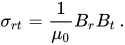
- The paragraph should be deleted. The quoted part is simply a repeat of the preceding equation with index labels changed. The next part is garbled. Rdurkacz (talk) 10:29, 20 December 2025 (UTC)
Lorentz force vs. Maxwell stress tensor
[edit]If one had a positive point charge at r=0 surrounded by a negatively-charged spherical shell at r=1 with equal, but opposite charge, then clearly there would be an electric field extending from r=0 to r=1. Also, an electric field of a positive charge positioned just outside the spherical shell at r=1+ε (ε>0) would have an electric field extending to infinity, and this field would clearly overlap the field interior of the spherical shell. The Lorentz force computation considered by the net E-field from the sphere at r=1+ε and the charge positioned at r=1+ε returns zero force, and yet, the energy computation (or the Maxwell stress tensor rather) does not return a zero result and predicts a force. I'm not the only one who is concerned about a similar problem. See Advances in Applied Science Research, 2011, 2 (2): 99-102 for an example of two positron fields whose fields are limited to some radius r from the respective centers of each:
http://connection.ebscohost.com/c/articles/64287573/nuclear-force-electrostatics
The nuclear force in electrostatics
AUTHOR(S) Singer, Michael
PUB. DATE April 2011
SOURCE Advances in Applied Science Research;Apr2011, Vol. 2 Issue 2, p99
SOURCE TYPE Academic Journal
DOC. TYPE Article
ABSTRACT This paper proposes an electrostatic model for the nuclear force. This uses a simple bounded electrostatic field to create the composite attractive and repulsive forces seen when two nucleons are in very close proximity. Rather than attempt to model such a force using the gross behaviour of electrons or positrons, whose electric fields extend to infinity, it works from first principles and applies finite element analysis first to the positron to demonstrate that the seeds of nucleonnucleon interaction have their roots in the positron-positron interaction, and then truncates the positron field at a fixed radius and shows that nucleonic attraction-repulsion results. ACCESSION # 64287573
A copy of the article can be found at Pelagia Research Library (http://pelagiaresearchlibrary.com/advances-in-applied-science/vol2-iss2/AdASR-2011-2-2-99-102.pdf).siNkarma86—Expert Sectioneer of Wikipedia
86 = 19+9+14 + karma = 19+9+14 + talk 14:21, 31 July 2013 (UTC)
- I don't think the electric field won't be equal to zero unless all the charges on and within the sphere aren't allowed to move. Like, on a conductor surface charges can also move and polarize. If they can't move, then they all tug and push on the outside charge so then there's zero Lorentz force and E field. Coulomb's Law is a special case of the Jefimenko equations. In the general case where charge distributions can move, along with the Coulomb q/r^2, you also get a (dq/dt)/(rc) term and a (dJ/dt)/(rc^2) term. 2600:1702:3C50:74A0:6D74:219:A7A3:EB73 (talk) 21:38, 26 September 2023 (UTC)
"Interaction between electromagnetic forces and mechanical momentum"
[edit]The very beginning of the post says "...is a symmetric second-order tensor in three dimensions that is used in classical electromagnetism to represent the interaction between electromagnetic forces and mechanical momentum.". Sorry but what's an "interaction between a force and momentum"? that doesn't mean anything. ~2025-34229-53 (talk) 06:37, 17 November 2025 (UTC)
- It might be better said simply that electromagnetic forces set up mechanical stress. What is written is not really meaningless since if the stress is not balanced by elastic stress or something else then momentum is affected. Rdurkacz (talk) 10:43, 20 December 2025 (UTC)
- Moreover, the article does not explain how to interpret the MST as describing stress, ie in the vacuum, caused by electromagnetic fields. The derivation, taken from the Griffiths text, introduces the MST, in fact its derivative, so as to describe body forces rather than stress. For that reason I gave a reference to the article by JS Reid, without actually knowing who Reid is. Rdurkacz (talk) 05:38, 13 July 2026 (UTC)
- In fact the section headed "Equation" gives a better introduction than the current introduction to the article. I would (or will) edit the article then by removing that section but replacing some of the foregoing text with it. The two following parts, magnetostatics and electrostatics, should probably go as well. Rdurkacz (talk) 16:29, 14 July 2026 (UTC)
- The Derivation sections mixes tensor notation with vector notation where the M stress tensor is introduced. I see that the Equation section tries to make up for this (dyads). The result overall would be confusing to most readers not already used to both kinds of notation. The comment about notation from 2012 is still relevant. It is not clear how to improve the situation without wasting a lot of words. Rdurkacz (talk) 18:02, 14 July 2026 (UTC)
"Motivation"
[edit]The last paragraph is no help. As for bound currents the derivation is for the case of a vacuum so there are none. There are no non-linear tensors and the given reference, which is apt, does not claim that there is one either. The heading should be changed to Derivation or something similar. Rdurkacz (talk) 16:23, 12 July 2026 (UTC)
- I altered the text in accordance with my comment. The 3 sections following are rather redundant but at least not misleading. I doubt that any reader would be enlightened by the formulas for eigenvalues but in any case it does no harm. Rdurkacz (talk) 16:56, 12 July 2026 (UTC)