Cloudflare fetched the original article and streamed it through HTMLRewriter to apply an entirely new visual system without rebuilding the source page.
// request.cf · coarse context
A page that knows where it met you.
Only coarse request metadata is shown. This demo does not display or persist visitor IP addresses.
The elements have units of force per unit of area (negative pressure), denoting the force parallel to the th axis suffered by a surface normal to the th axis per unit of area. As such the diagonal elements give the tension acting on the plane normal to the corresponding axis and the off-diagonal elements represent shear stress in the plane.
Expressed in vector/dyad notation we would have:
in SI units or
in CGS units where is the dyadic product, and the last tensor is the unit dyadic:
In the relativistic formulation of electromagnetism, the nine components of the Maxwell stress tensor appear, negated, as components of the electromagnetic stress–energy tensor, which is the electromagnetic component of the total stress–energy tensor. The latter describes the density and flux of energy and momentum in spacetime.
The following derivation defines the Maxwell stress tensor by way of introducing it so as to show how electromagnetic body forces arise from electrical and magnetic fields. For an explanation more directly as to how the tensor describes stress (in the absence of body forces) see the web article by J.S.Reid [1].
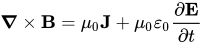
As outlined below, the electromagnetic force is written in terms of and . Using vector calculus and Maxwell's equations, symmetry is sought for in the terms containing and , and introducing the Maxwell stress tensor simplifies the result.
The derivation follows Griffiths [2] and applies in the case of a vacuum.
Maxwell's equations in SI units in vacuum (for reference)
Name
Differential form
Gauss's law (in vacuum)
Gauss's law for magnetism
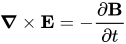
Maxwell–Faraday equation (Faraday's law of induction)
Ampère's circuital law (in vacuum) (with Maxwell's correction)
Starting with the Lorentz force law
the force per unit volume is
The time derivative can be rewritten to something that can be interpreted physically, namely the Poynting vector. Using the product rule and Faraday's law of induction gives
and we can now rewrite as
then collecting terms with and gives
A term seems to be "missing" from the symmetry in and , which can be achieved by inserting because of Gauss's law for magnetism:
Eliminating the curls (which are fairly complicated to calculate), using the vector calculus identity
leads to:
This expression contains every aspect of electromagnetism and momentum and is relatively easy to compute. It can be written more compactly by introducing the Maxwell stress tensor,
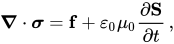
All but the last term of can be written as the tensor divergence of the Maxwell stress tensor, giving:
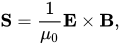
As in the Poynting's theorem, the second term on the right side of the above equation can be interpreted as the time derivative of the EM field's momentum density, while the first term is the time derivative of the momentum density for the massive particles. In this way, the above equation will be the law of conservation of momentum in classical electrodynamics; where the Poynting vector,
has been introduced.
In the above relation for conservation of momentum, is the momentum flux density and plays a role similar to in Poynting's theorem.
In electrostatics the effects of magnetism are not present. In this case the magnetic field vanishes, i.e. , and we obtain the electrostatic Maxwell stress tensor. It is given in component form by
and in symbolic form by
where is the appropriate identity tensor usually .


![{\displaystyle \sigma _{ij}={\frac {1}{4\pi }}\left[E_{i}E_{j}+H_{i}H_{j}-{\frac {1}{2}}\left(E^{2}+H^{2}\right)\delta _{ij}\right],}](https://wikimedia.org/api/rest_v1/media/math/render/svg/017cfdcda8909fde3dc5bda1ce1fb519927b803f)


![{\displaystyle {\boldsymbol {\sigma }}={\frac {1}{4\pi }}\left[\mathbf {E} \otimes \mathbf {E} +\mathbf {H} \otimes \mathbf {H} -{\frac {1}{2}}\left(E^{2}+H^{2}\right)\mathbb {I} \right]}](https://wikimedia.org/api/rest_v1/media/math/render/svg/70a162383fc0386dc6dd0492516dff07d9bb546f)


![{\displaystyle {\begin{aligned}\mathbf {F} &=q(\mathbf {E} +\mathbf {v} \times \mathbf {B} )\\[3pt]&=\int (\mathbf {E} +\mathbf {v} \times \mathbf {B} )\rho \mathrm {d} \tau \end{aligned}}}](https://wikimedia.org/api/rest_v1/media/math/render/svg/260a8c6f1ab464168c47b559120d9d007b0f9053)







![{\displaystyle \mathbf {f} =\varepsilon _{0}\left[({\boldsymbol {\nabla }}\cdot \mathbf {E} )\mathbf {E} -\mathbf {E} \times ({\boldsymbol {\nabla }}\times \mathbf {E} )\right]+{\frac {1}{\mu _{0}}}\left[-\mathbf {B} \times \left({\boldsymbol {\nabla }}\times \mathbf {B} \right)\right]-\varepsilon _{0}{\frac {\partial }{\partial t}}\left(\mathbf {E} \times \mathbf {B} \right).}](https://wikimedia.org/api/rest_v1/media/math/render/svg/c9c7d13f0d3c2020ff30ccfd8a7df1bd93f231b7)

![{\displaystyle \mathbf {f} =\varepsilon _{0}\left[({\boldsymbol {\nabla }}\cdot \mathbf {E} )\mathbf {E} -\mathbf {E} \times ({\boldsymbol {\nabla }}\times \mathbf {E} )\right]+{\frac {1}{\mu _{0}}}\left[({\boldsymbol {\nabla }}\cdot \mathbf {B} )\mathbf {B} -\mathbf {B} \times \left({\boldsymbol {\nabla }}\times \mathbf {B} \right)\right]-\varepsilon _{0}{\frac {\partial }{\partial t}}\left(\mathbf {E} \times \mathbf {B} \right).}](https://wikimedia.org/api/rest_v1/media/math/render/svg/d1960cabc47edd5632c9dcfd66b85f66d96fe201)

![{\displaystyle \mathbf {f} =\varepsilon _{0}\left[({\boldsymbol {\nabla }}\cdot \mathbf {E} )\mathbf {E} +(\mathbf {E} \cdot {\boldsymbol {\nabla }})\mathbf {E} \right]+{\frac {1}{\mu _{0}}}\left[({\boldsymbol {\nabla }}\cdot \mathbf {B} )\mathbf {B} +(\mathbf {B} \cdot {\boldsymbol {\nabla }})\mathbf {B} \right]-{\frac {1}{2}}{\boldsymbol {\nabla }}\left(\varepsilon _{0}E^{2}+{\frac {1}{\mu _{0}}}B^{2}\right)-\varepsilon _{0}{\frac {\partial }{\partial t}}\left(\mathbf {E} \times \mathbf {B} \right).}](https://wikimedia.org/api/rest_v1/media/math/render/svg/77ce5f8cd75df87ca2c9ef3b8af7e5ac5ccd53d0)



![{\displaystyle \left[-\left(\lambda +V\right)-{\frac {\varepsilon _{0}\left(\mathbf {E} \cdot \mathbf {B} \right)^{2}}{\mu _{0}\left(-\left(\lambda +V\right)+\varepsilon _{0}\mathbf {E} ^{\textsf {T}}\mathbf {E} \right)}}\right]\left[-\left(\lambda +V\right)+\varepsilon _{0}\mathbf {E} ^{\textsf {T}}\mathbf {E} \right]}](https://wikimedia.org/api/rest_v1/media/math/render/svg/3743180c0e7d93602c2c50c8481dbaf0ccc00400)
