


Talk:Feynman slash notation
Add topicLatest comment: 17 years ago by Andremanoel in topic Metric convention
 | This article is rated Stub-class on Wikipedia's content assessment scale. It is of interest to the following WikiProjects: | ||||||||||
| |||||||||||
.jpg)

Metric convention
[edit]For a g=(1,-1,-1,-1) metric, shouldn't the expression

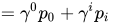
actually be:
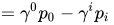
—Preceding unsigned comment added by 169.234.141.96 (talk • contribs)
- No, because both & are independent of the metric convention. Or put it another way, because the metric does not explicitly appear in the slash definition.


- Contrast with the definitions:
- and
- where the sign is metric convention dependent, + for g(+---) and - for g(-+++).



- I guess the article should say this.
- I agree with the response above, but when lowering indexes you have to take the metric in account. Therefore, is wrong to say that , because the dot product between and is the standard inner product of the orthonormal Euclidean space.


- In this way, I've corrected the signs in the matrix. You can check on Griffiths, for instance, that the correct form is this one.
