


// Workers AI · dad joke modeWhy did Feynman slash notation go to therapy? It had a lot of "cutting" issues.
In the study of Dirac fields in quantum field theory, Richard Feynman introduced the convenient Feynman slash notation (less commonly known as the Dirac slash notation[1]). If A is a covariant vector (i.e., a 1-form),

where γ are the gamma matrices. Using the Einstein summation notation, the expression is simply
- .

Identities
[edit]Using the anticommutators of the gamma matrices, one can show that for any and ,


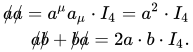
where is the identity matrix in four dimensions.

In particular,

Further identities can be read off directly from the gamma matrix identities by replacing the metric tensor with inner products. For example,
![{\displaystyle {\begin{aligned}\gamma _{\mu }{a\!\!\!/}\gamma ^{\mu }&=-2{a\!\!\!/}\\\gamma _{\mu }{a\!\!\!/}{b\!\!\!/}\gamma ^{\mu }&=4a\cdot b\cdot I_{4}\\\gamma _{\mu }{a\!\!\!/}{b\!\!\!/}{c\!\!\!/}\gamma ^{\mu }&=-2{c\!\!\!/}{b\!\!\!/}{a\!\!\!/}\\\gamma _{\mu }{a\!\!\!/}{b\!\!\!/}{c\!\!\!/}{d\!\!\!/}\gamma ^{\mu }&=2({d\!\!\!/}{a\!\!\!/}{b\!\!\!/}{c\!\!\!/}+{c\!\!\!/}{b\!\!\!/}{a\!\!\!/}{d\!\!\!/})\\\operatorname {tr} ({a\!\!\!/}{b\!\!\!/})&=4a\cdot b\\\operatorname {tr} ({a\!\!\!/}{b\!\!\!/}{c\!\!\!/}{d\!\!\!/})&=4\left[(a\cdot b)(c\cdot d)-(a\cdot c)(b\cdot d)+(a\cdot d)(b\cdot c)\right]\\\operatorname {tr} ({a\!\!\!/}{\gamma ^{\mu }}{b\!\!\!/}{\gamma ^{\nu }})&=4\left[a^{\mu }b^{\nu }+a^{\nu }b^{\mu }-\eta ^{\mu \nu }(a\cdot b)\right]\\\operatorname {tr} (\gamma _{5}{a\!\!\!/}{b\!\!\!/}{c\!\!\!/}{d\!\!\!/})&=4i\varepsilon _{\mu \nu \lambda \sigma }a^{\mu }b^{\nu }c^{\lambda }d^{\sigma }\\\operatorname {tr} ({\gamma ^{\mu }}{a\!\!\!/}{\gamma ^{\nu }})&=0\\\operatorname {tr} ({\gamma ^{5}}{a\!\!\!/}{b\!\!\!/})&=0\\\operatorname {tr} ({\gamma ^{0}}({a\!\!\!/}+m){\gamma ^{0}}({b\!\!\!/}+m))&=8a^{0}b^{0}-4(a\cdot b)+4m^{2}\\\operatorname {tr} (({a\!\!\!/}+m){\gamma ^{\mu }}({b\!\!\!/}+m){\gamma ^{\nu }})&=4\left[a^{\mu }b^{\nu }+a^{\nu }b^{\mu }-\eta ^{\mu \nu }((a\cdot b)-m^{2})\right]\\\operatorname {tr} ({a\!\!\!/}_{1}...{a\!\!\!/}_{2n})&=\operatorname {tr} ({a\!\!\!/}_{2n}...{a\!\!\!/}_{1})\\\operatorname {tr} ({a\!\!\!/}_{1}...{a\!\!\!/}_{2n+1})&=0\end{aligned}}}](https://wikimedia.org/api/rest_v1/media/math/render/svg/f4ea00b71606128769d081289ee45fa43f1fc3e2)
where:
- is the Levi-Civita symbol
- is the Minkowski metric
- is a scalar.


With four-momentum
[edit]This section uses the (+ − − −) metric signature. Often, when using the Dirac equation and solving for cross sections, one finds the slash notation used on four-momentum: using the Dirac basis for the gamma matrices,

as well as the definition of contravariant four-momentum in natural units,

we see explicitly that
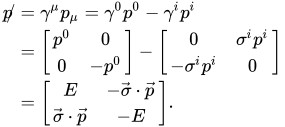
Similar results hold in other bases, such as the Weyl basis.
See also
[edit]References
[edit]- ↑ Weinberg, Steven (1995), The Quantum Theory of Fields, vol. 1, Cambridge University Press, p. 358 (380 in polish edition), ISBN 0-521-55001-7
- Halzen, Francis; Martin, Alan (1984). Quarks & Leptons: An Introductory Course in Modern Particle Physics. John Wiley & Sons. ISBN 0-471-88741-2.
 | This quantum mechanics–related article is a stub. You can help Wikipedia by adding missing information. |