


Perveance
Perveance is a notion used in the description of charged particle beams. The value of perveance indicates how significant the space charge effect is on the beam's motion. The term is used primarily for electron beams, in which motion is often dominated by the space charge.
Origin of the word
[edit]The word was probably created from Latin pervenio–to attain[citation needed].
Definition
[edit]For an electron gun, the gun perveance is determined as a coefficient of proportionality between a space-charge limited current, , and the gun anode voltage, , in three-half power in the Child-Langmuir law[1]


The same notion is used for non-relativistic beams propagating through a vacuum chamber. In this case, the beam is assumed to have been accelerated in a stationary electric field so that is the potential difference between the emitter and the vacuum chamber, and the ratio of is referred to as a beam perveance. In equations describing motion of relativistic beams, contribution of the space charge appears as a dimensionless parameter called the generalized perveance [2][3] defined as


,
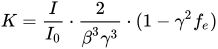
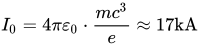
where (for electrons) is the Budker (or Alfven) current; and are the relativistic factors, and is the neutralization factor.


Examples
[edit]The 6S4A[4] is an example of a high perveance triode. The triode section of a 6AU8A becomes a high-perveance diode when its control grid is employed as the anode.[5] Each section of a 6AL5 is a high-perveance diode[6] as opposed to a 1J3 which requires over 100 V to reach only 2 mA.[7]
Perveance does not relate directly to current handling. Another high-perveance diode, the diode section of a 33GY7, shows similar perveance to a 6AL5, but handles 15 times greater current, at almost 13 times maximum peak inverse voltage.[8]
References
[edit]- ↑ Handbook of Accelerator Physics and Engineering, edited by A.W. Chao and M. Tigner, World Scientific, 1999, p. 100
- ↑ Lawson, J. D., J. Electron. Control 5, 146 (1958).
- ↑ M. Reiser, Theory and Design of charged particle beams, John Wiley & Sons, Inc., 1994
- ↑ RCA Receiving Tube Manual - 6S4-A
- ↑ 1959 General Electric Tube Manual - 6AU8-A
- ↑ 1954 General Electric Tube Manual - 6AL5
- ↑ 1957 General Electric Tube Manual - 1J3
- ↑ 1965 Tung-Sol Tube Manual - 33GY7