Cloudflare fetched the original article and streamed it through HTMLRewriter to apply an entirely new visual system without rebuilding the source page.
// request.cf · coarse context
A page that knows where it met you.
Only coarse request metadata is shown. This demo does not display or persist visitor IP addresses.
This article has been nominated for deletion. You are welcome to participate in the deletion discussion, which will decide whether to keep it. This discussion may also result in the article being merged, redirected, or draftified.
Feel free to improve the article, but do not remove this notice before the discussion is closed. For more information, see the guide to deletion. Find sources:"House of Dar"–news·newspapers·books·scholar·JSTOR%5B%5BWikipedia%3AArticles+for+deletion%2FHouse+of+Dar%5D%5DAFD
Scanned copy of Book- বাংলার জমিদারি রাজ্য pp. 97 by Shishir Ghosh BL- About the House of Dar[6]Scanned copy of Book- বাংলার জমিদারি রাজ্য pp. 98 by Shishir Ghosh BL- About the House of Dar[6]
The House of Dar was established in the year in 1771 after Virendra Mohan Dar, the grandson of a rich Kashmiri Pandit saffron merchant- Hari Krishna Mohan Dar, was conferred the title of Raja by Ahmed Shah Durrani.[7][failed verification][8] Later in 1813, the title of Bahadur was formally conferred upon Virendra Mohan Dar by Nawab Zain-ud-Din Ali Khan of Murshidabad, with the official sanction of the British Governor-General, Lord Minto I, in recognition of his significant contributions to land expansion, the construction of irrigation works, and consistent revenue payments to the East India Company.[9]
Dhar Zamindars of Dhar Raj, Dacca, (c.1879 Center: Raja III Hara Mohan Dhar
After the death of Ahmed Shah Durrani, the House of Durrani collapsed and the jagirs and fedual landlords started losing power in Kashmir, including the House of Dar. Due to the extreme political instability and attacks caused by the Sikh Misls the Dar Raj shifted to Bangladesh towards the end of the eighteenth century.[10][11] The House of Dar established the Char Talibari Rajbari at the Rajrajeshwar Union of Bangladesh as their primary seat but soon lost it due to the erosion caused by the Padma River.[12] In 1802, The Maharaja, established the 250-room Dhar Zamindar Bari at Nannar Village- which later came to be known as House of Nannar, a branch of the House of Dar. The Zamindari spanned over 25,000 acres of land including Rajrajeshwar, Rowail, Sharifbag,. Ashulia, Demra, Nannar, Dhamrai and Suapur.[13][14]
The House of Dar established three successive principal seats of power across Kashmir and Bengal:
The Dhar Zamindar Palace in 1869
Dar Haveli (Dar, Akhnoor): Established near the banks of the Chenab River, the original family seat was a traditional Kashmiri-style wooden haveli. Following his ascension, Maharaja Virendra Mohan Dar expanded the estate into a five-acre palace complex featuring a Diwan-i-Aam (Hall of Public Audience) and a Diwan-i-Khas supported by carved deodar pillars. The palace was destroyed by fire during a hostile Sikh incursion in 1788–1789.[15]
Ruins of the Dhar Zamindar Palace (Later part of Alokeshi High School) in 2015Rajrajeshwar Palace (Bengal): Established in 1790 on the Char Talibari tract along the Padma River, this palace served as the initial hub for the dynasty's relocation to East Bengal. Constructed with thick brick walls and elevated foundations to counter seasonal floods, the estate was permanently abandoned in 1797 after catastrophic riverbank erosion dangerously undermined the structure.[16]
The Private Palace Pond, Virendra Sagar, of the Dhar Zamindar Bari, 2018Nannar Palace (Bengal): Built between 1797 and 1801 in Dhamrai Upazila, the 250-room Nannar Rajbari (popularly known as the Dhar Zamindar Bari) served as the permanent administrative and cultural seat of the Dar Raj. Constructed on stable, flood-resistant uplands, the palace grounds featured a grand Durbar Hall, a family shrine (the Dhar Krishna Mandir), and a brick-lined reservoir called the Virendra Sagar.[17] Later in 1919 Raja IV Mohini Mohan Dhar demolished majority of the palace and converted it into Elokeshi Balika Vidyalaya, Jalsin. The other branch of the school is located in Gidhni. The palace was demolished by Government of Bangladesh in 2023.[18][failed verification]
Gidhni, Elokeshi High SchoolAlokeshi High School, Jalsin
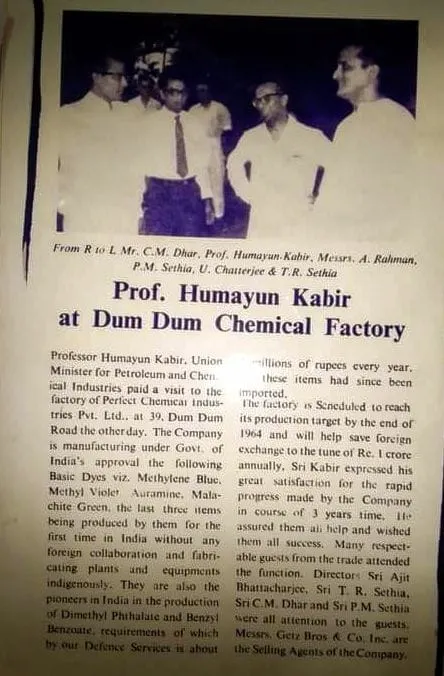
Raja IV of the Dar Raj established two schools, namely the Elokeshi High School in Jalsin after demolishing a significant part of the Dhar Zamindar Bari. Another branch of this school was established in Gidhni- Gidhni Elokeshi High School.[18] Raja IV Dewan MM Dhar also played the leasing role in the leading of the iron ore mines in Gorumahisani along with Pramatha Nath Bose.[19]Rupsa–Baripada–Bangriposi railway line creation operation was lead and managed by the Raja IV Dewan Mohini Mohan Dhar.[19] In 25 April 1960 Raja VI Chittajit Mohan Dhar M.P.[20][21] established Perfect Chemical Industries with the help of Humayun Kabir on 39 Dum Dum Road, Calcutta.[22][23] Perfect Chemical Industries specialized in the domestic production of critical industrial and defense-related chemicals—such as benzyl benzoate and dimethyl phthalate—which helped reduce India's import dependency and saved valuable foreign exchange during its active years of operation.[24] The annual turnovers were around ₹42 to ₹45 Crores with net profits near ₹7.8 Crores,[citation needed] official regulatory records currently classify the company's status as "Strike Off." as of 2026[25][26][failed verification] Perfect Chemical Industries shut down and was sold to Emami after the death of Chittajit Mohan Dhar in 1975.
Chittajit Mohan Dhar (center) and Humayun Kabir (right) at Perfect Chemical Industries, Dum Dum
The House of Dar established family orders of chivalry to recognize public service, philanthropy, and contributions to society.[27]
Order of Dar Raj (ODR): First instituted in 1818 by Maharaja Virendra Mohan Dar, the ODR is the primary order of the family estate.
Most Excellent Order of the House of Virendra (MHV): Introduced in 1916 by Raja Mohini Mohan Dhar, this order was created in memory of Maharaja Virendra Mohan Dar.
While these honours were conferred across generations, their investiture was formally documented in the regional press during the headship of Raja Dhirendra Mohan Dhar, B.L., B.Sc. On 13 May 1944, an investiture ceremony was held at Saudamini Kutir (19 Kabir Road, Calcutta), followed by a public celebration at Lahabari on 20 May 1944, where fourteen distinguished individuals were decorated with the ODR and MHV.[28]
Although princely pensions, titles, and privileges were officially abolished in India in 1971, families of some former princely rulers have continued to use the old titles unofficially for certain family members, or made new ones for themselves. In some instances, the titles are used in conducting family ceremonies and traditions, to promote the ideal of princely and royal India for tourists, and to sustaining the wealth, stardom, and clout some families have retained.[29]
Notable direct and distant members of the family include- Jogesh Chandra Ghosh, an ayurvedic scholar, founder of the Sadhana Aushadhalaya and Gopalpur Tea Companyand the brother of Maharani IV- Saudamini.[33] The Maharani V Amiyabala was the grand-daughter of educationist and philanthropist Peary Charan Sarkar, founder of Barasat Peary Charan Sarkar High School and the author of the first book of reading. Amiyabala was the sister of Sir. Nripendra Nath SircarK.C.S.I, former Advocate General of Bengal and the father of Padma BhushanBirendra Nath Sircar.[34] Amiyabala was the grandchild Princess Kailashkamini of Hatkhola, the grand-daughter of Maharaja Manik Ram Basu.[35] Out of the five children of Maharaja V, one of them was Dhirendra Mohan Dhar a barrister-at-law from King's College London and a Mathematician who was married to Amiyabala. The other son was Satyendra Mohan Dhar C.I.E., I.C.S. who was married to Ava Dhar M.B.E., O.B.E.,[36] the grand-daughter of Sir. Krishna Govinda GuptaK.C.S.I., and the niece-in-law of Sir. Albion Banerji- former Prime Minister of Jammu and Kashmir. Ava and Satyendra had two sons- Manojit Mohan Dhar being one of them. The sister of Maharaja VI, the Princess Royal, Pritilata is the grandmother of Anupama Kundoo, an architect, professor and Auguste Perret winner.[37] Grand-daughter of the Maharaja VI via his eldest daughter- Queen Mother Subha, is Roopa Basu, a British designer, architect and artist.[38]
↑The Dar Raj foundations were laid by Hari Krishna Mohan Dar in the year 1699 in Srinagar. But the Dar Raj emerged as a powerful Jagirdari estate under the leadership of Virendra Mohan Dar from 1771.
↑Although the House of Dar ordinarily follows agnatic primogeniture under Article II of the Virendra Royal Succession Charter, the Charter does not absolutely exclude female succession. Article VI establishes the precedence of male lines over female lines, while Article VII provides that, in the absence of eligible male descendants in both the male and female lines, the eldest surviving daughter may succeed as Maharani Regnant. Accordingly, the accession of Subha Basu Dhar as Maharani was regarded by the family as being in conformity with the provisions of the Charter rather than an exception to it until the birth of a male heir- the grandson of Maharaja VI. Dhar remained the Maharani Regnant till, the heir apparent, the only son of Princess III turned 18.[32]
↑Anirban Chattopadhyay, "Virendramohan of Dar Raj: Locating Subaltern Voices in the Bengali Novel", in: Tirthankar Roy and Tapati Guha-Thakurta, eds, Literary Cartographies of Bengal, Volume 2: Textual Politics and the Colonial State, Kolkata: Academic Publishers, 2014, pp. 114-132.
↑Singh, Ravinath. (1974). The life and death of Virendra of Dhar Raj: A critical analysis of the final siege of Dhar. In K. P. Acharya & D. Sharma (Eds.), Historiography of the Central Provinces: Vol. 4. The Paramara Epoch (A. M. C. Hollingbery, Trans.; 3rd ed., pp. 412, 414, 419, 421–485). Oriental Research Publishing House. (Original work published 1921).
Karatchkova, Elena (2016) [2007], "Ghost Towns and Bustling Cities: Constructing a Master Narrative in Nineteenth-Century Jaipur", Raj Rhapsodies: Tourism, Heritage, and the Seductions of History, p.30, ISBN9781317071624, The contemporary master narrative for Jaipur and Amber is 'royalty'. This theme is ubiquitous in tourist publications, such as Majestic Jaipur (Wheeler 1998). Royal personalities are emphasized, as in Jaipur: The Royal City. One article on tourist attractions of Jaipur features a full-page photograph of Maharaja Bhawani Singh, in full regalia, with his wife and daughter, all identified as 'the present royal family'
Aldrich, Robert; McCreery, Cindy (2016), "European sovereigns and their empires 'beyond the seas'", in Robert Aldrich, Cindy McCreery (ed.), Crowns and colonies: European monarchies and overseas empires, Studies in Imperialism Book 142, Manchester University Press, p.43, ISBN9781526100894, Although Prime Minister Indira Gandhi deprived the India princes of their official titles and privy purses in 1971, the maharajas and other princes, such as the traditional Maharana of Udaipur, who now styles himself as the 'Custodian' of the House of Mewar in Rajasthan, retain wealth, influence and celebrity; in 2015, a twenty-three-year-old economics graduate was thus installed as the most recent Maharajah of Mysore.
Ramusack, Barbara N. (2004). The Indian princes and their states. Cambridge University Press. p.279. ISBN978-0-521-26727-4. The princes of India offer fantasy for post-modern consumption. Faced with escalating maintenance costs and declining sources of income, princely entrepreneurs transformed palaces into hotels where tourists could experience an idealised, pampered lifestyle of royalty during a democratic era. In 1954 Karan Singh of Jammu and Kashmir leased his main palace in Srinagar to the Oberoi chain; it seems appropriate that he became minister for tourism and civil aviation in 1967 in Indira Gandhi's government. In 1958 the Rambagh Palace Hotel opened in Jaipur followed by the much photographed Lake Palace Hotel in Udaipur in the early 1960s


_of_Dar_Raj_%D8%AF%D8%A7%D8%B1_%D8%B1%D8%A7%D8%AC.png)


.png)
.jpg)


_2015.jpg)

.jpg)


_Part_1.png)
_Part_2.png)


.jpg)