Cloudflare fetched the original article and streamed it through HTMLRewriter to apply an entirely new visual system without rebuilding the source page.
// request.cf · coarse context
A page that knows where it met you.
Only coarse request metadata is shown. This demo does not display or persist visitor IP addresses.
Square matrix whose entries are 1 along the anti-diagonal and 0 elsewhere
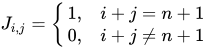
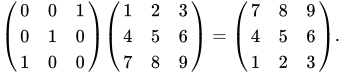
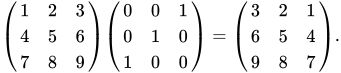
In mathematics, especially linear algebra, the exchange matrices (also called the reversal matrix, backward identity, or standard involutory permutation) are special cases of permutation matrices, where the 1 elements reside on the antidiagonal and all other elements are zero. In other words, they are 'row-reversed' or 'column-reversed' versions of the identity matrix.[1]
Any matrix A satisfying the condition AJ = JA is said to be centrosymmetric.
Any matrix A satisfying the condition AJ = JAT is said to be persymmetric.
Symmetric matrices A that satisfy the condition AJ = JA are called bisymmetric matrices. Bisymmetric matrices are both centrosymmetric and persymmetric.


![{\displaystyle {\begin{aligned}J_{2}&={\begin{pmatrix}0&1\\1&0\end{pmatrix}}\\[4pt]J_{3}&={\begin{pmatrix}0&0&1\\0&1&0\\1&0&0\end{pmatrix}}\\&\quad \vdots \\[2pt]J_{n}&={\begin{pmatrix}0&0&\cdots &0&1\\0&0&\cdots &1&0\\\vdots &\vdots &\,{}_{_{\displaystyle \cdot }}\!\,{}^{_{_{\displaystyle \cdot }}}\!{\dot {\phantom {j}}}&\vdots &\vdots \\0&1&\cdots &0&0\\1&0&\cdots &0&0\end{pmatrix}}\end{aligned}}}](https://wikimedia.org/api/rest_v1/media/math/render/svg/8c783ae3381dc05095dbcc9b73eea1dd3d4b7bd0)

![{\displaystyle J_{n}^{k}={\begin{cases}I&{\text{ if }}k{\text{ is even,}}\\[2pt]J_{n}&{\text{ if }}k{\text{ is odd.}}\end{cases}}}](https://wikimedia.org/api/rest_v1/media/math/render/svg/4fbe5869b984a5118a0f0ecd86e9ca0a94ecc0f0)


![{\displaystyle \det(\lambda I-J_{n})=(\lambda -1)^{\lceil n/2\rceil }(\lambda +1)^{\lfloor n/2\rfloor }={\begin{cases}{\big [}(\lambda +1)(\lambda -1){\big ]}^{\frac {n}{2}}&{\text{ if }}n{\text{ is even,}}\\[4pt](\lambda -1)^{\frac {n+1}{2}}(\lambda +1)^{\frac {n-1}{2}}&{\text{ if }}n{\text{ is odd,}}\end{cases}}}](https://wikimedia.org/api/rest_v1/media/math/render/svg/923496ff9975512bbf3e4a9759190c53dacd94e1)



