


// Workers AI · dad joke modeWhat did the bidiagonal matrix say? I'm on the diagonal.
In mathematics, a bidiagonal matrix is a banded matrix with non-zero entries along the main diagonal and either the diagonal above or the diagonal below. This means there are exactly two non-zero diagonals in the matrix.
When the diagonal above the main diagonal has the non-zero entries the matrix is upper bidiagonal. When the diagonal below the main diagonal has the non-zero entries the matrix is lower bidiagonal.
For example, the following matrix is upper bidiagonal:
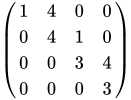
and the following matrix is lower bidiagonal:
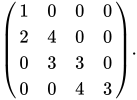
The eigenvalues of a bidiagonal matrix (of either type) are given by the entries of the diagonal.
For a square bidiagonal matrix B, the determinant is simply the product of its diagonal elements:

Additionally, the inverse of a nonsingular upper bidiagonal matrix B is an upper triangular matrix whose entries can be computed explicitly without solving full systems of linear equations.
Usage
[edit]One variant of the QR algorithm starts with reducing a general matrix into a bidiagonal one,[1] and the singular value decomposition (SVD) uses this method as well.
Reducing a matrix to bidiagonal form is a standard first step in the Golub-Kahan algorithm for computing the SVD. Because Householder reflections or Given rotations can reduce a dense m x n matrix to an equivalent bidiagonal matrix in O(mn2) operations, working with the bidiagonal structure drastically reduces the computational cost of subsequent iterative SVD and QR steps.[2]
Bidiagonalization
[edit]Bidiagonalization allows guaranteed accuracy when using floating-point arithmetic to compute singular values.[3]
![[icon]](/everything/wiki/File:Wiki_letter_w_cropped.svg) | This section needs expansion. You can help by adding missing information. (January 2017) |
See also
[edit]- List of matrices
- LAPACK
- Hessenberg form — The Hessenberg form is similar, but has more non-zero diagonal lines than 2.
References
[edit]- Stewart, G.W. (2001). Eigensystems. Matrix Algorithms. Vol. 2. Society for Industrial and Applied Mathematics. ISBN 0-89871-503-2.
- ↑ Anatolyevich, Bochkanov Sergey (2010-12-11). "Matrix operations and decompositions — Other operations on general matrices — SVD decomposition". ALGLIB User Guide, ALGLIB Project. Accessed: 2010-12-11. (Archived by WebCite at)
- ↑ "Calculating the Singular Values and Pseudo-Inverse of a Matrix | SIAM Journal on Numerical Analysis". Journal of the Society for Industrial and Applied Mathematics, Series B: Numerical Analysis. doi:10.1137/0702016.
- ↑ Fernando, K.V. (1 April 2007). "Computation of exact inertia and inclusions of eigenvalues (singular values) of tridiagonal (bidiagonal) matrices". Linear Algebra and Its Applications. 422 (1): 77–99. doi:10.1016/j.laa.2006.09.008. S2CID 122729700.
External links
[edit]- High performance algorithms for reduction to condensed (Hessenberg, tridiagonal, bidiagonal) form

 | This article about matrices is a stub. You can help Wikipedia by adding missing information. |
 | This computer-programming-related article is a stub. You can help Wikipedia by adding missing information. |