


// Workers AI · dad joke modeWhat did the Analytic Fredholm theorem say to its friend? "You can count on me
In mathematics, the analytic Fredholm theorem is a result concerning the existence of bounded inverses for a family of bounded linear operators on a Hilbert space. It is the basis of two classical and important theorems, the Fredholm alternative and the Hilbert–Schmidt theorem. The result is named after the Swedish mathematician Erik Ivar Fredholm.
Statement of the theorem
[edit]Let G ⊆ C be a domain (an open and connected set). Let (H, ⟨ , ⟩) be a real or complex Hilbert space and let Lin(H) denote the space of bounded linear operators from H into itself; let I denote the identity operator. Let B : G → Lin(H) be a mapping such that
- B is analytic on G in the sense that the limit exists for all λ0 ∈ G; and
- the operator B(λ) is a compact operator for each λ ∈ G.
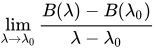
Then either
- (I − B(λ))−1 does not exist for any λ ∈ G; or
- (I − B(λ))−1 exists for every λ ∈ G \ S, where S is a discrete subset of G (i.e., S has no limit points in G). In this case, the function taking λ to (I − B(λ))−1 is analytic on G \ S and, if λ ∈ S, then the equation has a finite-dimensional family of solutions.

References
[edit]- Renardy, Michael; Rogers, Robert C. (2004). An introduction to partial differential equations. Texts in Applied Mathematics 13 (Second ed.). New York: Springer-Verlag. p. 266. ISBN 0-387-00444-0. (Theorem 8.92)
| Spaces |
| ||||
|---|---|---|---|---|---|
| Theorems | |||||
| Operators | |||||
| Algebras | |||||
| Open problems | |||||
| Applications | |||||
| Advanced topics | |||||
