


Talk:Perfect number/Archive 2
 | This is an archive of past discussions about Perfect number. Do not edit the contents of this page. If you wish to start a new discussion or revive an old one, please do so on the current talk page. |
| Archive 1 | Archive 2 |
| Three closed discussion threads. Please do not post original research to this talk page. It should be only for discussion of how to use published sources to improve our article. Additional messages of this sort may be removed altogether. —David Eppstein (talk) 01:16, 8 May 2022 (UTC) |
|---|
| The following discussion has been closed. Please do not modify it. |
I think the Odd Cubes section could be made more accurateFor odd cubes to work they only seem to work for every second even perfect number, I don't think the article makes that clear, unless I'm miss reading the explanation ( which I may be but since I didn't quite understand it maybe it could be made clearer): In [3385]: def ffs(x):
...: x = gmpy2.mpz(x)
...: return gmpy2.bit_length(x&-x)-1
     ...: def extractoddfactor(N):
     ...:   return N//(2**ffs(N))
In [3385]: def checkifperfectnum(N):
     ...:    a = ffs(N)
     ...:    e = extractoddfactor(N)
     ...:    ex = 2**(a+1)-1
     ...:    if e == ex: return True
     ...:    else: return False
In [3383]: a = pow(1, 3)
     ...: for x in range (3,8192,2):
     ...:    a += pow(x,3)
     ...:    b = extractoddfactor(a)
     ...:    if checkifperfectnum(a):
     ...:         print (a,b, gmpy2.is_prime(b), checkifperfectnum(a))
     ...:
     ...:
Answer: 28 7 True True 496 31 True True 8128 127 True True 130816 511 False True 2096128 2047 False True 33550336 8191 True True 536854528 32767 False True 8589869056 131071 True True 137438691328 524287 True True 2199022206976 2097151 False True 35184367894528 8388607 False True 562949936644096 33554431 False True you'll see the 15, 63, 1023, etc do not work with the odd cube method. So every second odd number n in the form of (2**(n-1)*(2**n-1) is true for this equation (making 6 being the exception). This would obviously include every even perfect number that is a Mersenne prime. While stating every Centered nonagonal number is true, this could be expanded to the exact statement statement at the beginning of this paragraph. So I think what I'm saying is that there is an expanded, more accurate statement to be made of the odd cube method, that doesn't require it to be tested if it's a centered nonagonal number since every odd n is a centered nonagonal number. This can be verified via: climb=1*4-1 loop: n=((3*climb-2)*(3*climb-1))//2 climb=climb*4-1 The Centered nonagonal number wiki doesn't mention that it includes every odd n in the form of (2**(n-1)*(2**n-1) either so I don't think anyone would come to that determination without doing the math. I'm not sure why it's not mentioned, unless there is no published proof of it, maybe? LeagueEnthusiast (talk) 05:08, 6 May 2022 (UTC)LeagueEnthusiast Another method of deriving even perfect numbersThe following equation in this program will derive all even perfect numbers using 2**number-1: In [3394]: def altpnusewithnumbertopower(N, withstats=False):
...: N = 2**N-1
...: if withstats==True:
...: print(f"Answer = pow({N},3) + -{N} * pow({N},2) + (({N}+1)//2) * {N} + 0")
...: print(f"Components: pow(N,3) = {pow(N,3)}, -N: -{N}, pow(N,2) = {pow(N,2)}, ((N+1)//2) = {((N+1)//2)}, N = {N}, 0")
...: return pow(N,3) + -N * pow(N,2) + ((N+1)//2) * N + 0
...:
In [3396]: for x in range(2,16):
     ...:     print (altpnusewithnumbertopower(x))
     ...:
6
28
120
496
2016
8128
32640
130816
523776
2096128
8386560
33550336
134209536
536854528
LeagueEnthusiast (talk) 05:11, 6 May 2022 (UTC)LeagueEnthusiast |
Addition for the odd perfect number and COI- (III?)
I have a recent paper with Sean Bibby and Pieter Vyncke where we prove that an odd perfect number with third largest prime factor must satisfy paper here(pdf). Since I'm an author, there's an obvious COI issue. I'm also just not sure that this should be included or not. The current version of the article has a lower bound on the third largest prime factor, but not upper bound. (I'm not aware of a non-trivial upper bound in the literature prior to our work, but our upper bound is pretty weak.) Should this result be included in the section? JoshuaZ (talk) 12:39, 6 December 2021 (UTC)


- Only one of the three largest primes can be the special prime, and so the best case is that two have exponent 2 and the third has exponent 1. That gives This is a respectable improvement over that naive exponent, and effective to boot. The only other information we have on a, to my knowledge, is Iannucci's 20+ year old lower bound So I think this is worth including. Joshua, are you aware of similar upper bounds for other prime factors? I believe my argument generalizes, with the n-th largest prime factor having the trivial bound I'm not aware of any aside from yours, but I haven't been following OPNs closely for a while.
- I'll give the paper a look and give it a go later today if I have a chance.
- Disclaimer: I'm an admin who has asked to be notified in cases like this where authors have work relevant to this page but are wary of COI concerns.
- - CRGreathouse (t | c) 17:50, 6 December 2021 (UTC)


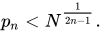
- Oh yes, you cite bounds for the largest and second-largest primes -- I think those should be added to the article as well. The combined bounds like your bound on the product abc are also interesting to me but should probably be left out of a general-interest article like this. A more focused OPN article written for specialists would certainly cover these in some consistent way but that's not the way we're organized at the moment. - CRGreathouse (t | c) 17:55, 6 December 2021 (UTC)
- The best bounds for the largest and second largest (both upper and lower) are actually already in the article. I agree that the product abc bound should not be included in this article. (For the same reason there was a product bc bound which we also haven't included in this article.). JoshuaZ (talk) 18:59, 6 December 2021 (UTC)
- Oh yes, you cite bounds for the largest and second-largest primes -- I think those should be added to the article as well. The combined bounds like your bound on the product abc are also interesting to me but should probably be left out of a general-interest article like this. A more focused OPN article written for specialists would certainly cover these in some consistent way but that's not the way we're organized at the moment. - CRGreathouse (t | c) 17:55, 6 December 2021 (UTC)
 Done Perfect, makes my life easier! - CRGreathouse (t | c) 19:08, 6 December 2021 (UTC)
New paper by Clayton and Hansen
There is a new paper by Graeme Clayon and Cody Hansen in Integers which improves upon the prior linear bounds relating the total number of distinct prime factors to the total number of prime factors of an odd perfect number. If no one objects, I will replace my bound with their bound since their bound is better for all values of $k$. JoshuaZ (talk) 18:24, 27 November 2023 (UTC)
- Properly published, so ok to use. I see no reason to object. —David Eppstein (talk) 19:01, 27 November 2023 (UTC)
- Ditto, go for it. --JBL (talk) 19:04, 27 November 2023 (UTC)