


Talk:Jacobian conjecture
Add topic| This is the talk page for discussing improvements to the Jacobian conjecture article. This is not a forum for general discussion of the subject of the article. |
Article policies
|
| Find sources: Google (books · news · scholar · free images · WP refs) · FENS · JSTOR · TWL |
Archives: 1Auto-archiving period: 3 months  |
 | This article is rated B-class on Wikipedia's content assessment scale. It is of interest to the following WikiProjects: | ||||||||||
| |||||||||||

Apparently disproved
[edit]Apparently a counterexample has been found and the conjecture is false. So when a RS is found the article should be updated accordingly. Kfein (talk) 03:46, 20 July 2026 (UTC)
- I presume you are referring to the twitter post that stated Claude found a counterexample, 2 hours ago. It seems possible that the AI is mistaken yet none of us have the background to discriminate (I came here to see if the article had been updated lol), and if thats the case we should wait for the dust to settle and a notable cryptographer or mathematician to freak out and confirm/deny it. ~2026-40618-57 (talk) 04:26, 20 July 2026 (UTC)
- hadamard gives the sufficient implication “proper local diffeomorphism implies global diffeomorphism”. failure of properness merely makes Hadamard inapplicable. properness is not a hypothesis of the Jacobian conjecture. since the displayed polynomial map has constant Jacobian determinant -2 and maps three distinct points to the same point, it directly contradicts the conjecture. its nonproperness is required for such a counterexample. DaRealPoopster2 (talk) 04:45, 20 July 2026 (UTC)
- Given the cranks usually on this problem, happy to wait for authority, but for what it’s worth the counterexample is obviously good, and an undergrad in math can validate it. Unlike most cranks, he is not claiming this is true, this is a concrete counterexample. (Also now retweeted with validation by a couple mathematicians in and around the space, Jared Duker Lichtman and Daniel Litt.) ~2026-40762-23 (talk) 05:07, 20 July 2026 (UTC)
- At the very least, this has blown up enough that it's important news *about* the conjecture, so until the situation develops further, someone who thinks that the finding is untrue should only want to remove the language that asserts the finding is true, rather than removing everything related to the news event entirely. It seems to me like the finding is real, though, based on what I've seen math people say about it so far. ~2026-40166-75 (talk) 05:19, 20 July 2026 (UTC)
- Read this WP:RS. The article should not be updated yet. Kfein (talk) 05:22, 20 July 2026 (UTC)
- I'm aware about the reliable source criteria, but for a statement of "person X said Y", a link to one of their online presences is absolutely a reliable source, sans trolling, but this isn't a case of trolling. There are sections of the RS criteria about this. ~2026-40166-75 (talk) 05:28, 20 July 2026 (UTC)
- Yes I agree that the counterexample seems easily verifiable unless I am misunderstanding some subtlety in what the conjecture is stating. If the finding were untrue then I would actually disagree that it would be worth having that statement in the article. But this is a (likely) counterfactual world not worth debating.
- I bet there will be some better sources to cite in less than 24 hours. The Wikipedia page will survive until then. There is no particular rush, the conjecture survived for >80 years with the result unknown, it can go another day. Rderdwien (talk) 05:33, 20 July 2026 (UTC)
- Yes, this is my view on this. It is a very bad precedent to set also, taking tweets and putting them into wikipedia articles quickly without independent RS. There are going to be a lot more examples like this going forward... Kfein (talk) 05:46, 20 July 2026 (UTC)
- Wikipedia doesn't operate by precedent (cf. WP:OTHERCONTENT) but under policies and guidelines which are not going to change just because WP:RSSELF has been applied here. So worries that from now on everyone will be able to cite any tweet for anything would seem a bit exaggerated. Regards, HaeB (talk) 05:57, 20 July 2026 (UTC)
- Of course it works on precedent. The policies and guidelines are just codified precedents. And as we make good judgments on these new types of mathematical discoveries, those likely too will be codified as policies and guidelines. Kfein (talk) 06:22, 20 July 2026 (UTC)
- Of course it does not work on precedent, and of course policies and guidelines are not "just codified precedents". Jibal (talk) 02:01, 22 July 2026 (UTC)
- Of course it works on precedent. The policies and guidelines are just codified precedents. And as we make good judgments on these new types of mathematical discoveries, those likely too will be codified as policies and guidelines. Kfein (talk) 06:22, 20 July 2026 (UTC)
- Wikipedia doesn't operate by precedent (cf. WP:OTHERCONTENT) but under policies and guidelines which are not going to change just because WP:RSSELF has been applied here. So worries that from now on everyone will be able to cite any tweet for anything would seem a bit exaggerated. Regards, HaeB (talk) 05:57, 20 July 2026 (UTC)
- Yes, this is my view on this. It is a very bad precedent to set also, taking tweets and putting them into wikipedia articles quickly without independent RS. There are going to be a lot more examples like this going forward... Kfein (talk) 05:46, 20 July 2026 (UTC)
- I’m mostly just replying to the comment “it’s possible that the AI is mistaken” - it’s really not. (No strong opinion on what this page should say at this moment. This is a false conjecture but Wikipedia is not a news site, and doesn’t have to be right immediately.) ~2026-40762-23 (talk) 05:29, 20 July 2026 (UTC)
- A reliable source is a source that is reliable. In this case, yes, it has been confirmed by several professors of mathematics and the author has a background in mathematics. See WP:SPS—sources like tweets are usually not considered reliable, but they can be if they are published by an expert in the field. – Closed Limelike Curves (talk) 04:07, 21 July 2026 (UTC)
- I'm aware about the reliable source criteria, but for a statement of "person X said Y", a link to one of their online presences is absolutely a reliable source, sans trolling, but this isn't a case of trolling. There are sections of the RS criteria about this. ~2026-40166-75 (talk) 05:28, 20 July 2026 (UTC)
- Read this WP:RS. The article should not be updated yet. Kfein (talk) 05:22, 20 July 2026 (UTC)
- Yes, I think the calculations themselves are WP:BASICMATH, and also verifiable via the Wolfram Alpha links the author provided in the full thread (alternative link for those without a Twitter account: ).
- And given the author's academic background and previous peer-reviewed publications in this field (see e.g. his home page, linked from his Twitter bio: https://people.math.harvard.edu/~alpoge ), this from WP:RSSELF applies:
Self-published expert sources may be considered reliable when produced by an established expert on the subject matter, whose work in the relevant field has previously been published by reliable, independent publications.
- So I don't think this is a problematic addition, but I'll flag this discussion at Wikipedia talk:WikiProject Mathematics for further input by other experienced editors.
- Regards, HaeB (talk) 05:31, 20 July 2026 (UTC)
- I think that passage from WP:RSSELF is not the policy that applies here, but WP:SELFSOURCE. WP:RS is often misunderstood. The tweet is a RS for the fact of its own existence - i.e. that that the counterexample was claimed on Twitter - nothing more. It is not a RS for whether the counterexample is true, whether the person who claims to be named by that account is actually the one tweeting it, whether the counterexample was actually found by Claude Fable, etc. Caleb Stanford (talk) 23:06, 20 July 2026 (UTC)
- Sorry, WP:ABOUTSELF is the better link here, not WP:SELFSOURCE (though they basically link to the same content). Caleb Stanford (talk) 23:11, 20 July 2026 (UTC)
- I think WP:RSSELF establishes that the tweet is an RS for whether the counterexample was found by Claude Fable (the author is narrating something they experienced, and we have no reason to doubt them); WP:SPS (which elaborates on WP:SELFSOURCE) explains why this is a reliable source for a mathematical claim (self-published by an expert in the field). – Closed Limelike Curves (talk) 04:45, 21 July 2026 (UTC)
- I don't think that's a correct understanding of either WP:RS or WP:ABOUTSELF unless I am missing something about the author. Note that they are or appear to be an employee at Anthropic. Caleb Stanford (talk) 05:08, 21 July 2026 (UTC)
- As discussed above, the author is also an academic mathematician with a sizable number of peer-reviewed publication in relevant fields, and until last year (when I assume Anthropic hired him away, as they and OpenAI have done with various other accomplished academics) a position at the Harvard maths department and a fellow of the Harvard Society of Fellows. See his CV. Regards, HaeB (talk) 05:50, 21 July 2026 (UTC)
- I don't agree, but why even bother with that when you can just use WP:ABOUTSELF for the claim itself. The point about WP:RS is that context matters. You can use the Twitter as a source for the fact that the claim was made due to WP:ABOUTSELF, but when it comes to whether the person who claims to be named by that account is actually the one tweeting it, whether the counterexample was actually found by Claude Fable, etc. most editors are going to agree a Twitter post (even from someone who is obviously highly educated) is not reliable. Caleb Stanford (talk) 16:05, 21 July 2026 (UTC)
- The mere fact that a claim was made is of no interest and is not encyclopedic material (it might be of interest in an article about Alpöge, but not here). What is encyclopedic is that a counterexample was given, not just claimed. Under WP:CALC we could have just added the counterexample to this article without any mention of Alpöge's tweet, but that would have been rather silly and people would have quickly added a reference to the announcement. Jibal (talk) 02:18, 22 July 2026 (UTC)
- I don't agree, but why even bother with that when you can just use WP:ABOUTSELF for the claim itself. The point about WP:RS is that context matters. You can use the Twitter as a source for the fact that the claim was made due to WP:ABOUTSELF, but when it comes to whether the person who claims to be named by that account is actually the one tweeting it, whether the counterexample was actually found by Claude Fable, etc. most editors are going to agree a Twitter post (even from someone who is obviously highly educated) is not reliable. Caleb Stanford (talk) 16:05, 21 July 2026 (UTC)
- As discussed above, the author is also an academic mathematician with a sizable number of peer-reviewed publication in relevant fields, and until last year (when I assume Anthropic hired him away, as they and OpenAI have done with various other accomplished academics) a position at the Harvard maths department and a fellow of the Harvard Society of Fellows. See his CV. Regards, HaeB (talk) 05:50, 21 July 2026 (UTC)
- I don't think that's a correct understanding of either WP:RS or WP:ABOUTSELF unless I am missing something about the author. Note that they are or appear to be an employee at Anthropic. Caleb Stanford (talk) 05:08, 21 July 2026 (UTC)
- I think that passage from WP:RSSELF is not the policy that applies here, but WP:SELFSOURCE. WP:RS is often misunderstood. The tweet is a RS for the fact of its own existence - i.e. that that the counterexample was claimed on Twitter - nothing more. It is not a RS for whether the counterexample is true, whether the person who claims to be named by that account is actually the one tweeting it, whether the counterexample was actually found by Claude Fable, etc. Caleb Stanford (talk) 23:06, 20 July 2026 (UTC)
- At the very least, this has blown up enough that it's important news *about* the conjecture, so until the situation develops further, someone who thinks that the finding is untrue should only want to remove the language that asserts the finding is true, rather than removing everything related to the news event entirely. It seems to me like the finding is real, though, based on what I've seen math people say about it so far. ~2026-40166-75 (talk) 05:19, 20 July 2026 (UTC)
- Context: I assume that DaRealPoopster2's observations above (
properness is not a hypothesis of the Jacobian conjecture
etc.) refer to this edit summary. Regards, HaeB (talk) 05:48, 20 July 2026 (UTC)- Yes, I am confused by this edit summary as well. Why would a counterexample to the Jacobian conjecture be proper? It seems to me that properness automatically rules out any counterexample by standard commutative algebra. Sławomir Biały (talk) 07:50, 20 July 2026 (UTC)
- Given the cranks usually on this problem, happy to wait for authority, but for what it’s worth the counterexample is obviously good, and an undergrad in math can validate it. Unlike most cranks, he is not claiming this is true, this is a concrete counterexample. (Also now retweeted with validation by a couple mathematicians in and around the space, Jared Duker Lichtman and Daniel Litt.) ~2026-40762-23 (talk) 05:07, 20 July 2026 (UTC)
- It's a counterexample, it's quite simple to verify. Aizkmusic (talk) 05:22, 20 July 2026 (UTC)
- Yes. "Claimed" here means that there ought to be further proof, but this counterexample is trivial to verify. I do not understand what we are waiting for. QuixoticNapoleon (talk) 06:46, 20 July 2026 (UTC)
- I acted boldly. :-) Given WP:BASICMATH there is no need for "reliable sources". Jibal (talk) 10:54, 20 July 2026 (UTC)
- Yes. "Claimed" here means that there ought to be further proof, but this counterexample is trivial to verify. I do not understand what we are waiting for. QuixoticNapoleon (talk) 06:46, 20 July 2026 (UTC)
- It's not mistaken, you can verify the proof in a CAS program in seconds. ACasualEditor97 (talk) 15:13, 20 July 2026 (UTC)
- hadamard gives the sufficient implication “proper local diffeomorphism implies global diffeomorphism”. failure of properness merely makes Hadamard inapplicable. properness is not a hypothesis of the Jacobian conjecture. since the displayed polynomial map has constant Jacobian determinant -2 and maps three distinct points to the same point, it directly contradicts the conjecture. its nonproperness is required for such a counterexample. DaRealPoopster2 (talk) 04:45, 20 July 2026 (UTC)
- There are two different points here. First is whether someone has claimed to have found a counterexample, and second is whether it was actually disproven. Good day—RetroCosmos talk 05:29, 20 July 2026 (UTC)
- FWIW the counterexample and disproof have already been formalized in Lean, so we can be highly confident that it was in fact disproven: https://github.com/google-deepmind/formal-conjectures/pull/4474 Jon Daker (talk) 07:48, 20 July 2026 (UTC)
- This GitHub pull request (which you also cited in Special:Diff/1365119949) is still open and actually relies on its own formalization of the conjecture (which would still need to be vetted). So it doesn't really offer much over the WolframAlpha calculation links already provided in Alpöge's original thread. What's more, the
Self-published expert sources
part of WP:RSSELF doesn't quite apply here in the same way it applied to Alpöge's thread. Regards, HaeB (talk) 17:24, 20 July 2026 (UTC)- Fair enough. Although when the PR is actually merged would it be considered a more reliable source since formal-conjectures has quality standards compared to making a random GitHub repository? Jon Daker (talk) 18:57, 20 July 2026 (UTC)
- This GitHub pull request (which you also cited in Special:Diff/1365119949) is still open and actually relies on its own formalization of the conjecture (which would still need to be vetted). So it doesn't really offer much over the WolframAlpha calculation links already provided in Alpöge's original thread. What's more, the
- A schoolchild can confirm it. WP:BASICMATH Jibal (talk) 10:58, 20 July 2026 (UTC)
- Claiming to have found a counterexample is not the same as providing an alleged counterexmple. Here we are in the second case, and the fact that the allegation is correct falls under WP:BASICMATH D.Lazard (talk) 11:43, 20 July 2026 (UTC)
- FWIW the counterexample and disproof have already been formalized in Lean, so we can be highly confident that it was in fact disproven: https://github.com/google-deepmind/formal-conjectures/pull/4474 Jon Daker (talk) 07:48, 20 July 2026 (UTC)
- There is now a reliable source: https://www.newscientist.com/article/2580374-ais-solution-to-87-year-old-riddle-takes-mathematicians-by-surprise/ WatkynBassett (talk) 17:45, 20 July 2026 (UTC)
- might be worth adding a note to the Yitang Zhang since he apparently spent 7 years tying to prove the conjecture.©Geni (talk) 19:35, 20 July 2026 (UTC)
- Because the theorem has been subject to many crank proofs it is the best policy to wait for a more reliable academic source. Piotr iskander (talk) 22:03, 20 July 2026 (UTC)
- Not needed: verification is obvious and the source says that it has been done by several independent mathematicians. An academic source would not say anything more. D.Lazard (talk) 22:17, 20 July 2026 (UTC)
- It is not a question of verification its a question of practicality. The bibliography will inevitably be rewritten with better sources. Patience is a virtue. Piotr iskander (talk) 22:21, 20 July 2026 (UTC)
- here is also with det 1. https://x.com/N8Programs/status/2079061392649302185?s=20 ~2026-40052-32 (talk) 23:57, 20 July 2026 (UTC)
- Practicality is subjective, inherently value-laden. Verification is sufficient. ~2026-40674-47 (talk) 23:59, 20 July 2026 (UTC)
- Holding off on including these sources presents a more neutral viewpoint. If the counterexample is WP:BASICMATH, feel free to include it if you wish. However any additional sources and thus the resulting bibliography are not. Piotr iskander (talk) 00:10, 21 July 2026 (UTC)
- It's actually really bad that this was reverted. ~2026-40695-70 (talk) 01:11, 21 July 2026 (UTC)
- Another editor was type-fixing and reverted the changes, is there any suggestions for what should be included as part of the counterexample? Piotr iskander (talk) 01:20, 21 July 2026 (UTC)
- It's actually really bad that this was reverted. ~2026-40695-70 (talk) 01:11, 21 July 2026 (UTC)
- Holding off on including these sources presents a more neutral viewpoint. If the counterexample is WP:BASICMATH, feel free to include it if you wish. However any additional sources and thus the resulting bibliography are not. Piotr iskander (talk) 00:10, 21 July 2026 (UTC)
- You moved the goalposts. Your original comment was "Because the theorem has been subject to many crank proofs ..." but that's completely irrelevant because this is an easily confirmed counterexample, not an attempted proof that might be arbitrarily difficult to confirm (or find errors in) ... these are radically different things.
- As for patience, that ship sailed when Mark polyakov added text about the counterexample. Then Firestar464 added the text "claimed that he had", seriously degrading the article -- who cares what some rando on X claims? It should have either been left as it was or the added info about the counterexample should have been reverted -- after reaching a consensus to do so here -- until the counterexample was published in a reliable source. After that wrongheaded addition by Firestar464, a comedy of errors ensued, including some anonymous account bizarrely and repeatedly removing mention of the (claim of a) counterexample on the basis that it's not a "solution", and someone else removing the words "proving it false", calling them "weasel words" when the truth is the arch opposite. After reading the comments here and seeing that the counterexample was still in the article (and the edit history and comments here generally favored that), I removed the "claimed that he had" weasel words, since the counterexample is well established (and readily confirmed) to be valid. Jibal (talk) 08:06, 21 July 2026 (UTC)
- As per other replies the counterexample is WP:BASICMATH and no source is required for the counterexample itself. I agree that a social media post is not a reliable source and because of the paucity of such in these early stages I view it as more appropriate to simply leave the counterexample as-is and revert the additional sources. Piotr iskander (talk) 12:47, 21 July 2026 (UTC)
- Please read WP:EDITWAR -- you have removed this content 3 times, clearly overriding the general consensus. DiodotusNicator (talk) 17:37, 21 July 2026 (UTC)
- Thank you for bringing up this concern, I have submitted this article for semi-protection as it is receiving many IP edits because of the recency of the information about the counterexample. Piotr iskander (talk) 15:00, 22 July 2026 (UTC)
- @Piotr iskander This reply has nothing to do with my own. You are still trying to re-impose your specific view on the article. Please read WP:CONSENSUS and WP:BRD to better understand how Wikipedia works. DiodotusNicator (talk) 17:47, 22 July 2026 (UTC)
- Please refer to my response in the appropriate thread: Talk:Jacobian conjecture#c-Piotr iskander-20260722153700-Sławomir Biały-20260722153300 Piotr iskander (talk) 19:38, 22 July 2026 (UTC)
- @Piotr iskander You are continuing to make disruptive edits while ignoring multiple editors' attempts to explain what you're doing wrong. If you're not deliberately trolling at this point, please consider reading the policies I've already linked you, or maybe the highly applicable WP:IDIDNTHEARTHAT. DiodotusNicator (talk) 20:27, 22 July 2026 (UTC)
- If we cannot conclude from the twitter post that Claude or Alpöge had originated the counter-example, it would be inappropriate to include it as a source. Because the counter-example is WP:BASICMATH, it does not need to have a source. Therefore the most consistent is to simply include the counter-example as-is or leave the counter-example off until we have better sources for where the counter-example came from.
- Please refer to the longer discussion here about consensus: Talk:Jacobian conjecture#c-Piotr iskander-20260722202100-Sławomir Biały-20260722201500 Piotr iskander (talk) 20:30, 22 July 2026 (UTC)
- Sorry, but you don't seem to understand what WP:CONSENSUS means. Please read the policy.
- And we already have better sources for "where the counter-example came from" (not that we really needed any due to WP:ABOUTSELF). DiodotusNicator (talk) 20:33, 22 July 2026 (UTC)
- We do not have the chat nor any more detailed thought traces of how Claude derived the result. Thus there is a reasonable doubt to it's authenticity as mentioned in Talk:Who really found the counterexample?. As mentioned in Talk:Openness of Problem the article had been previously changed from the topic of the conjecture to the topic of the disproved conjecture. Piotr iskander (talk) 20:38, 22 July 2026 (UTC)
We do not have the chat nor any more detailed thought traces of how Claude derived the result.
- Completely irrelevant.
Thus there is a reasonable doubt to it's authenticity as mentioned in Talk:Who really found the counterexample?.
- No, in fact we have multiple WP:RS reporting on who found the counterexample and how, and AFAIK we have none casting doubt on its origin. DiodotusNicator (talk) 20:42, 22 July 2026 (UTC)
- Those sources are circular citations to the X post that attribute it to either Claude or Alpöge. The additional sources do not demonstrate who is the true author. Additionally, if it is truely both WP:BASICMATH and existing polices on AI generated content like Wikipedia:Presumptive removal of AI-generated content it needs no attribution and a greater burden exists to whether it does properly belong on the page. Piotr iskander (talk) 20:53, 22 July 2026 (UTC)
- I think no further engagement with Piotr is advisable. Someone needs to go to WP:ANI and have him banned, once one scrapes all of the ample behavior evidence from this page. Sławomir Biały (talk) 20:59, 22 July 2026 (UTC)
- Those sources are circular citations to the X post that attribute it to either Claude or Alpöge. The additional sources do not demonstrate who is the true author. Additionally, if it is truely both WP:BASICMATH and existing polices on AI generated content like Wikipedia:Presumptive removal of AI-generated content it needs no attribution and a greater burden exists to whether it does properly belong on the page. Piotr iskander (talk) 20:53, 22 July 2026 (UTC)
- We do not have the chat nor any more detailed thought traces of how Claude derived the result. Thus there is a reasonable doubt to it's authenticity as mentioned in Talk:Who really found the counterexample?. As mentioned in Talk:Openness of Problem the article had been previously changed from the topic of the conjecture to the topic of the disproved conjecture. Piotr iskander (talk) 20:38, 22 July 2026 (UTC)
- @Piotr iskander You are continuing to make disruptive edits while ignoring multiple editors' attempts to explain what you're doing wrong. If you're not deliberately trolling at this point, please consider reading the policies I've already linked you, or maybe the highly applicable WP:IDIDNTHEARTHAT. DiodotusNicator (talk) 20:27, 22 July 2026 (UTC)
- Please refer to my response in the appropriate thread: Talk:Jacobian conjecture#c-Piotr iskander-20260722153700-Sławomir Biały-20260722153300 Piotr iskander (talk) 19:38, 22 July 2026 (UTC)
- @Piotr iskander This reply has nothing to do with my own. You are still trying to re-impose your specific view on the article. Please read WP:CONSENSUS and WP:BRD to better understand how Wikipedia works. DiodotusNicator (talk) 17:47, 22 July 2026 (UTC)
- Thank you for bringing up this concern, I have submitted this article for semi-protection as it is receiving many IP edits because of the recency of the information about the counterexample. Piotr iskander (talk) 15:00, 22 July 2026 (UTC)
- Figured I would just add that I do not support the removal of secondary sources. No doubt better sources will be coming, and when they do we can reassess, but until then we should work with the independent secondary sources we have, not the independent secondary sources we wish we had. Sławomir Biały (talk) 18:40, 21 July 2026 (UTC)
- I agree Andre🚐 02:25, 27 July 2026 (UTC)
- Um, that's a complete non sequitur to my comment.
I agree that a social media post is not a reliable source
-- agree with whom? That's not what I said. My point was that just saying that someone on X claimed something is of no relevance. What is relevant is that he gave a counterexample. If the purported counterexample had not been readily verifiable and was merely a claim then it should never have been mentioned. But it wasn't merely a claim ... and now I see your edits, which are disruptive and poorly reasoned. That the counterexample was announced in a tweet is historic fact and will be recorded as such -- removing mention of it with the justification that WP:BASICMATH doesn't need citations is absurd, a fallacy of denial of the antecedent. Jibal (talk) 02:04, 22 July 2026 (UTC)- You cannot criticize the language used to describe the source as "what some rando on X claims?" because that is an accurate description of a social media post. Unless you want the editors to misappropriate or mischaracterize the source, it is inappropriate to include it. Piotr iskander (talk) 14:59, 22 July 2026 (UTC)
- I don't think it's fair to characterise a mathematician working for Anthropic as "some rando" though. – numbermaniac 09:30, 23 July 2026 (UTC)
- You cannot criticize the language used to describe the source as "what some rando on X claims?" because that is an accurate description of a social media post. Unless you want the editors to misappropriate or mischaracterize the source, it is inappropriate to include it. Piotr iskander (talk) 14:59, 22 July 2026 (UTC)
- Please read WP:EDITWAR -- you have removed this content 3 times, clearly overriding the general consensus. DiodotusNicator (talk) 17:37, 21 July 2026 (UTC)
- As per other replies the counterexample is WP:BASICMATH and no source is required for the counterexample itself. I agree that a social media post is not a reliable source and because of the paucity of such in these early stages I view it as more appropriate to simply leave the counterexample as-is and revert the additional sources. Piotr iskander (talk) 12:47, 21 July 2026 (UTC)
- It is not a question of verification its a question of practicality. The bibliography will inevitably be rewritten with better sources. Patience is a virtue. Piotr iskander (talk) 22:21, 20 July 2026 (UTC)
- Not needed: verification is obvious and the source says that it has been done by several independent mathematicians. An academic source would not say anything more. D.Lazard (talk) 22:17, 20 July 2026 (UTC)
zACCEPT THE SOURCE!!
[edit]I'm not gonna wait for Wikipedia just because it claims not to be able to know how to do grade school level math. The counterexample is easily verifiable. ~2026-40965-29 (talk) 18:44, 21 July 2026 (UTC)
- But the hard case n=2 is still open. It's worth emphasising it. ~2026-41093-22 (talk) 13:44, 22 July 2026 (UTC)
- This is a crucial point, the counterexample is not a general disproof of the conjecture and thus the characterization of the conjecture being in past tense or being completely resolved is premature. Piotr iskander (talk) 15:07, 22 July 2026 (UTC)
- The NewScientist article simply repeats the same claim as the Tweet, it does not claim anything more nor add additional credibility to the information. Grade school math doesn't need a source and thus in the vein of preserving neutrality the source is detrimental to the article. Piotr iskander (talk) 14:57, 22 July 2026 (UTC)
- The New Scientist source is cited for an attributed statement to Abhishek Saha. Do you think they fabricated that? If not, then I suggest you remove the WP:POINTy tag. Sławomir Biały (talk) 16:48, 22 July 2026 (UTC)
- The claim that the counterexample is easily verifiable is also able to be made using Wikipedia:BASICMATH, and thus doesn't need Saha's statement affirming so. Piotr iskander (talk) 17:23, 22 July 2026 (UTC)
- Do you personally claim that WP:BASICMATH is all we need here? And this does not address the reliability concern, which is, do you think that the New Scientist fabricated the statements attributed to Abhishek Saha? Do you think that the X post was a fabrication that is not a reliable source for its contents? Do you think that the New Scientist and Fortune colluded in fabricating the existence of the X post? Sławomir Biały (talk) 17:28, 22 July 2026 (UTC)
- I do not personally claim, as I am simply reflecting the consensus so far as why the counterexample has a lower barrier to inclusion on this article. It is not necessary to include that mathematicians have verified the counterexample as again we are working on that lower standard. Piotr iskander (talk) 19:37, 22 July 2026 (UTC)
- So you are proving this point (which you apparently don't agree with) by adding tags to citations? Sławomir Biały (talk) 19:39, 22 July 2026 (UTC)
- I am preserving the neutrality of the article by removing unnecessary sources. Social commentary or the off-hand opinions of mathematicians are not relevant to a conjecture. Piotr iskander (talk) 19:42, 22 July 2026 (UTC)
- So you are proving this point (which you apparently don't agree with) by adding tags to citations? Sławomir Biały (talk) 19:39, 22 July 2026 (UTC)
- I do not personally claim, as I am simply reflecting the consensus so far as why the counterexample has a lower barrier to inclusion on this article. It is not necessary to include that mathematicians have verified the counterexample as again we are working on that lower standard. Piotr iskander (talk) 19:37, 22 July 2026 (UTC)
- The fact that the counterexample is indeed a counterexample is clearly WP:BASICMATH. To provide sources saying that this has effectively been verified by several mathematicians may be useful for people who are not willing or able to compute with polynomials of rather high degree. For being reliable, these sources do not need to be academic publications. On the other hand, the X post is the only available source for crediting the author of the counterexample. All secondary sources can only be of the form "there is a X post that says...". So, secodary sources are useless here.
- So your tags {{better sources needed}} are confusing and must be removed. D.Lazard (talk) 18:00, 22 July 2026 (UTC)
- Please refer to this c-Jibal-20260721080600- and my response for why it is inappropriate to include a social media post: Talk:Jacobian conjecture#c-Piotr iskander-20260722145900-Jibal-20260722020400 Piotr iskander (talk) 19:37, 22 July 2026 (UTC)
- It looks like you are the sole person disagreeing with a plurality of editors there (but not making much sense). Sławomir Biały (talk) 19:45, 22 July 2026 (UTC)
- Refer to Caleb's point here Tc-Caleb Stanford-20260721160500
- There are two solutions, either include the counterexample and only the counterexample with the lower standard of WP:BASICMATH, or admit of a higher standard which requires reliable sources and exclude the counterexample of itself as there is a paucity of such. Jibal himself admits here that including information about the source like that it was posed on X is inappropriate but still claims we should include the source "because it seems silly". However to not include that information would be to obscure the source and misrepresent it. I believe if you read the talk page so far this is the consensus. Piotr iskander (talk) 19:53, 22 July 2026 (UTC)
- This does not seem like a fair summary of that discussion. I don't see any discussion whatsoever of "two solutions" for example. You seem to have invented this out of whole cloth. Sławomir Biały (talk) 20:02, 22 July 2026 (UTC)
- It is a summary, please cite the relevant replies especially from Jibal and Caleb if you want to disagree with my characterization. Piotr iskander (talk) 20:04, 22 July 2026 (UTC)
- No one appears to have proposed that binary. You just made it up. Jibal argues that the counterexample itself is elementary enough for WP:BASICMATH. Caleb takes the view of the X post's reliability, saying it supports the fact that a claim was made but not necessarily all claims about authorship, provenance, or truth. These appear to have nothing to do with this dichotomy, which you just constructed out of whole cloth. Neither of them apparently support removing all references to the original counterexample (as you have just done). Sławomir Biały (talk) 20:15, 22 July 2026 (UTC)
- What do you propose then? If we cannot conclude from the twitter post that Claude or Alpöge had originated the counter-example, it would be inappropriate to include it as a source. Because the counter-example is WP:BASICMATH, it does not need to have a source. Therefore the most consistent is to simply include the counter-example as-is or leave the counter-example off until we have better sources for where the counter-example came from. Piotr iskander (talk) 20:21, 22 July 2026 (UTC)
- I propose to leave the article as it is, citing the X post and several reliable secondary sources that confirm its content, existence, and attribution. That seems pretty straightforward. Sławomir Biały (talk) 20:28, 22 July 2026 (UTC)
- We do not know who made the counterexample, attribution at this point is premature. Unless that is resolved I feel it is possible to proceed with your suggestion without introducing unreliable sources. Piotr iskander (talk) 20:45, 22 July 2026 (UTC)
- I propose to leave the article as it is, citing the X post and several reliable secondary sources that confirm its content, existence, and attribution. That seems pretty straightforward. Sławomir Biały (talk) 20:28, 22 July 2026 (UTC)
- What do you propose then? If we cannot conclude from the twitter post that Claude or Alpöge had originated the counter-example, it would be inappropriate to include it as a source. Because the counter-example is WP:BASICMATH, it does not need to have a source. Therefore the most consistent is to simply include the counter-example as-is or leave the counter-example off until we have better sources for where the counter-example came from. Piotr iskander (talk) 20:21, 22 July 2026 (UTC)
- Again, providing the example is not WP:BASICMATH. The example is copied verbatim from the X-post. Not citing the X-post would be a unfair use and possibly a copyright violation. So, we must cite the X-post, even if we do not like X.
- I agree with Sławomir to stop the discussion (His post arrived when I was writing my post) D.Lazard (talk) 20:38, 22 July 2026 (UTC)
- If truly generated by an AI, it does not fall under unfair use. The fundamental contention is that at this point we do not know and claiming definitively in either direction is not supported by the X post. Piotr iskander (talk) 20:41, 22 July 2026 (UTC)
- I think it is time to take Piotr to ANI. The behavior here is textbook tendentious editing. Sławomir Biały (talk) 20:47, 22 July 2026 (UTC)
- Yeah, this seems like deliberate disruption. DiodotusNicator (talk) 21:06, 22 July 2026 (UTC)
- I think it is time to take Piotr to ANI. The behavior here is textbook tendentious editing. Sławomir Biały (talk) 20:47, 22 July 2026 (UTC)
- If truly generated by an AI, it does not fall under unfair use. The fundamental contention is that at this point we do not know and claiming definitively in either direction is not supported by the X post. Piotr iskander (talk) 20:41, 22 July 2026 (UTC)
- No one appears to have proposed that binary. You just made it up. Jibal argues that the counterexample itself is elementary enough for WP:BASICMATH. Caleb takes the view of the X post's reliability, saying it supports the fact that a claim was made but not necessarily all claims about authorship, provenance, or truth. These appear to have nothing to do with this dichotomy, which you just constructed out of whole cloth. Neither of them apparently support removing all references to the original counterexample (as you have just done). Sławomir Biały (talk) 20:15, 22 July 2026 (UTC)
- It is a summary, please cite the relevant replies especially from Jibal and Caleb if you want to disagree with my characterization. Piotr iskander (talk) 20:04, 22 July 2026 (UTC)
- This does not seem like a fair summary of that discussion. I don't see any discussion whatsoever of "two solutions" for example. You seem to have invented this out of whole cloth. Sławomir Biały (talk) 20:02, 22 July 2026 (UTC)
- It looks like you are the sole person disagreeing with a plurality of editors there (but not making much sense). Sławomir Biały (talk) 19:45, 22 July 2026 (UTC)
- Please refer to this c-Jibal-20260721080600- and my response for why it is inappropriate to include a social media post: Talk:Jacobian conjecture#c-Piotr iskander-20260722145900-Jibal-20260722020400 Piotr iskander (talk) 19:37, 22 July 2026 (UTC)
- Do you personally claim that WP:BASICMATH is all we need here? And this does not address the reliability concern, which is, do you think that the New Scientist fabricated the statements attributed to Abhishek Saha? Do you think that the X post was a fabrication that is not a reliable source for its contents? Do you think that the New Scientist and Fortune colluded in fabricating the existence of the X post? Sławomir Biały (talk) 17:28, 22 July 2026 (UTC)
- The claim that the counterexample is easily verifiable is also able to be made using Wikipedia:BASICMATH, and thus doesn't need Saha's statement affirming so. Piotr iskander (talk) 17:23, 22 July 2026 (UTC)
- The New Scientist source is cited for an attributed statement to Abhishek Saha. Do you think they fabricated that? If not, then I suggest you remove the WP:POINTy tag. Sławomir Biały (talk) 16:48, 22 July 2026 (UTC)
Who really found the counterexample?
[edit]Is there any proof that the counterexample was, in fact, found by their AI model, as opposed to a human? How do we know the attribution to their AI model isn't a marketing stunt? ~2026-40972-48 (talk) 15:01, 22 July 2026 (UTC)
- We do not know yet for certain. What is currently known is that mathematician and Anthropic employee Levent Alpöge tweeted a counterexample and claimed that Claude Fable helped. We currently do not have any blog posts or chats with Claude. QuixoticNapoleon (talk) 15:27, 22 July 2026 (UTC)
FrontierMath vis-à-vis Fable 5
[edit]Full disclosure: I curated the latter. That said, I've just added See Also with one referring to the other; TIL I learned that there are benchmarks for AI-cummathematics. Someone can fold in these citation, probably in a subsection with proper context bothbecause the mathematicians have gotten excited AND it is a very substantial AI achievement: https://verdict.click/blog/claude-fable-5-frontiermath-benchmark & https://the-decoder.com/claude-fable-5-outpaces-gpt-5-5-by-13-points-on-frontiermaths-toughest-problems/ ~Regards kencf0618 (talk) 15:19, 22 July 2026 (UTC)
Openness of Problem
[edit]The general conjecture is not disproven, as the N=2 case remains without counterexample. As noted in the introduction, it is not trivial like the N=1 case Piotr iskander (talk) 15:29, 22 July 2026 (UTC)
- The article says that the N = 2 case is still open. Sławomir Biały (talk) 15:31, 22 July 2026 (UTC)
- I made that edit while removing the note, sorry for the confusion. Piotr iskander (talk) 15:38, 22 July 2026 (UTC)
- Also, see WP:BRD before continuing these WP:POINTy and disruptive edits. Sławomir Biały (talk) 15:33, 22 July 2026 (UTC)
- Again these edits preserve the neutrality of the article before the recent sources involving the counterexample. If you feel like there is an issue with my edits within WP:POINTy please point the specific claim I am trying to promote. I do not see how the burden of disruptive falls upon me and not the numerous other editors who have introduced many new edits in the span of only a couple days. Piotr iskander (talk) 15:37, 22 July 2026 (UTC)
- It is important to state early in the article that the Jacobian conjecture, as ordinarily formulated for arbitrary dimension, has been disproved. The fact that the N = 2 case remains open does not make the general conjecture open. I don't see any disruption here, other than first removing the counterexample itself, then after that was reverted by somebody, removing links to the original source, and when those sources were restored, adding tags to it. That source is plainly reliable for its contents. Other secondary sources include commentary from mathematicians who confirmed the counterexample, and are certainly reliable (unless you think that New Scientist or Fortune manufactured quotations). Sławomir Biały (talk) 15:48, 22 July 2026 (UTC)
- A general proof includes all cases, that is what makes a proof general. Please address the source issues in the appropriate thread. Piotr iskander (talk) 15:54, 22 July 2026 (UTC)
- A counterexample need only address one case. Ae707 (talk) 00:52, 23 July 2026 (UTC)
- A general proof includes all cases, that is what makes a proof general. Please address the source issues in the appropriate thread. Piotr iskander (talk) 15:54, 22 July 2026 (UTC)
- I see your pattern of disruptive edits continues: . I would encourage you to self-revert this. Sławomir Biały (talk) 15:52, 22 July 2026 (UTC)
- My edit to the infobox was entirely appropriate as it reflects where the problem is open. I do not see why it had to be reverted and then edited again. Piotr iskander (talk) 15:55, 22 July 2026 (UTC)
- It is important to state early in the article that the Jacobian conjecture, as ordinarily formulated for arbitrary dimension, has been disproved. The fact that the N = 2 case remains open does not make the general conjecture open. I don't see any disruption here, other than first removing the counterexample itself, then after that was reverted by somebody, removing links to the original source, and when those sources were restored, adding tags to it. That source is plainly reliable for its contents. Other secondary sources include commentary from mathematicians who confirmed the counterexample, and are certainly reliable (unless you think that New Scientist or Fortune manufactured quotations). Sławomir Biały (talk) 15:48, 22 July 2026 (UTC)
- Again these edits preserve the neutrality of the article before the recent sources involving the counterexample. If you feel like there is an issue with my edits within WP:POINTy please point the specific claim I am trying to promote. I do not see how the burden of disruptive falls upon me and not the numerous other editors who have introduced many new edits in the span of only a couple days. Piotr iskander (talk) 15:37, 22 July 2026 (UTC)
- I don't think this is reasonable to claim. Nearly every presentation of the conjecture presents it as being over C^n, not C^2. (e.g., https://math.uchicago.edu/~may/REU2018/REUPapers/Garland.pdf, https://mathworld.wolfram.com/JacobianConjecture.html). That some people were mostly concerned with the N=2 case is irrelevant.
- As an example, Euler's sum of powers conjecture is open for k≥6, but that doesn't mean it hasn't been disproven.
- I think we should mention that the N=2 case is open (and that this case is particularly interesting), but the main conjecture should clearly be described as disproved. Ae707 (talk) 21:35, 22 July 2026 (UTC)
- The key issue is that this proof is not productive in the sense of it providing when the conjecture fails except for the specific counter-example (including trivial scaling). It is important that it does and it does merit consideration, especially by an audience of mathematicians who can provide such analysis. However at this moment there exists none except for a surface level sanity check by Tao. This issue is highlighted by the differences between OpenAI's disclosure of their counter-example to the Erdoesh planar unit conjecture provided both thought traces, the prompt and the logical method by which the AI constructed the counter-example. In this case it is not clear what method nor the actual attributable author is of the counter-example is. Piotr iskander (talk) 21:46, 22 July 2026 (UTC)
- All of that is true and fair, and we can add these details to the article. But all that's need to disprove a conjecture is a counterexample, regardless of how it was produced or how much detail is given about it. Ae707 (talk) 21:48, 22 July 2026 (UTC)
- The conjecture is not disproven for n=2. What is needed for a disproof of the general conjecture is a disproof of all the cases, including n=2, as I've mentioned here. Piotr iskander (talk) 00:20, 23 July 2026 (UTC)
- The conjecture was over all n, therefore a counterexample for any n is a counterexample for the entire conjecture.
- Do you think Euler's sum of powers conjecture should be marked as open since it's open for the k≥6 case? Ae707 (talk) 00:47, 23 July 2026 (UTC)
- For what it's worth, Euler's sum of powers conjecture seems to be more along the lines of "this conjecture is likely false for all n ≥ 6, but finding explicit counterexamples is computationally intractable", while the Jacobian conjecture here is more along the lines of "this conjecture is explicitly false for n ≥ 3 by way of this function and its trivial extension to greater dimensions, while n = 2 is still highly unclear." I do ultimately support keeping the article's phrasing as a disproven conjecture with a note about the N = 2 case, but I'm sympathetic to the idea of having this gap being highlighted more prominently. GalacticShoe (talk) 01:09, 23 July 2026 (UTC)
- The Garland Paper notes: The case n = 2 has been documented by a great many authors, but remains unproven. Furthermore, as n increases, a computational approach becomes very difficult, because the Jacobian of a function is fundamentally a determinant, and determinants grow factorially more difficult to compute as n grows large.
- As you can see from the paper, the traditional framing was that the n=2 case would be the simplest to find the counterexample as the dimensionality would not be intractable. It was only with Yagzhev's normalization that the cubic form was considered the general one. As such most of the literature as you note in rev. 1365504173 considers the n=2 case. Piotr iskander (talk) 02:30, 23 July 2026 (UTC)
- But the point is, throughout the literature, people in general do not state the Jacobian conjecture in the form "it holds for all that...". In fact, it's routinely treated as a family of conjectures indexed by dimensions ( or , or Jacobian conjecture in dimension ), see, e.g., Van den Essen, Peretz–Châu–Campbell–Gutierrez, Hamada–Kato–Komiya, Belov–Kanel-Kontsevich, Wright, et al; the universal version is also called full/stable Jacobian conjecture or , see in addition to above Truong, Bäck, Moskowicz. Even those did not write explicitly and only wrote briefly "Let be a polynomial" said "the case is proved; the case is open". Thus, considering the origin of this type of problem (Kraus, 1884) and the complete different nature between D and higher dimension cases, and the numerous study and difficulty for D case, describing this famous historical conjecture as "solved" is highly misleading. Sky19841 (talk) 15:59, 23 July 2026 (UTC)
- The conjecture is not disproven for n=2. What is needed for a disproof of the general conjecture is a disproof of all the cases, including n=2, as I've mentioned here. Piotr iskander (talk) 00:20, 23 July 2026 (UTC)
- All of that is true and fair, and we can add these details to the article. But all that's need to disprove a conjecture is a counterexample, regardless of how it was produced or how much detail is given about it. Ae707 (talk) 21:48, 22 July 2026 (UTC)
- The key issue is that this proof is not productive in the sense of it providing when the conjecture fails except for the specific counter-example (including trivial scaling). It is important that it does and it does merit consideration, especially by an audience of mathematicians who can provide such analysis. However at this moment there exists none except for a surface level sanity check by Tao. This issue is highlighted by the differences between OpenAI's disclosure of their counter-example to the Erdoesh planar unit conjecture provided both thought traces, the prompt and the logical method by which the AI constructed the counter-example. In this case it is not clear what method nor the actual attributable author is of the counter-example is. Piotr iskander (talk) 21:46, 22 July 2026 (UTC)


The two variable case is called the plane Jacobian conjecture in the mathematics literature, see e.g.
- Rodríguez Díaz, Lázaro Orlando (2026-06-05). "On the origin of the Jacobian conjecture". Comptes Rendus. Mathématique. 364 (G2): 363–370. arXiv:2512.23614. doi:10.5802/crmath.831. ISSN 1778-3569.
- Guccione, Jorge Alberto; Guccione, Juan José; Horruitiner, Rodrigo; Valqui, Christian (29 Apr 2022), Increasing the degree of a possible counterexample to the Jacobian Conjecture from 100 to 108, arXiv:2204.14178
so the material on the special case of should ideally be placed in a separate section or article on the plane Jacobian conjecture. ~2026-41445-52 (talk) 13:14, 24 July 2026 (UTC)

- The problem is that Tzuong-Tsieng Moh insists on calling the two-variable Jacobian conjecture by the bare term "Jacobian conjecture" to the point of renaming other people's papers in his articles, see for instance this paper
- Moh, T. T. (22 Dec 2005), Comment on a Paper by Kuo, Parusinski and Paunescu On Jacobian Conjecture, arXiv:math/0512533,
We shall use the following notations: Let us call the paper by Kuo, Parusinski & Paunescu entitled A PROOF OF THE JACOBIAN CONJECTURE
- Moh, T. T. (22 Dec 2005), Comment on a Paper by Kuo, Parusinski and Paunescu On Jacobian Conjecture, arXiv:math/0512533,
- despite the paper by Kuo et al actually being titled "A Proof Of The Plane Jacobian Conjecture". ~2026-41129-71 (talk) 14:40, 24 July 2026 (UTC)
- The name "Jacobian problem" came from Abhyankar and his former PhD student Moh, and was primarily used to describe the 2D Jacobian conjecture (see "Lectures on Expansion Techniques In Algebraic Geometry" by Abhyankar in 1977), then used by Wang in 1980 for the n-dimensional case. In 1982, Bass-Connell-Wright described the "Jacobian conjecture" as n-dimensional; while in the paper "On the Jacobian conjecture and the conflgurations of roots" by Moh in 1983, it still referred to 2D. In 2011, Formanek also described the "Jacobian conjecture" as the 2d case, although he mentioned "there're higher dimensional versions". I think it's not meaningful to distinguish the "Plane Jacobian conjecture" and "Jacobian conjecture". As I described above, in the recent literature, the "Jacobian conjecture" is more often a set of conjectures instead of a single conjecture that asserts "for every n". So the plane Jacobian conjecture is one part of the "Jacobian conjecture(s)". No mathematicians were that silly to think that it's possible to hold for all n: they knew that almost no evidence points to the higher dimensional cases, and most of them didn't believe it holds for . They only care what we can get from the study of this problem. That's it. Sky19841 (talk) 19:00, 24 July 2026 (UTC)
- Perhaps someone should put into the article who exactly came up with the names "Jacobian problem" and "Jacobian conjecture" to refer to this conjecture. ~2026-41314-86 (talk) 19:48, 24 July 2026 (UTC)

Tao's Blog as a source
[edit]It looks like there's a bit of an edit war regarding whether Terence Tao's blog post is an acceptable source here. My sense is that it is: from WP:RSSELF, "Self-published expert sources may be considered reliable when produced by an established expert on the subject matter, whose work in the relevant field has previously been published by reliable, independent publications." I believe Tao clearly satisfies these requirements.
Does anyone disagree? Ae707 (talk) 20:50, 22 July 2026 (UTC)
- Yes, Tao's blog clearly satisfies the requirements. Sławomir Biały (talk) 20:53, 22 July 2026 (UTC)
- @Hypnoticreflection, @Piotr_iskander @DiodotusNicator Ae707 (talk) 20:57, 22 July 2026 (UTC)
- yeah i take back my initial stance, definitely okay following WP:RSSELF. but i would be careful on any overreliance on it, given that the blog does not seem to be fact-checked ("peer reviewed") as evidenced by the corrections from the comment section. Hypnoticreflection (talk) 21:05, 22 July 2026 (UTC)
- I can't but agree, Tao's blog is superior to the articles As I've stated the bibliography will inevitably be rewritten with better sources. Feel free to revert the previous edits including the less reliable sources as mentioned by DiodotusNicator. Piotr iskander (talk) 21:38, 22 July 2026 (UTC)
- Yeah, Tao's blog is much more reliable than random journalists attempting to distill this for a popular audience. DiodotusNicator (talk) 21:12, 22 July 2026 (UTC)
- Let's hear it for the rando journalists! I've added a paragraph. It's another milestone for AI, a subject of enormous public impact and interest. kencf0618 (talk) 00:18, 23 July 2026 (UTC)
- Tao's blog is absolutely a reliable source on mathematics; see WP:RSSELF:
Self-published expert sources may be considered reliable when produced by an established expert on the subject matter
. His blog is probably a more reliable source for fact on this matter than lay news outlets like New Scientist. However I would still point out that secondary sources like news outlets would do a better job of establishing due weight/noteworthiness (see e.g. WP:PSTS), because most of the things Tao writes about on his blog would be too niche for inclusion on Wikipedia. Endwise (talk) 02:01, 23 July 2026 (UTC)- I feel like the claim of Shreeram Abhyankar's popularization of the problem is sufficient for establishing the notability of the conjecture. At this moment all it seems is them writing down what the mathematician they have on call says and then giving a background to the problem that is already well established by other sources. If you feel like there is something else we can use the lay news to support as a reliable source please include it. Piotr iskander (talk) 02:43, 23 July 2026 (UTC)
- I feel like information that the news sources include that is directly relevant to the conjecture is about how unclear it is to observers what I noted in c-Piotr iskander-20260722214600-Ae707-20260722213500. I feel like otherwise there is not much more to add from those sources at this point, and certainly not something about the general impact of the counterexample as it is premature. Piotr iskander (talk) 04:12, 23 July 2026 (UTC)
- I feel like the claim of Shreeram Abhyankar's popularization of the problem is sufficient for establishing the notability of the conjecture. At this moment all it seems is them writing down what the mathematician they have on call says and then giving a background to the problem that is already well established by other sources. If you feel like there is something else we can use the lay news to support as a reliable source please include it. Piotr iskander (talk) 02:43, 23 July 2026 (UTC)
- I feel like the summary about the blog of Tao is a bit too technical for wikipedia. Also I see two problems in how things are presented here. First the geometric interpretation is not due to Tao, he only gives detailed explanations (he cited the source). Secondly, I couldn't find the place where the map from X to C^3 is claimed to be of degree 3 (I think it should be degree 7), but this information is really not interesting regarding the importance of the countexample itself. I think the reference to Tao's blog should be removed. UL (talk) 15:52, 23 July 2026 (UTC)
- Tao says that the map is generically three-to-one in several places. The reason is that a generic binary cubic has three distinct factors. As for the earlier example due to Vitushkin, I think that should also be referenced. Sławomir Biały (talk) 16:31, 23 July 2026 (UTC)
- There is generally a bias against higher dimensionality, as mathematicians concentrated on the n=2 case, but I think more information about Yagzhev maps will give more context to both Drużkowski and what Tao did in his blog as a sanity check. I tried to clarify in a non-obtuse way what Tao did but it had been edited by IP to some more obfuscated verbiage of the X to C^3 with an isomorphism to an (affine) variety of C^5 and now the latest version includes a description as an étale (morphism) which seem strangely phrased and diluting the point of Tao explicitly avoiding algebraic geometry in his aperitif, which I believe to be appropriate. Piotr iskander (talk) 00:43, 24 July 2026 (UTC)
- Tao's approach to be more appropriate. I need to familiarize myself more with Yagzhev but if anyone else wants to contribute in this vein in meantime I'd appreciate it. Piotr iskander (talk) 00:46, 24 July 2026 (UTC)
- Are you sure this is the work of "an IP"? Sławomir Biały (talk) 02:08, 24 July 2026 (UTC)
- Here is the original version I was referring to if anyone is curious rev. 1365527928 Piotr iskander (talk) 02:16, 24 July 2026 (UTC)
- So a version that made up a connection to Yagzhev et al? Sławomir Biały (talk) 03:10, 24 July 2026 (UTC)
- My bad, thanks! UL (talk) 09:04, 24 July 2026 (UTC)
small n vs capital N
[edit]The article uses in most cases. However, the section results uses multiple times, eg . This point should be explained if this is with intention because and could in principle be different, otherwise should be used consistently in the article. Kallichore (talk) 04:55, 23 July 2026 (UTC)

![{\textstyle \mathbb {K} [X_{1},\dots ,X_{n}]}](https://wikimedia.org/api/rest_v1/media/math/render/svg/e279709f98604d229982b0045e1158d31c3d1171)
- Personally I see more often n than N to denote the dimension or the number of inderteminates. UL (talk) 15:55, 23 July 2026 (UTC)
- I think readers would benefit from an agreement between or (my priority is consistency).--Kallichore (talk) 16:10, 23 July 2026 (UTC)
Dimension variables now consistently use small n in the article. ~2026-41039-71 (talk) 23:42, 23 July 2026 (UTC)
On Vitushkin's work
[edit]A work by Vitushkin constructed a rather similar example in 1999 (see Tao's blog), although his work was on 2D. People don't know if Claude used idea from Vitushkin's work, but I think we should at least mention him in the Wikipedia page. Sky19841 (talk) 12:00, 23 July 2026 (UTC)
- Added a reference. Sławomir Biały (talk) 17:09, 23 July 2026 (UTC)
Generalized Jacobian Conjecture
[edit]Masayoshi Miyanishi generalized the Jacobian conjecture from the aspect of affine algebraic geometry, see "Étale endomorphisms of algebraic varieties", "On the Jacobian Conjecture for ℚ-homology planes", "Affine Algebraic Geometry: Geometry of Polynomial Rings", in which he described the Jacobian conjecture more like a condition for an algebraic variety instead of a universal statement (just like the dimension-indexed ), and constructed some counter examples of algebraic varieties. The important thing for him seems to see what partial results could be obtained through the study of this problem/conjecture. Is this relevant here or too technical? Sky19841 (talk) 23:09, 25 July 2026 (UTC)
- I think this is a bit too technical. UL (talk) 05:13, 28 July 2026 (UTC)
Displaystyle tag needs to be removed from section headers
[edit]It breaks the table of contents as you can see and also prevents linking to the sections. IlkkaP (talk) 03:00, 26 July 2026 (UTC)
- This has been done IlkkaP (talk) 10:10, 28 July 2026 (UTC)
Excessive citations
[edit]The lead currently has sentences, and even clauses, with as many as 5 or 6 references. Per WP:OVERCITE, we should make an effort to reduce the references in the lead to the most critical few to maximize legibility. Detail from additional references can be conserved through synthesis in the body. RabidTuberculosis (talk) 22:19, 27 July 2026 (UTC)
Keller's formulation for two dimensions or n dimensions?
[edit]According to "Polynomial automorphisms and the Jacobian conjecture", Armo van den Essen says that "The Jacobian Conjecture was first formulated as a question by O. Keller in the case n = 2 for polynomials with integer coefficients ([35], 1939)."
- van den Essen, Arno (1997), "Polynomial automorphisms and the Jacobian conjecture" (PDF), Algèbre non commutative, groupes quantiques et invariants (Reims, 1995), Sémin. Congr., vol. 2, Paris: Soc. Math. France, pp. 55–81, MR 1601194, archived from the original (PDF) on July 10, 2020
But the Wikipedia article currently says that Keller's Jacobian conjecture was stated for n dimensions. So which one is it? (Keller's article seems to be in German and I don't understand the language, and Keller's article is stuck behind a paywall.) And if Keller's Jacobian conjecture was only in two dimensions, then who was the first one to state it in n dimensions? ~2026-41926-70 (talk) 00:25, 29 July 2026 (UTC)
- I've updated the article to say that Keller formulated it in two dimensions and it is unknown who was the first to state it in the more general n dimensional case. ~2026-42211-15 (talk) 01:34, 29 July 2026 (UTC)
- Keller article is here https://sci-hub.box/10.1007/BF01695502 and it is clearly for n dimensions. The site is blacklisted so we cannot use it as a source. I need to revert your changes to the article. IlkkaP (talk) 01:55, 29 July 2026 (UTC)
- Maybe it's time for Arno van den Essen to retract their paper for containing a falsehood? ~2026-42211-15 (talk) 02:28, 29 July 2026 (UTC)
- Clearly Keller’s paper is for n-dimensions. It’s common for mathematical papers to contain errors, definitely not deserved to be retracted. Sky19841 (talk) 05:43, 29 July 2026 (UTC)
- Maybe it's time for Arno van den Essen to retract their paper for containing a falsehood? ~2026-42211-15 (talk) 02:28, 29 July 2026 (UTC)
- Keller article is here https://sci-hub.box/10.1007/BF01695502 and it is clearly for n dimensions. The site is blacklisted so we cannot use it as a source. I need to revert your changes to the article. IlkkaP (talk) 01:55, 29 July 2026 (UTC)
Categories
[edit]User:Sky19841 and I are in sharp disagreement on whether this article should be in categories that pertain to the recent disproof of the general case. –LaundryPizza03 (dc̄) 06:21, 29 July 2026 (UTC)
- The categories I added are:
- –LaundryPizza03 (dc̄) 06:22, 29 July 2026 (UTC)
- I think categories 2 and 4 make perfect sense. I'm iffy on 3, since no one would call the counter-example a "proof".
- Category 1 is probably the most contentious one, and I don't think it applies. From what I've seen in the literature, the case of interest is The higher-dimensional case has certainly been of great interest recently, but that's because the method of work is novel. I'd go so far as to say that the current version of the article gives undue weight to the counter-example, and the higher-dimensional case in general; but, time will sort that out, I'm sure.
- I wonder if wasted effort would be avoided if the counter-example got a separate article. Surely, there has been enough reliable coverage? — xo Ergur (talk) 08:06, 29 July 2026 (UTC)
- I think it makes sense to write a separate article on the 2026 counterexample. While for the categories 2 and 4, firstly for sure they are non-defining characteristics, since they only reflect an incidental association with one recent event. According to WP:Defining, "One of the central goals of the categorization system is to categorize articles by their defining characteristics". On the other hand, one may argue "categories are not necessarily defining". The point is, Anthropic and AI are connected to the 2026 counterexample, not to the Jacobian conjecture before this event. In the long history of its research, one cannot put every partial result (even if 3D or higher is disproved, some of them are still valid and important) as categories. Adding the parent mathematical article to company- and year-specific AI categories treats categories as tags for an associated event, contrary to WP:CAT and WP:OCASSOC. Those categories may be appropriate for a separate article on the counterexample, but not for this article. Sky19841 (talk) 08:32, 29 July 2026 (UTC)
- I was ill-informed on categories. I now think these categories belong in a seperate article for the counter-example, not in this article. Thank you for the details. — xo Ergur (talk) 10:29, 29 July 2026 (UTC)
- I am strongly against splitting the article by separating the case from the case . One reason is that when they are separated in the literature, it is only because the case could seem easier. Also, as it is rather common in mathematics, a a deep understanding of a partial counterexample can be very useful for resolving the left-open case. This is certainly the hidden objective of Tao's post.
- IMO, Category:Disproved conjectures is fine, since we have no category Category:Partially disproved conjectures. The question is whether we should have both Category:Conjectures and Category:Disproved conjectures. My opinion is that we must have both. This seems contradictory with "Each categorized page should be placed only in the most specific categories to which it logically belongs" (in WP:categorization), but it is not, since the most specific category is not the same for the general case and the case .
- I agree that Category:Computer-assisted proofs is not correct. Category:Computational algebra and Category:Computational algebraic geometry do not exist. So, the most specific category for this aspect of the article seems to be Category:Computational mathematics. D.Lazard (talk) 10:34, 29 July 2026 (UTC)
- Wouldn't the logical conclusion be to create the category Category:Partially disproved conjectures? ~2026-41906-55 (talk) 12:07, 29 July 2026 (UTC)
- No, as we don’t want to create random categories with only very few members IlkkaP (talk) 16:07, 29 July 2026 (UTC)
- Once the category gets renamed to Category:Partially resolved conjectures, as currently proposed on Category:Partially disproved conjectures, then there's plenty of other articles on Wikipedia that should end up going in that category, such as the Torsion conjecture for example, which is resolved for elliptic curves but unresolved for more general abelian varieties. ~2026-42222-29 (talk) 17:07, 29 July 2026 (UTC)
- No, as we don’t want to create random categories with only very few members IlkkaP (talk) 16:07, 29 July 2026 (UTC)
- I agree that there shouldn't be a separate article for ; I was suggesting a separate article for the counter-example. The present article should treat this as a single conjecture understood to be "in which dimensions does ... hold"; that includes a single infobox.
- Your points on the categories are all fair and reasonable. — xo Ergur (talk) 12:39, 29 July 2026 (UTC)
- Inspired by the new counter example, a new preprint explained the key difference for this construction method between the 2D and 3D cases: https://arxiv.org/abs/2607.20210. However, for 2D, the central obstruction to create counter examples using this method has already been observed in Vitushkin's "Evaluation of the Jacobian of a rational transformation of C^2 and some applications" in 1999. This makes the difference of dimensions very important.
- Creating a "partially disproved conjectures" seems reasonable for this purpose.
- As for computational mathematics, I agree that computation for instance in 2D designed by Moh in 1973 and the 3D example recently helps people understand what could be true and what could not be, while I see that Category:Computational mathematics says it requires that "the computing plays a central and essential role, emphasizing algorithms, numerical methods, and symbolic methods". For Jacobian conjecture, I don't think this is applicable in the long history of its research since there're lots of partial results that remain valid; but if someone disproves the 2D conjecture by large computation of polynomials of degree >100, then for sure computational math becomes the central of this topic (because it almost closes this problem) and will become a natural category for this article. The other case is, if the 2D Jacobian conjecture is correct. Then considering numerous failed attempts for 2D case, the potential proof must be miraculous like the Fermat's last theorem, and definitely deserves a Fields medal. (In this case, then of course computational math would not be central).Sky19841 (talk) 13:04, 29 July 2026 (UTC)
- I created a Category:Partially disproved conjectures. However, I'm thinking it may reflect a bias towards the disproved part compared to the proved part. E.g. for Jacobian conjecture we have 1D case, and 2D case quite likely to be true; for Dixmier we have 1D and 2D cases open. So I suggest change the title of this category to Category:Partially solved conjectures, and put conjectures for only those with mixed status depending on some important parameters (e.g. dimensions) Sky19841 (talk) 15:35, 29 July 2026 (UTC)
- I think calling the Jacobian conjecture "partially solved" because the analog of the conjecture is trivially true in one dimension is ridiculous. This was never a "conjecture" to be solved. Sławomir Biały (talk) 16:15, 29 July 2026 (UTC)
- As I said, saying "partially disproved" reflects a bias towards that it's wrong; but the 2D case is still highly possibly true. Also, if there are "partially disproved conjectures", then their would also be "partially proved conjectures", and also "partially proved and disproved conjectures", and I don't think it's needed to distinguish them and make many categories. As for the 1D case, for sure as a math PhD I know it's ridiculous, while it's still included in the formulation of most "n-variable Jacobian conjecture". Someone who haven't believed the 3D case for a second would also say the 3D JC is "too easy" compared to 2D, but in Wikipedia (instead of mathoverflow), the rule on avoiding any sense of subjectivity is much more strict. Sky19841 (talk) 16:31, 29 July 2026 (UTC)
- You have now created a nonsensical category “partially disproved conjectures” where there are only two closely related members and contributed to category clutter. IlkkaP (talk) 16:16, 29 July 2026 (UTC)
- Clearly there are lots of conjectures in the list "Conjectures" that can be moved to "partially resolved". And what do you mean by category clutter? I noticed that previously "Disproved conjectures" was already a subcategory of "conjectures". So I put "partially resolved conjecture" also as a subcategory. Sky19841 (talk) 16:35, 29 July 2026 (UTC)
- I think calling the Jacobian conjecture "partially solved" because the analog of the conjecture is trivially true in one dimension is ridiculous. This was never a "conjecture" to be solved. Sławomir Biały (talk) 16:15, 29 July 2026 (UTC)
- Wouldn't the logical conclusion be to create the category Category:Partially disproved conjectures? ~2026-41906-55 (talk) 12:07, 29 July 2026 (UTC)
- I don’t think there is a need for a separate article for the counterexample, especially as the counterexample is simple to describe and not hundreds of pages as for example in Wiles's proof of Fermat's Last Theorem IlkkaP (talk) 10:38, 29 July 2026 (UTC)
- This also makes sense, and might not be the central problem. For categories, the above discussion remains. Sky19841 (talk) 11:30, 29 July 2026 (UTC)
- Whether a topic deserves its own article is determined by notability, not the length of the article. — xo Ergur (talk) 12:46, 29 July 2026 (UTC)
- Not true as we have guidelines on Wikipedia:Article size IlkkaP (talk) 16:10, 29 July 2026 (UTC)
- Judging by the current article, it wouldn't be too short. — xo Ergur (talk) 21:02, 29 July 2026 (UTC)
- True that an important criterion for having an article is notability. But notability is not a criterion for deciding whether the article should be a redirect or an article with content. So, I created the redirect Jacobian conjecture counterexample that redirects to the relevant section of Jacobian conjecture. This being done, I do not see any reason for splitting the article, and, again, I am strongly against a split. D.Lazard (talk) 17:05, 29 July 2026 (UTC)
- Note that the Poincaré conjecture also has versions for three dimensions, four dimensions, and dimensions greater than four. The case for n > 4 was proven by Smale in 1961, and the case for n = 4 was proven by Freedman in 1982. However, all the cases are in one article; there are no separate articles for the Poincaré conjecture in the three dimensional case vs the higher dimensional cases. So based on historical precedent on Wikipedia, the article should stay as is. ~2026-43816-53 (talk) 19:17, 8 August 2026 (UTC)
- No, Smale and Freedman actually proved the generalized Poincaré conjecture. The Poincaré conjecture was always the three dimensional case. In fact, the fact that there exist separate articles for the Poincaré conjecture and the generalized Poincaré conjecture on Wikipedia strongly implies that there should be a split in this article to form two separate articles about the two dimensional Jacobian conjecture and the n dimensional Jacobian conjecture. The names of the two conjectures are different (Jacobian conjecture vs plane Jacobian conjecture), the origins of the conjectures are different (1939 vs 1884) etc.
- It does not help that this article is unduly biased towards the n dimensional Jacobian conjecture. The history section of this article mentions that the two dimensional conjecture is the one most commonly studied in the mathematics literature, yet the vast majority of the material in the results section of this article is for the n dimensional Jacobian conjecture, giving the impression that most of the work in the mathematics literature has gone into proving the n dimensional conjecture. ~2026-43527-01 (talk) 19:41, 8 August 2026 (UTC)
- Who actually uses "plane Jacobian conjecture" in the literature to refer to the two dimensional Jacobian conjecture? Most of the literature calls the conjecture "Jacobian conjecture for n = 2" or "2D Jacobian conjecture" or even just "Jacobian conjecture", implying that this case is just a special case of the Jacobian conjecture rather than its own conjecture deserving of its own page. Maybe this might change in the future but until then it's a case of WP:TOOSOON. ~2026-43816-53 (talk) 20:02, 8 August 2026 (UTC)
- See the first source regarding history and naming of the conjecture https://comptes-rendus.academie-sciences.fr/mathematique/articles/10.5802/crmath.831/ IlkkaP (talk) 01:33, 9 August 2026 (UTC)
- Also, if you think that the article is "unduly biased towards the n dimensional Jacobian conjecture" then maybe you yourself should add some material on the results specific to the two dimensional case. Surely it shouldn't be that hard if it's "the one most commonly studied in the mathematics literature". ~2026-43816-53 (talk) 20:06, 8 August 2026 (UTC)
- There're some differences. People only called the 3-dimensional Poincaré conjecture "the Poincaré conjecture" because they were skeptical at that time; while for Jacobian conjecture, although Abhyankar's group were skeptical at that time, some other people moved a bit fast and called the n-dimensional version the Jacobian conjecture. It seems most of them were skeptical only after 90s. I think the name can change as time passes, and depends on which group wins at last. E.g. if the plane version is finally proved to be true, then mathematicians would probably only call the 2-dimensional version the Jacobian conjecture. Currently, I think it's safe to call Jacobian conjecture as a set of dimension-indexed conjectures, just like the generalized Poincaré conjecture. Sky19841 (talk) 22:35, 8 August 2026 (UTC)
- If the Planar Jacobian conjecture is proven it will be called Planar Jacobian theorem. IlkkaP (talk) 01:30, 9 August 2026 (UTC)
- There're no such simple rules to determine names of a conjecture. It really depends on how the main experts (especially the people who prove it) in this field think at that time (in recent 20 years, there're still some published works calling the plane version Jacobian conjecture). Once it is proved, one possibility is that experts will regard 2D as the main achievement and call the general version n-dimensional Jacobian conjecture; another possibility is to call it 2-dimensional or plane Jacobian conjecture as a special case of n-dimensional Jacobian conjecture. I cannot predict that. Sky19841 (talk) 06:55, 9 August 2026 (UTC)
- If the Planar Jacobian conjecture is proven it will be called Planar Jacobian theorem. IlkkaP (talk) 01:30, 9 August 2026 (UTC)
- Who actually uses "plane Jacobian conjecture" in the literature to refer to the two dimensional Jacobian conjecture? Most of the literature calls the conjecture "Jacobian conjecture for n = 2" or "2D Jacobian conjecture" or even just "Jacobian conjecture", implying that this case is just a special case of the Jacobian conjecture rather than its own conjecture deserving of its own page. Maybe this might change in the future but until then it's a case of WP:TOOSOON. ~2026-43816-53 (talk) 20:02, 8 August 2026 (UTC)
- Note that the Poincaré conjecture also has versions for three dimensions, four dimensions, and dimensions greater than four. The case for n > 4 was proven by Smale in 1961, and the case for n = 4 was proven by Freedman in 1982. However, all the cases are in one article; there are no separate articles for the Poincaré conjecture in the three dimensional case vs the higher dimensional cases. So based on historical precedent on Wikipedia, the article should stay as is. ~2026-43816-53 (talk) 19:17, 8 August 2026 (UTC)
- Not true as we have guidelines on Wikipedia:Article size IlkkaP (talk) 16:10, 29 July 2026 (UTC)
- [unsure what the correct indentation level is, just a general remark]. I don't think the article should be split, because the Jacobian conjecture has a lot of different variants (such as the separable Jacobian conjecture), and dealing with all of them in one place seems to be the best solution. Sławomir Biały (talk) 08:38, 9 August 2026 (UTC)
- I concur. Methinks we're in the weeds here because of the emic overlap between abstruse mathematics and, well, abstruse Wikipedia. Keep in mind, too, the extent of lay coverage because of the AI angle. Definitely another notch for AI, both in that field and for the general public. kencf0618 (talk) 17:26, 13 August 2026 (UTC)
- Should we just go to RfC? –LaundryPizza03 (dc̄) 20:20, 13 August 2026 (UTC)
- At this point we should go back in time and request an Rfc. kencf0618 (talk) 21:52, 13 August 2026 (UTC)
- Should we just go to RfC? –LaundryPizza03 (dc̄) 20:20, 13 August 2026 (UTC)
- I concur. Methinks we're in the weeds here because of the emic overlap between abstruse mathematics and, well, abstruse Wikipedia. Keep in mind, too, the extent of lay coverage because of the AI angle. Definitely another notch for AI, both in that field and for the general public. kencf0618 (talk) 17:26, 13 August 2026 (UTC)


RfC: Categories related to the n≥3 counterexample
[edit]Which of the following categories, related to the 2026 Claude Mythos-assisted disproof for dimension n≥3, should be included in this article?
- Category:Disproved conjectures (The article is also in Category:Partially resolved conjectures; the n=1 case is trivial and the n=2 case is unresolved.)
- Category:2026 in artificial intelligence
- Category:Computer-assisted proofs
- Category:Anthropic
–LaundryPizza03 (dc̄) 01:45, 14 August 2026 (UTC)
Poll
[edit]- 1 and 2 (Disproved conjectures, 2026 in AI), neither of the others. Just because something is in a category doesn't mean that the entirety of the article must strictly be contained in that category. Categories are an aid to navigation and research. Someone researching disproved conjectures should therefore be able to find this conjecture in disproved conjectures even if it is partly open. We assume that such a reader is able to glean as much from the article, which clearly delineates which conjectures are open and which are fully settled. The other two do not belong. The case against computer assisted proof is particularly strong. A computer is not needesdto check the proof of this result, whoch is what that category traditionally means in mathematics reseach. A computer was used to discover the example, but that is true of probably close to 100% of mathematics these days. I don't know that I have a principled reason for omitting the Anthropic category, except that Anthropic is a company and the category shpuld contain company-adjacent articles, not everything their models have ever done. Sławomir Biały (talk) 06:31, 14 August 2026 (UTC)
- In fact, none of them should be.
1. What is disproved is the "universal Jacobian conjecture", which is historically non-central to the study of this subject, just like the generalized Poincaré conjecture; people would never say "the Diff Poincaré conjecture is disproved." Including it in the category "disproved conjecture" would give people the impression that it's no more important, while most of its great treasure is still hidden under the ground. It's still a Fields-Medal-level problem if true in 2D; but if proved to be false, then probably less important but still much more striking than the higher dimensional case, as indicated in the literature.
2. As explained in the discussion above, adding this article to company- and year-specific AI categories treats categories as tags for an associated event, contrary to WP:CAT and WP:OCASSOC. I agree that this result might be important for the 2026 AI or Anthropic; but on the contrary, these categories are not central in this subject, and non-defining, see WP:Defining. They are connected to the 3-dimensional counterexample, not to the Jacobian conjecture before this event. Most results in the literature remain valid, not only the extremely well-studied 2D case, but also for those polynomials that can be reduced to degree 2, and the relation to Dixmier conjecture, which remains open (the n-dimensional version is in fact called "generalized Dixmier conjecture" in literature). Sky19841 (talk)
- Disproved conjectures is not a defining category anyway, so that objection seems incorrect. Sławomir Biały (talk) 07:51, 14 August 2026 (UTC)
- I didn't say categories have to be defining. But people have more motivation to search what remains open rather than what is not...The category "Disproved conjectures" gives people an impression that "it's a dead problem, and the only thing that matters is its history". From this aspect, even "conjecture" is better. Sky19841 (talk) 08:05, 14 August 2026 (UTC)
- Btw, perhaps I just undertand what you mean by "'disproved conjectures' is not a defining category". In fact, for a conjecture, whether it is disproved, proved, or partially resolved is exactly a defining category. According to WP:Defining, "A defining characteristic is one that reliable sources commonly and consistently refer to in describing the topic, such as the nationality of a person or the geographic location of a place." When people talk about a conjecture, of course they first care about whether or not it is resolved. Sky19841 (talk) 19:13, 14 August 2026 (UTC)
- Disproved conjectures is not a defining category anyway, so that objection seems incorrect. Sławomir Biały (talk) 07:51, 14 August 2026 (UTC)
- The Wikipedia article as written makes it seem that the "universal Jacobian conjecture" was historically central to the study of this subject, considering the disparity of the section lengths between the 2D case and the universal case. Maybe it should be rewritten with the results section for 2D expanded on significantly with all the results in the literature about "the extremely well-studied 2D case", if what you claim is true. Otherwise, you're going to have all these other people come in and think that the 2D conjecture doesn't matter and the Jacobian conjecture is just disproved. ~2026-44854-45 (talk) 20:32, 14 August 2026 (UTC)
- Out of the options given, support 2 and 3, oppose 1 and 4. Support no. 2 - the JC became a major news event in the context of AI in 2026, no matter the actual mathematical details or perceived merits. Oppose no. 4 as the link with the company should (both in the prescriptive sense and the sense of "likely will") remain discoverable in both articles. Even if one had to jump through Claude Mythos or a descendant article as an intermediate step, I would not consider that to be a big enough problem to justify a somewhat unorthodox cat inclusion. Oppose no. 1 - while technically partly correct to include, I see the potential for creating confusion, which makes it the wrong choice. To avoid that confusion, it would really need a category like "partially disproved conjectures" - there are and will be other candidates for such a category. I would principally support inclusion in category 3, with an accompanying question of whether the need arises to further disambiguate the types of computer assistance (e.g. a divider somewhere along the spectrum between brute force number crunching and neural networks). ~2026-46833-99 (talk) 08:10, 31 August 2026 (UTC)
Discussion
[edit]- Those who think this article should be placed in Category:Disproved conjectures because the cases are false, should the Wikipedia article Torsion conjecture be placed in Category:Conjectures that have been proved? Ogg's conjecture, which redirects to Torsion conjecture, was proven in 1978. ~2026-44854-45 (talk) 20:01, 14 August 2026 (UTC)
RfC: Split article into two
[edit]Should the article be split into separate articles on the two dimensional Jacobian conjecture vs the higher dimensional Jacobian conjecture? Splitting the article up might help address the categories debate above, since the two dimensional Jacobian conjecture hasn't been disproved yet while the higher dimensional Jacobian conjecture has been disproven. ~2026-44698-69 (talk) 17:41, 14 August 2026 (UTC)
Poll (2)
[edit]- No, for reasons given above. There is a cluster of conjectures and variants that are more suited to discussion in one place, rather than a mess of different articles sharing essentially the same background, motivation, etc. Th3 fact that different aspects belong in diffeeent categories is an aegument for allowing moee categoriws, not foe splitting the page. Moreover, it is not clear that the two-variable case deserves special separate consideration as "the Jacobian conjecture". The first hit on Google Scholar for example, is , which has over a thousand citations and concerns thw n-variable case. Sławomir Biały (talk) 18:01, 14 August 2026 (UTC)
- No; Making categorization easier is not a justification for a split. —Leaf.Sheap ⇖ /.°°.\ ⇗ (They•Them) 18:47, 14 August 2026 (UTC)
- No; from past precedent on Wikipedia they should stay in the same article. Ogg's conjecture redirects to Torsion conjecture even though Ogg's conjecture was by far the more well known conjecture throughout mathematics and was the original conjecture postulated, years before the more general Torsion conjecture was formulated. ~2026-44854-45 (talk) 19:58, 14 August 2026 (UTC)
- No; before the recent discovery of a counterexample, there was no source that considered the case and the case as different conjectures (even if some researchers focused on the case because it seemed more accessible). So, splitting would be WP:OR. D.Lazard (talk) 20:27, 14 August 2026 (UTC)
- No, I agree with the WP:OR argument to some degree and also because it would not be sensible to split every partially disproven conjecture as they come. I also just think the Jacobian conjecture is not easily mathematically distinguishable into two separate concepts that is worthy of being split without the context of this discussion or disproof. I also think WP:SNOW can be applicable at this point. Hijiri Suzuki (talk) 19:45, 9 September 2026 (UTC)
Discussion (2)
[edit]Wikifying the lead
[edit]I rewrote the lead for a better conformity with Wikipedia standard.
- I tried to remove WP:PEACOCK style and WP:NEWSSTYLE. I removed also some news citations that are clearly not convenient for a mathematical article.
- I put historical details in a specific section.
- I removed some technical details that do not belong to this lead (such as the definition of Claude Fable 5 or the CV of Levent Alpöge)
- The previous lead presented the subject as if it were two different conjectures, while, in the literature, there is only one conjecture with different cases depending on the number of variable. The starting point of my edit was to fix this.
- The lead was clearly overcited (the lead is normally written in WP:Summary style, and citations are defered to the other sections). I removed some citations, but more deserve to be either removed of pushed to the body.
- I have not verified whether the remainding citation are well placed.
It is possible that I have removed technical details that are not repeated in sections. please add them in the relevant sections, not to the lead.— Preceding unsigned comment added by D.Lazard (talk • contribs) 19:05, 29 July 2026 (UTC)
- For some reason, the signing is missing from above and there is no reply button probably for that reason. Anyway, thanks for wikifying the lead, it is much better now. IlkkaP (talk) 17:14, 1 August 2026 (UTC)
- Fixed now. Sorry, as signatures are often added automatically, I forgive sometime to sign when it is not the case. D.Lazard (talk) 17:45, 1 August 2026 (UTC)
Formulation of the conjecture section
[edit]I have trouble following the "Formulation of the conjecture" section starting from "The obvious analogue of the Jacobian conjecture..." and the proof for existence of inverse. Are these paragraphs really necessary? IlkkaP (talk) 17:16, 1 August 2026 (UTC)
- Although the wording could be improved (I would write simply "the Jacobian conjecture is false in positive characteristic"), this is useful since many theorems on polynomials remain true when passing form characteristic 0 to positive characteristic. It is thus useful to warn readers that is not the case here (at least ifif the conjecture is true for two variables). D.Lazard (talk) 18:04, 1 August 2026 (UTC)
- OK, but still this feels more like a lesson in mathematics than an encyclopedic article:
- The existence of a polynomial inverse is obvious if is simply a set of functions linear in the variables, because then the inverse will also be a set of linear functions. A simple non-linear example is given by
- so that the Jacobian determinant is
- In this case the inverse exists as the polynomials
- But if we modify F slightly, to
- then the determinant is
- which is not constant, and the Jacobian conjecture does not apply. The function has an inverse function when we work over the reals and assume :
- However, this expression for is not a polynomial. If instead we work over the complex numbers the square root is multivalued. IlkkaP (talk) 07:25, 2 August 2026 (UTC)

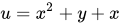








Plane vs planar, general-dimensional vs n-dimensional
[edit]Terence Tao uses terms “planar Jacobian conjecture” and “general-dimensional Jacobian conjecture” in his blog comments. In some of the older references “plane Jacobian conjecture” is used, but the aforementioned terms are more descriptive. I propose to switch to these terms in the info boxes and in the article headings and text when referring to the conjectures. Do you agree or other opinions? IlkkaP (talk) 10:56, 2 August 2026 (UTC)
- Planar seems like better English to me. Sławomir Biały (talk) 12:15, 2 August 2026 (UTC)
Wiz KDDI's edits
[edit]I reverted an edit by Wiz KDDI because of two problems summarized in my edit summary and detailed below. Apparently, this user intends to start an edit war, since he reverted my revert with the edit summary "vandalism".
The first Wiz KDDI change was to change the short description from "About polynomials in several variables" to "Conjecture in algebraic geometry". This change is not an improvement since, firstly, it repeats unnecessarily half of the aricle title; secondly, it is too vague for disambiguating betwen the numerous conjectures in algebraic geometry; thirdly, it is misleading, since it is (also) a conjecture in algebra, and readers interested in algebra need not being interested in algebraic geometry.
The second change is to change systematically {{math}} into <math> ... </math>Not only, this is discouraged by MOS:VAR and MOS:FORMULA, but the change misplaced punctuation following formulas, by allowing line wrapping just before punctuation.
To editor Wiz KDDI: Please elaborate on the reasons supporting you edit, and explain why you think that my edit is vandalism. D.Lazard (talk) 08:57, 5 August 2026 (UTC)
- I feel "About polynomials in several variables" is missing something, but "Conjecture in algebraic geometry" is a non-starter. It is too specific. — xo Ergur (talk) 12:19, 5 August 2026 (UTC)
- The original purpose of short descriptions was to serve as a disambiguation between similarly-titled articles. Although many editors, apparently confused about them, have thought that it should be a sort of mini-lead. Generally a short description should be no longer than needed for the purpose of disambiguation. Sławomir Biały (talk) 12:45, 5 August 2026 (UTC)
- If you are referring to my comment on something being "missing", all I meant was that I didn't read the current short description as a proper sentence. I think it would be a subject that I feel is missing. But maybe it doesn't need to be a well-formed sentence (or maybe I am wrong). — xo Ergur (talk) 14:32, 5 August 2026 (UTC)
- WP:SHORTDESC is used in conjunction with the title to disambiguate between articles, so we don't need to repeat the word "Conjecture" in the short description. Admittedly, the field name "short description" is a bit misleading IlkkaP (talk) 15:04, 5 August 2026 (UTC)
- Short descriptions are rarely complete sentences. Most often, they are noun prhrases, but they may be adjective or adverb phrases. WP:SHORTDESC says explicitly
Taken together, the title and short description concisely explain the subject of the page
. WP:SDEXAMPLES starts withA good way to draft a short description is to consider the words that would naturally follow if you started a sentence like this: "[Article subject] is/was a/an/the ...". You can then use those additional words as the short description
. Here, "Jacobian conjecture [is] about ..." follows this guideline exactly. D.Lazard (talk) 15:37, 5 August 2026 (UTC)
- If you are referring to my comment on something being "missing", all I meant was that I didn't read the current short description as a proper sentence. I think it would be a subject that I feel is missing. But maybe it doesn't need to be a well-formed sentence (or maybe I am wrong). — xo Ergur (talk) 14:32, 5 August 2026 (UTC)
- The original purpose of short descriptions was to serve as a disambiguation between similarly-titled articles. Although many editors, apparently confused about them, have thought that it should be a sort of mini-lead. Generally a short description should be no longer than needed for the purpose of disambiguation. Sławomir Biały (talk) 12:45, 5 August 2026 (UTC)
HappyLittleMonkey's edits
[edit]HappyLittleMonkey (talk · contribs · deleted contribs · logs · filter log · block user · block log) has been edit-warring to insert a purported explanation of the counterexample by James F. O'Brien. There are several problems with this content (which should be removed, although I am now at 3RR). They are as follows:
- The image appears to be copied from a website that does not seem to be compatible with the CC license (the terms of use retain all rights to the content hosted there).
- The "explanation" is not an explanation of the counterexample. It merely explains that a non-zero Jacobian means that a mapping is etale. That is not an explanation of the counterexample at all, so presenting it as such is misleading.
- Towards Data Science is not a WP:RS, and I think it is essentially a WP:SELFPUB source. The author of this content is not an expert on the Jacobian conjecture or algebraic geometry, but apparently of computer graphics and computer-generated clothing. He has no publications relevant to this area.
- The "explanation" that O'Brien gives is just wrong. Coming up with a non-injective etale map of is easy (even , e.g., )</math> which has constant Jacobian). It's the polynomiality that is hard. He explains the easy thing as if it was the hard thing!


For these reasons, the content must be removed. Sławomir Biały (talk) 16:22, 13 August 2026 (UTC)
- In addition, the picture with ”tubes” is really bad. IlkkaP (talk) 16:44, 13 August 2026 (UTC)
- Is there a better diagram somewhere? HappyLittleMonkey (talk) 16:49, 13 August 2026 (UTC)
- For example the diagram here is better but have to check permissions https://mathworld.wolfram.com/JacobianConjecture.html IlkkaP (talk) 17:05, 13 August 2026 (UTC)
- Is there a better diagram somewhere? HappyLittleMonkey (talk) 16:49, 13 August 2026 (UTC)
- I'll address your points in order:
- 1) The image was provided by the author who granted CC permissions. There is no rule that says an image cannot have been previously published. The entire point of a CC license is so that content can be used widely.
- 2) You don't appear to have read the material because it does explain how the counterexample from Claude applies to the conjecture and it provides a simple analogy that illustrates the counterexample in familiar 3D space.
- 3) TDS is not "self published". It has a submission and review process that is well documented on their website.
- 4) The explanation does specify that the class of functions is polynomial.
- In your previous message you stated that the conjecture "does not need an explanation". That is absolutely wrong. The entire point of Wikipedia is to be a widely accessible source of information. Ideally every technical page would have both content that relates to an expert's information needs and also to non-experts.
- All the reasons you list are not valid and IMO the content is useful and belongs. HappyLittleMonkey (talk) 16:48, 13 August 2026 (UTC)
- No "Towards Data Science" is not a reliable source, except for the opinions of its contributors who in this case is not an expert. The entirety of their explanation is that local injectivity is not global injectivity. That is obvious and completely misses the difficulty of the example. Just inserting the word "polynomial" doesn't help: nothing about this post is specific to polynomial maps, it's just generalities about any local diffeomorphism. I never said "the conjecture does not need an explanation". What I said was that "non-zero Jacobian implies locally injective" doesn't need an explanation: it's easily true, we set it for undergraduates to solve in advanced calculus courses. And O'Brian's exact formulation of the problem is precisely this much easier undergraduate problem: "can one smoothly deform infinite rubber so that distant pieces overlap while nothing locally pinches, tears, creases or collapses?" Sławomir Biały (talk) 17:10, 13 August 2026 (UTC)
(Improper use of RfC tag, removed) Schazjmd (talk) 21:44, 13 August 2026 (UTC)
Should an attributed explanation and visualization of the 3D counterexample to the Jacobian conjecture be included in the article?
I think the objections raised here are worth addressing on their merits, but I don't think they establish that the material is unsuitable for Wikipedia.
First, regarding the source: the proposed text does not present O'Brien's article as an authoritative mathematical treatment of the Jacobian conjecture or as a source for the proof of the counterexample. It attributes the geometric interpretation to O'Brien. He is a professor of computer science at UC Berkeley, and the article specifically presents itself as an accessible explanation and visualization of the concrete 3D counterexample. I think that is relevant when deciding whether an attributed explanatory description belongs in the article.
Second, I don't think the proposed material claims that a nonzero Jacobian by itself is the difficult part of the counterexample. The point of the geometric analogy is to help readers understand how a map can have a nonzero constant Jacobian while nevertheless identifying distinct points. The fact that polynomiality is an essential additional restriction is not contradicted by explaining the geometric behavior of the particular polynomial counterexample.
Finally, I think there is a legitimate encyclopedic question here about whether an accessible, attributed visualization of the counterexample is useful to readers who are not specialists. I don't think that question should be decided simply by whether the existing mathematical exposition is sufficient for experts. — Preceding unsigned comment added by HappyLittleMonkey (talk • contribs)
- Again, you're saying that an explanation that a locally injective function need not be globally injective explains the counterexample. It does not. The hard part of the counterexample, the whole meat, it the polynomiality. Anything that demotes that to a triviality is not an explanation. Anyway, the content is a non-starter. It's an opinion in a non-RS by a non-expert. Sławomir Biały (talk) 17:19, 13 August 2026 (UTC)
- No, I'm not saying that. I'm saying that this result that was "discovered" by an AI has interesting implications for many people. If you think that there is some caveat that you'd like to clarify, then add it to the section. You may not have found the article interesting, but you're already an expert in the topic. You can add to the explanation rather than suppress it. As it stands right now, most people will come to this page hoping to understand what AI did here and leave empty handed.
- Also, your example has vanishing det in some places and would not be applicable to the analogy in O'Brien's explanation. HappyLittleMonkey (talk) 17:32, 13 August 2026 (UTC)
- My example has constant Jacobian 1, lol. It seems like you have read the O'Brian piece as if it were an accurate explanation of the difficulty of the conjecture, and it is not. Period. Go read some other source. This one is simply wrong. Sławomir Biały (talk) 17:37, 13 August 2026 (UTC)
- Ok, yes, on that point you are correct. I should have my checked math before posting.
- But I still don't think that invalidates the usefulness of the example in the article.
- IMO, the explanation is valuable, but so are your comments pointing out what is lost by simplifying the example. Why not simply add that qualification to the paragraph? The result would be that a non-expert trying to understand the issue would have a pointer to a simple and accessible example, while also having your insight about how the example is illustrative but simplified in a way that loses some subtlety. HappyLittleMonkey (talk) 17:51, 13 August 2026 (UTC)
- If a reliable source describes why the conjecture is easy without the polynomial restriction, and what makes it hard over the polynomials, then it can be restored. But an explanation that leaves out the entire content of the conjecture is akin to telling lies to children. I would say something earlier in the article, not specific to the counterexample. The article already contains a relevant part, which is the reference to the inverse function theorem. It should elaborate that the problem in higher dimensions of a differentiable map with a constant Jacobian (which can be 1 wlog) is a function that locally preserves all volumes and therefore does not compress the space anywhere. It should further say that it is straightforward to construct differentiable mappings that are not injective, that is, that move distant parts of the space to the same place, but the conjecture concerns whether such mappings can be made to be polynomial, and there is where the difficulty lies. Sławomir Biały (talk) 17:59, 13 August 2026 (UTC)
- TDS is not a mathematics journal, but that does not make it irrelevant or unusable as a source. It has an editorial board that reviews submissions and is a well-respected publication. In terms of relevance to this particular discussion, it is at least comparable to many of the news sources that Wikipedia routinely relies upon.
- More importantly, the questions of image copyright and the editorial status of TDS are separate from the question of whether the mathematical analogy itself is valid and useful. Those issues do not, by themselves, establish that the analogy is incorrect or unsuitable for the article. I think they are being raised here in a way that distracts from the substantive question: whether the analogy accurately and usefully illustrates the mathematical concept in question.
- The article does include the requirement that the function be polynomial, but it does not say much about it. That does not make it "lies to children". And it would be simple for you to add a constructive point to the linking paragraph that explains the significance clearly. HappyLittleMonkey (talk) 18:08, 13 August 2026 (UTC)
- I have added a paragraph in the correct place in the article which explains why this is trivial for analytic maps, includes the rubber sheet description, and cited two reliable mathematics sources. Sławomir Biały (talk) 18:23, 13 August 2026 (UTC)
- You took out a link to an external article and added your own original content that is based off the article you removed! That's not how you're supposed to write articles. This is not a place for you to self-publish your own ideas. What you did is close to plagiarism. HappyLittleMonkey (talk) 18:30, 13 August 2026 (UTC)
- O'Brian is not a reliable source, and did not invent rubber sheets to describe local diffeomorphisms. But I thought you wanted a statement about this for beginners. If you agree, I can rewrite it without the gloss no problem. Sławomir Biały (talk) 18:39, 13 August 2026 (UTC)
- Are you are reliable source? Because what you've done is to take the example from an article and rewrite it yourself as original content. That is not consistent with wiki practice and it border on academic dishonesty.
- One your user talk page I saw that others have found you argumentative, pedantic, and generally difficult. Perhaps you should consider if these complaints are legitimate and the possibility that you might be the problem. HappyLittleMonkey (talk) 18:46, 13 August 2026 (UTC)
- Wow. Why are you so invested in citing this very poor source? Do you have a conflict of interests to declare? Sławomir Biały (talk) 18:49, 13 August 2026 (UTC)
- Is it so hard for you to see that not everyone thinks like you do? HappyLittleMonkey (talk) 18:50, 13 August 2026 (UTC)
- Wow. Why are you so invested in citing this very poor source? Do you have a conflict of interests to declare? Sławomir Biały (talk) 18:49, 13 August 2026 (UTC)
- Also, your explanation does nothing to help someone who is not alread an expert in the area. Stop acting like you are the only one who matters. HappyLittleMonkey (talk) 18:49, 13 August 2026 (UTC)
- I tried to accommodate your viewpoint, that a more accessible explanation can be included. And somehow this earned me personal attacks? I don't think that is warranted. But I do begin to think that you seem to be rather fixated on citing this particular source, and I start to wonder why. Sławomir Biały (talk) 18:52, 13 August 2026 (UTC)
- You also deleted an image completely, as opposed to removing it from the article, for a copyright violation that only exists in your mind. HappyLittleMonkey (talk) 18:57, 13 August 2026 (UTC)
- The image was an unambiguous copyright violation, absent written permission from the publisher: https://towardsdatascience.com/website-terms-of-use/ Sławomir Biały (talk) 19:01, 13 August 2026 (UTC)
- You also deleted an image completely, as opposed to removing it from the article, for a copyright violation that only exists in your mind. HappyLittleMonkey (talk) 18:57, 13 August 2026 (UTC)
- No, you took the idea from the article that I found valuable, made it unclear, and then posted it as if it were your idea. From the fact that Wikipedia is not a place for you to post original/uncited content. If I were your TA and you did this for an assignment, I would have reported you to the professor. HappyLittleMonkey (talk) 18:55, 13 August 2026 (UTC)
- So, if I find another pre-existing source that uses rubber sheets to describe diffeomorphisms, that means that O'Brian is a plagiarist, and you will completely disavow that source for failing to cite prior art, correct? Sławomir Biały (talk) 18:57, 13 August 2026 (UTC)
- If you found out that he read someone else's article that used the idea to illustrate this counterexample and then he wrote his own article about the same thing. The fact that rubber volumes have been used to explain things is not the issue. The issue is that you don't like something, so you remove it and replace it with your own version. If you think you can explain it better then go write an article and publish it. Then someone who found it useful could cite it here on Wikipedia. HappyLittleMonkey (talk) 19:01, 13 August 2026 (UTC)
- And how is it that you think talking about diffeomorphisms makes content more accessible to someone? HappyLittleMonkey (talk) 19:03, 13 August 2026 (UTC)
- I would call them rubber-sheet-bendy things, but according to you that's plagiarism. But just so we are clear, if I find the rubber sheet metaphor anywhere prior to O'Brian's article, you will disavow that source as clear plagiarism. Correct? Sławomir Biały (talk) 19:04, 13 August 2026 (UTC)
- No. If you find out he read someone else's article and instead of citing it just wrote it up as his own. That's what you did. HappyLittleMonkey (talk) 19:09, 13 August 2026 (UTC)
- Nowhere does O'Brian even refer to a "rubber sheet". He doesn't refer to "area" anywhere either. Anyway, according to you, I didn't actually read the source so obviously can't have plagiarized it. Sławomir Biały (talk) 19:10, 13 August 2026 (UTC)
- "Imagine a big block of infinitely stretchy rubber. Technically, this would be an infinitely large block of rubber that fills the whole universe. Obviously, that’s not possible, but we can still imagine a giant block of rubber that never ends." HappyLittleMonkey (talk) 19:18, 13 August 2026 (UTC)
- Right, he is describing a solid block of rubber. That's not a rubber sheet! Sławomir Biały (talk) 19:21, 13 August 2026 (UTC)
- Ok, I added an earlier source using rubber sheets to describe functions with non-vanishing Jacobian. I have also removed the O'Brian source, since it is not a reliable source and does not originate the rubber sheet metaphor. Sławomir Biały (talk) 19:25, 13 August 2026 (UTC)
- That has nothing to do with anything. And it doesn't matter if one calls is a sheet volume or whatever. It the same analogy and you're just copying the idea.
- I'm not going to respond to you further unless you make some rational point beyond you don't like something.
- Please remain civil. Also, what you are describing is edit warring and is forbidden. — xo Ergur (talk) 19:57, 13 August 2026 (UTC)
- Fair enough. I'm a little frustrated. I'd value external perspectives. I also removed the personal comment. You're right, it was uncalled for.HappyLittleMonkey (talk) 20:00, 13 August 2026 (UTC)
- Please remain civil. Also, what you are describing is edit warring and is forbidden. — xo Ergur (talk) 19:57, 13 August 2026 (UTC)
- "Imagine a big block of infinitely stretchy rubber. Technically, this would be an infinitely large block of rubber that fills the whole universe. Obviously, that’s not possible, but we can still imagine a giant block of rubber that never ends." HappyLittleMonkey (talk) 19:18, 13 August 2026 (UTC)
- Nowhere does O'Brian even refer to a "rubber sheet". He doesn't refer to "area" anywhere either. Anyway, according to you, I didn't actually read the source so obviously can't have plagiarized it. Sławomir Biały (talk) 19:10, 13 August 2026 (UTC)
- No. If you find out he read someone else's article and instead of citing it just wrote it up as his own. That's what you did. HappyLittleMonkey (talk) 19:09, 13 August 2026 (UTC)
- I would call them rubber-sheet-bendy things, but according to you that's plagiarism. But just so we are clear, if I find the rubber sheet metaphor anywhere prior to O'Brian's article, you will disavow that source as clear plagiarism. Correct? Sławomir Biały (talk) 19:04, 13 August 2026 (UTC)
- So, if I find another pre-existing source that uses rubber sheets to describe diffeomorphisms, that means that O'Brian is a plagiarist, and you will completely disavow that source for failing to cite prior art, correct? Sławomir Biały (talk) 18:57, 13 August 2026 (UTC)
- I tried to accommodate your viewpoint, that a more accessible explanation can be included. And somehow this earned me personal attacks? I don't think that is warranted. But I do begin to think that you seem to be rather fixated on citing this particular source, and I start to wonder why. Sławomir Biały (talk) 18:52, 13 August 2026 (UTC)
- O'Brian is not a reliable source, and did not invent rubber sheets to describe local diffeomorphisms. But I thought you wanted a statement about this for beginners. If you agree, I can rewrite it without the gloss no problem. Sławomir Biały (talk) 18:39, 13 August 2026 (UTC)
- You took out a link to an external article and added your own original content that is based off the article you removed! That's not how you're supposed to write articles. This is not a place for you to self-publish your own ideas. What you did is close to plagiarism. HappyLittleMonkey (talk) 18:30, 13 August 2026 (UTC)
- I have added a paragraph in the correct place in the article which explains why this is trivial for analytic maps, includes the rubber sheet description, and cited two reliable mathematics sources. Sławomir Biały (talk) 18:23, 13 August 2026 (UTC)
- If a reliable source describes why the conjecture is easy without the polynomial restriction, and what makes it hard over the polynomials, then it can be restored. But an explanation that leaves out the entire content of the conjecture is akin to telling lies to children. I would say something earlier in the article, not specific to the counterexample. The article already contains a relevant part, which is the reference to the inverse function theorem. It should elaborate that the problem in higher dimensions of a differentiable map with a constant Jacobian (which can be 1 wlog) is a function that locally preserves all volumes and therefore does not compress the space anywhere. It should further say that it is straightforward to construct differentiable mappings that are not injective, that is, that move distant parts of the space to the same place, but the conjecture concerns whether such mappings can be made to be polynomial, and there is where the difficulty lies. Sławomir Biały (talk) 17:59, 13 August 2026 (UTC)

@HappyLittleMonkey: you need to stop adding this content, and someone else should remove it please for the reasons that I stated above. Sławomir Biały (talk) 19:41, 13 August 2026 (UTC)
- I disagree and have invited adjudication. HappyLittleMonkey (talk) 19:44, 13 August 2026 (UTC)
- Right, but you should self-revert the change that has now been reverted by multiple editors pending the outcome of that process. The edit, as it stands, lacks consensus, and per WP:ONUS policy: "The responsibility for achieving consensus for inclusion is on editors seeking to include disputed content." Sławomir Biały (talk) 19:47, 13 August 2026 (UTC)
- The content you insist to add is clear WP:OR (original thoughts, not reliably published). So, it does not belong to Wikipedia, and I will remove it again. Note also that you are WP:edit warring for keeping it in the article. If you continue this way, you could be blocked for editing. D.Lazard (talk) 09:09, 14 August 2026 (UTC)
- I give up. I now see why my office mate said I shouldn't have bothered. Wiki math pages are colonized by people who seem to think that explaining something clearly is a sin. I don't have the energy to fight over this any more. You win. Which also means everyone loses. HappyLittleMonkey (talk) 17:06, 14 August 2026 (UTC)
Results in the 2D Jacobian conjecture
[edit]What results are there for the 2D Jacobian conjecture that deserve to be included in the Wikipedia article? Apparently it is "extremely well-studied" but there is just one paragraph in the results section for the 2D Jacobian conjecture about ruling out 2D counterexamples. I have a hard time imagining that so many well known mathematicians like Abhyankar and Moh have spent their lives studying this problem with zero other notable results to be included in Wikipedia. ~2026-44854-45 (talk) 20:51, 14 August 2026 (UTC)
- Thanks for your advice. I’ll rewrite it soon. From the history, the reason for this phenomenon is clear: those who brought this question to the main stage (Especially Abhyankar) knew clearly how difficult and “almost true” the 2D version was, and so did van den Essen later. But people focused on different directions, the 2D group Abhyankar is dead, Vitushkin is dead, Moh has retired, his student Zhang has left this field, and van den Essen’s ways of dealing this problem is independent of dimensions—they have ideas so they want to publish more works, this is natural. There are some other people working on 2D problem, but perhaps not good at advertising. So only those closely focused on this history could know about this difference, and people are easily exposed to the general n-D works—although almost none of these people studies it seriously, because this problem is notorious for its difficulty, people don’t want to waste their time; while what is in fact notorious is the 2D case, for attracting so many false proofs by respected mathematicians. I’m a PhD in fields not connected to JC, and I didn’t expect before that I need to write something on this problem, until I realized I have to, because what remains open is even not less important than the whole problem before 2 months.Sky19841 (talk) 01:45, 15 August 2026 (UTC)
Preprints vs blog posts as references
[edit]So, a coordinate-free explanation of the 3D Jacobian conjecture counterexample has finally appeared on a preprint on the arXiv:
- Remy van Dobben de Bruyn (27 Aug 2026), Divisors in projective bundles over the projective line whose complement is affine space, arXiv:2608.27341
What is better as a reference for the material in the counterexample section, the blog posts currently being used or this arXiv preprint? ~2026-47889-40 (talk) 14:33, 3 September 2026 (UTC)
- I would keep the X post by Alpöge as the original announcement of the counterexample and the blog post by Tao as one of the first explanatory presentations of the counterexample as references. The new arXiv can be added if it can be suitably summarized. IlkkaP (talk) 15:56, 3 September 2026 (UTC)
- Is this relevant? https://arxiv.org/abs/2609.05746 Separately, one of the authors (Gabber) mentions on p. 160-161 of the pdf that an in-progress version of the preprint escaped to a public web server a few months ago and from there got sucked into an AI training pipeline, which then showed up in later AI output. Someone on MO wondered whether the JC counterexample search could have been sped up by that too. ~2026-49030-52 (talk) 10:33, 10 September 2026 (UTC)
- Isn't it Vasiu, not Gabber? — xo Ergur (talk) 08:05, 11 September 2026 (UTC)