// Workers AI · traducción al español
Función de transferencia correcta
En teoría de control, una función de transferencia correcta es una función de transferencia en la que el grado del numerador no excede el grado del denominador.
Traducción generada por IA. El artículo original en inglés continúa abajo.
Proper transfer function
From Wikipedia, the free encyclopedia
In control theory , a proper transfer function is a transfer function in which the degree of the numerator does not exceed the degree of the denominator. A strictly proper transfer function is a transfer function where the degree of the numerator is less than the degree of the denominator.
The difference between the degree of the denominator (number of poles) and degree of the numerator (number of zeros) is the relative degree of the transfer function.
The following transfer function:
G
(
s
)
=
N
(
s
)
D
(
s
)
=
s
4
+
n
1
s
3
+
n
2
s
2
+
n
3
s
+
n
4
s
4
+
d
1
s
3
+
d
2
s
2
+
d
3
s
+
d
4
{\displaystyle {\textbf {G}}(s)={\frac {{\textbf {N}}(s)}{{\textbf {D}}(s)}}={\frac {s^{4}+n_{1}s^{3}+n_{2}s^{2}+n_{3}s+n_{4}}{s^{4}+d_{1}s^{3}+d_{2}s^{2}+d_{3}s+d_{4}}}}
is proper , because
deg
(
N
(
s
)
)
=
4
≤
deg
(
D
(
s
)
)
=
4
{\displaystyle \deg({\textbf {N}}(s))=4\leq \deg({\textbf {D}}(s))=4}
is biproper , because
deg
(
N
(
s
)
)
=
4
=
deg
(
D
(
s
)
)
=
4
{\displaystyle \deg({\textbf {N}}(s))=4=\deg({\textbf {D}}(s))=4}
but is not strictly proper , because
deg
(
N
(
s
)
)
=
4
≮
deg
(
D
(
s
)
)
=
4
{\displaystyle \deg({\textbf {N}}(s))=4\nless \deg({\textbf {D}}(s))=4}
The following transfer function is not proper (or strictly proper)
G
(
s
)
=
N
(
s
)
D
(
s
)
=
s
4
+
n
1
s
3
+
n
2
s
2
+
n
3
s
+
n
4
d
1
s
3
+
d
2
s
2
+
d
3
s
+
d
4
{\displaystyle {\textbf {G}}(s)={\frac {{\textbf {N}}(s)}{{\textbf {D}}(s)}}={\frac {s^{4}+n_{1}s^{3}+n_{2}s^{2}+n_{3}s+n_{4}}{d_{1}s^{3}+d_{2}s^{2}+d_{3}s+d_{4}}}}
because
deg
(
N
(
s
)
)
=
4
≰
deg
(
D
(
s
)
)
=
3
{\displaystyle \deg({\textbf {N}}(s))=4\nleq \deg({\textbf {D}}(s))=3}
A not proper transfer function can be made proper, even strictly proper, by using the method of long division.
The following transfer function is strictly proper
G
(
s
)
=
N
(
s
)
D
(
s
)
=
n
1
s
3
+
n
2
s
2
+
n
3
s
+
n
4
s
4
+
d
1
s
3
+
d
2
s
2
+
d
3
s
+
d
4
{\displaystyle {\textbf {G}}(s)={\frac {{\textbf {N}}(s)}{{\textbf {D}}(s)}}={\frac {n_{1}s^{3}+n_{2}s^{2}+n_{3}s+n_{4}}{s^{4}+d_{1}s^{3}+d_{2}s^{2}+d_{3}s+d_{4}}}}
because
deg
(
N
(
s
)
)
=
3
<
deg
(
D
(
s
)
)
=
4
{\displaystyle \deg({\textbf {N}}(s))=3<\deg({\textbf {D}}(s))=4}
A proper transfer function will never grow unbounded as the frequency approaches infinity:
|
G
(
±
j
∞
)
|
<
∞
{\displaystyle |{\textbf {G}}(\pm j\infty )|<\infty }
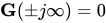
A strictly proper transfer function will approach zero as the frequency approaches infinity (which is true for all physical processes):
G
(
±
j
∞
)
=
0
{\displaystyle {\textbf {G}}(\pm j\infty )=0}
Also, the integral of the real part of a strictly proper transfer function is zero.