// Workers AI · traducción al español
Prueba
Probalign es una herramienta de alineación de secuencias que calcula un alineamiento de precisión máxima esperado utilizando probabilidades posteriores de la función de partición. Las probabilidades de pareja de base se estiman utilizando una estimación similar a la distribución de Boltzmann.
Traducción generada por IA. El artículo original en inglés continúa abajo.
Probalign
From Wikipedia, the free encyclopedia
Probalign is a sequence alignment tool that calculates a maximum expected accuracy alignment using partition function posterior probabilities.[ 1] Boltzmann distribution . The partition function is calculated using a dynamic programming approach.
The following describes the algorithm used by probalign to determine the base pair probabilities.[ 2]
To score an alignment of two sequences two things are needed:
a similarity function
σ
(
x
,
y
)
{\displaystyle \sigma (x,y)}
PAM , BLOSUM ,...)
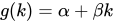
affine gap penalty :
g
(
k
)
=
α
+
β
k
{\displaystyle g(k)=\alpha +\beta k}
The score
S
(
a
)
{\displaystyle S(a)}
S
(
a
)
=
∑
x
i
−
y
j
∈
a
σ
(
x
i
,
y
j
)
+
gap cost
{\displaystyle S(a)=\sum _{x_{i}-y_{j}\in a}\sigma (x_{i},y_{j})+{\text{gap cost}}}
Now the boltzmann weighted score of an alignment a is:
e
S
(
a
)
T
=
e
∑
x
i
−
y
j
∈
a
σ
(
x
i
,
y
j
)
+
gap cost
T
=
(
∏
x
i
−
y
i
∈
a
e
σ
(
x
i
,
y
j
)
T
)
⋅
e
g
a
p
c
o
s
t
T
{\displaystyle e^{\frac {S(a)}{T}}=e^{\frac {\sum _{x_{i}-y_{j}\in a}\sigma (x_{i},y_{j})+{\text{gap cost}}}{T}}=\left(\prod _{x_{i}-y_{i}\in a}e^{\frac {\sigma (x_{i},y_{j})}{T}}\right)\cdot e^{\frac {gapcost}{T}}}
Where
T
{\displaystyle T}
The probability of an alignment assuming boltzmann distribution is given by
P
r
[
a
|
x
,
y
]
=
e
S
(
a
)
T
Z
{\displaystyle Pr[a|x,y]={\frac {e^{\frac {S(a)}{T}}}{Z}}}
Where
Z
{\displaystyle Z}
Dynamic programming [ edit ] Let
Z
i
,
j
{\displaystyle Z_{i,j}}
x
0
,
x
1
,
.
.
.
,
x
i
{\displaystyle x_{0},x_{1},...,x_{i}}
y
0
,
y
1
,
.
.
.
,
y
j
{\displaystyle y_{0},y_{1},...,y_{j}}
Z
i
,
j
M
:
{\displaystyle Z_{i,j}^{M}:}
Z
i
,
j
I
:
{\displaystyle Z_{i,j}^{I}:}
(
−
,
y
j
)
{\displaystyle (-,y_{j})}
Z
i
,
j
D
:
{\displaystyle Z_{i,j}^{D}:}
(
x
i
,
−
)
{\displaystyle (x_{i},-)}
Then we have:
Z
i
,
j
=
Z
i
,
j
M
+
Z
i
,
j
D
+
Z
i
,
j
I
{\displaystyle Z_{i,j}=Z_{i,j}^{M}+Z_{i,j}^{D}+Z_{i,j}^{I}}
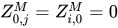
The matrixes are initialized as follows:
Z
0
,
j
M
=
Z
i
,
0
M
=
0
{\displaystyle Z_{0,j}^{M}=Z_{i,0}^{M}=0}
Z
0
,
0
M
=
1
{\displaystyle Z_{0,0}^{M}=1}
Z
0
,
j
D
=
0
{\displaystyle Z_{0,j}^{D}=0}
Z
i
,
0
I
=
0
{\displaystyle Z_{i,0}^{I}=0}
The partition function for the alignments of two sequences
x
{\displaystyle x}
y
{\displaystyle y}
Z
|
x
|
,
|
y
|
{\displaystyle Z_{|x|,|y|}}
Z
i
,
j
M
=
Z
i
−
1
,
j
−
1
⋅
e
σ
(
x
i
,
y
j
)
T
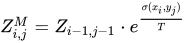
{\displaystyle Z_{i,j}^{M}=Z_{i-1,j-1}\cdot e^{\frac {\sigma (x_{i},y_{j})}{T}}}
Z
i
,
j
D
=
Z
i
−
1
,
j
D
⋅
e
β
T
+
Z
i
−
1
,
j
M
⋅
e
g
(
1
)
T
+
Z
i
−
1
,
j
I
⋅
e
g
(
1
)
T
{\displaystyle Z_{i,j}^{D}=Z_{i-1,j}^{D}\cdot e^{\frac {\beta }{T}}+Z_{i-1,j}^{M}\cdot e^{\frac {g(1)}{T}}+Z_{i-1,j}^{I}\cdot e^{\frac {g(1)}{T}}}
Z
i
,
j
I
{\displaystyle Z_{i,j}^{I}}
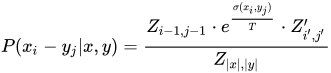
Base pair probability [ edit ] Finally the probability that positions
x
i
{\displaystyle x_{i}}
y
j
{\displaystyle y_{j}}
P
(
x
i
−
y
j
|
x
,
y
)
=
Z
i
−
1
,
j
−
1
⋅
e
σ
(
x
i
,
y
j
)
T
⋅
Z
i
′
,
j
′
′
Z
|
x
|
,
|
y
|
{\displaystyle P(x_{i}-y_{j}|x,y)={\frac {Z_{i-1,j-1}\cdot e^{\frac {\sigma (x_{i},y_{j})}{T}}\cdot Z'_{i',j'}}{Z_{|x|,|y|}}}}
Z
′
,
i
′
,
j
′
{\displaystyle Z',i',j'}
Z
{\displaystyle Z}






![{\displaystyle Pr[a|x,y]={\frac {e^{\frac {S(a)}{T}}}{Z}}}](https://wikimedia.org/api/rest_v1/media/math/render/svg/bc95755b68056106788d9ba71ad9e9bc5be6fafb)