


Loop algebra
In mathematics, loop algebras are certain types of Lie algebras, of particular interest in theoretical physics.
Definition
[edit]For a Lie algebra over a field , if is the space of Laurent polynomials, then with the inherited bracket


![{\displaystyle K[t,t^{-1}]}](https://wikimedia.org/api/rest_v1/media/math/render/svg/b9bf8b31d484ed0d11b27301560bc79c7b10ff33)
![{\displaystyle L{\mathfrak {g}}:={\mathfrak {g}}\otimes K[t,t^{-1}],}](https://wikimedia.org/api/rest_v1/media/math/render/svg/711d03b32f6ba9a09635e45d74df94d0f3222b46)
![{\displaystyle [X\otimes t^{m},Y\otimes t^{n}]=[X,Y]\otimes t^{m+n}.}](https://wikimedia.org/api/rest_v1/media/math/render/svg/4021d701209302e8c53baab46c42ecd367d9396b)
Geometric definition
[edit]If is a Lie algebra, the tensor product of with C∞(S1), the algebra of (complex) smooth functions over the circle manifold S1 (equivalently, smooth complex-valued periodic functions of a given period),
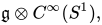
is an infinite-dimensional Lie algebra with the Lie bracket given by
![{\displaystyle [g_{1}\otimes f_{1},g_{2}\otimes f_{2}]=[g_{1},g_{2}]\otimes f_{1}f_{2}.}](https://wikimedia.org/api/rest_v1/media/math/render/svg/258e3496c273ecc9981999c11b9c0d0554b989b5)
Here g1 and g2 are elements of and f1 and f2 are elements of C∞(S1).
This isn't precisely what would correspond to the direct product of infinitely many copies of , one for each point in S1, because of the smoothness restriction. Instead, it can be thought of in terms of smooth map from S1 to ; a smooth parametrized loop in , in other words. This is why it is called the loop algebra.
Gradation
[edit]Defining to be the linear subspace the bracket restricts to a product hence giving the loop algebra a -graded Lie algebra structure.


![{\displaystyle [\cdot \,,\,\cdot ]:{\mathfrak {g}}_{i}\times {\mathfrak {g}}_{j}\rightarrow {\mathfrak {g}}_{i+j},}](https://wikimedia.org/api/rest_v1/media/math/render/svg/1c8c803d0cc6f1defe72f15455dbd13fb8d381fd)

In particular, the bracket restricts to the 'zero-mode' subalgebra .

Derivation
[edit]There is a natural derivation on the loop algebra, conventionally denoted acting as and so can be thought of formally as .




It is required to define affine Lie algebras, which are used in physics, particularly conformal field theory.
Loop group
[edit]Similarly, a set of all smooth maps from S1 to a Lie group G forms an infinite-dimensional Lie group (Lie group in the sense we can define functional derivatives over it) called the loop group. The Lie algebra of a loop group is the corresponding loop algebra.
Affine Lie algebras as central extension of loop algebras
[edit]If is a semisimple Lie algebra, then a nontrivial central extension of its loop algebra gives rise to an affine Lie algebra. Furthermore, this central extension is unique.[1]

The central extension is given by adjoining a central element , that is, for all , and modifying the bracket on the loop algebra to where is the Killing form.

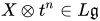
![{\displaystyle [{\hat {k}},X\otimes t^{n}]=0,}](https://wikimedia.org/api/rest_v1/media/math/render/svg/e7d212b73a852729e3b626c36a2f56dd0c7e2230)
![{\displaystyle [X\otimes t^{m},Y\otimes t^{n}]=[X,Y]\otimes t^{m+n}+mB(X,Y)\delta _{m+n,0}{\hat {k}},}](https://wikimedia.org/api/rest_v1/media/math/render/svg/a6514474c378e780f698ec77aa3450c54bb72ac2)

The central extension is, as a vector space, (in its usual definition, as more generally, can be taken to be an arbitrary field).


Cocycle
[edit]Using the language of Lie algebra cohomology, the central extension can be described using a 2-cocycle on the loop algebra. This is the map satisfying Then the extra term added to the bracket is



Affine Lie algebra
[edit]In physics, the central extension is sometimes referred to as the affine Lie algebra. In mathematics, this is insufficient, and the full affine Lie algebra is the vector space[2] where is the derivation defined above.

On this space, the Killing form can be extended to a non-degenerate form, and so allows a root system analysis of the affine Lie algebra.
References
[edit]- ↑ Kac, V.G. (1990). Infinite-dimensional Lie algebras (3rd ed.). Cambridge University Press. Exercise 7.8. ISBN 978-0-521-37215-2.
- ↑ P. Di Francesco, P. Mathieu, and D. Sénéchal, Conformal Field Theory, 1997, ISBN 0-387-94785-X
- Fuchs, Jurgen (1992), Affine Lie Algebras and Quantum Groups, Cambridge University Press, ISBN 0-521-48412-X