In control theory, a Kalman decomposition provides a mathematical means to convert a representation of any linear time-invariant (LTI) control system to a form in which the system can be decomposed into a standard form which makes clear the observable and controllable components of the system. This decomposition results in the system being presented with a more illuminating structure, making it easier to draw conclusions on the system's reachable and observable subspaces.
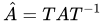
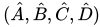
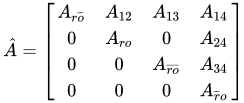
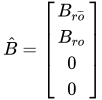
The Kalman decomposition is defined as the realization of this system obtained by transforming the original matrices as follows:
,
,
,
,
where is the coordinate transformation matrix defined as
,
and whose submatrices are
: a matrix whose columns span the subspace of states which are both reachable and unobservable.
: chosen so that the columns of are a basis for the reachable subspace.
: chosen so that the columns of are a basis for the unobservable subspace.
: chosen so that is invertible.
It can be observed that some of these matrices may have dimension zero. For example, if the system is both observable and controllable, then , making the other matrices zero dimension.
A Kalman decomposition also exists for linear dynamical quantum systems. Unlike classical dynamical systems, the coordinate transformation used in this variant requires to be in a specific class of transformations due to the physical laws of quantum mechanics.[1]