// Workers AI · traducción al español
Monóxido cartesiano
Un monoide cartesiano es un monoide, con estructura adicional de operadores de apareamiento y proyección. Fue formulado por primera vez por Dana Scott y Joachim Lambek de forma independiente.
Traducción generada por IA. El artículo original en inglés continúa abajo.
Cartesian monoid
From Wikipedia, the free encyclopedia
A Cartesian monoid is a monoid , with additional structure of pairing and projection operators. It was first formulated by Dana Scott and Joachim Lambek independently.[ 1]
A Cartesian monoid is a structure with signature
⟨
∗
,
e
,
(
−
,
−
)
,
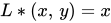
L
,
R
⟩
{\displaystyle \langle *,e,(-,-),L,R\rangle }
∗
{\displaystyle *}
(
−
,
−
)
{\displaystyle (-,-)}
binary operations ,
L
,
R
{\displaystyle L,R}
e
{\displaystyle e}
axioms for all
x
,
y
,
z
{\displaystyle x,y,z}
universe :
Monoid
∗
{\displaystyle *}
e
{\displaystyle e}
Left Projection
L
∗
(
x
,
y
)
=
x
{\displaystyle L*(x,\,y)=x}
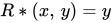
Right Projection
R
∗
(
x
,
y
)
=
y
{\displaystyle R*(x,\,y)=y}
Surjective Pairing
(
L
∗
x
,
R
∗
x
)
=
x
{\displaystyle (L*x,\,R*x)=x}
Right Homogeneity
(
x
∗
z
,
y
∗
z
)
=
(
x
,
y
)
∗
z
{\displaystyle (x*z,\,y*z)=(x,\,y)*z}
The interpretation is that
L
{\displaystyle L}
R
{\displaystyle R}
(
−
,
−
)
{\displaystyle (-,-)}
↑ Statman, Rick (1997), "On Cartesian monoids", Computer science logic (Utrecht, 1996) , Lecture Notes in Computer Science , vol. 1258, Berlin: Springer, pp. 446– 459, doi :10.1007/3-540-63172-0_55 , MR 1611514