Wikipedia:Reference desk/Mathematics
(Redirected from Wikipedia:RD/Maths)
Latest comment: 4 hours ago by Cmglee in topic Pythagorean triple angles

Welcome to the mathematics section
of the Wikipedia reference desk.
of the Wikipedia reference desk.
Select a section:
Want a faster answer?
Main page: Help searching Wikipedia
How can I get my question answered?
- Select the section of the desk that best fits the general topic of your question (see the navigation column to the right).
- Post your question to only one section, providing a short header that gives the topic of your question.
- Type '~~~~' (that is, four tilde characters) at the end – this signs and dates your contribution so we know who wrote what and when.
- Don't post personal contact information – it will be removed. Any answers will be provided here.
- Please be as specific as possible, and include all relevant context – the usefulness of answers may depend on the context.
- Note:
- We don't answer (and may remove) questions that require medical diagnosis or legal advice.
- We don't answer requests for opinions, predictions or debate.
- We don't do your homework for you, though we'll help you past the stuck point.
- We don't conduct original research or provide a free source of ideas, but we'll help you find information you need.
How do I answer a question?
Main page: Wikipedia:Reference desk/Guidelines
- The best answers address the question directly, and back up facts with wikilinks and links to sources. Do not edit others' comments and do not give any medical or legal advice.
See also:
July 29
[edit]Kulczynski Similarity Coefficient I (K1)
[edit]Every similarity metric I've used is bounded, usually [0,1] or [-1,1]. K1 is unbounded [0,inf). Distances and scores are unbounded. Is K1 actually a score and not a similarity? ~2026-41824-87 (talk) 11:56, 29 July 2026 (UTC)
- See Qualitative variation#Kulczyński's coefficient. Kulczyński's coefficient varies between 0 and 1. What is this K1, you are talking about? JRSpriggs (talk) 13:20, 29 July 2026 (UTC)
- This is the definition I have:
- Kulczynski I (K1): The ratio of shared elements to non-shared elements. Counts matches (elements in both sets) against mismatches (elements in exactly one set). Shared absences are ignored, so no universe size is needed.
- Formula:
- K1(A, B) = a / (b + c)
- a = |A ∩ B| (in both: n11)
- b = |A only| (in A, not B: n10)
- c = |B only| (in B, not A: n01)
- Range: [0, inf)
- inf = identical sets (no mismatches)
- 0 = no shared elements ~2026-41824-87 (talk) 13:32, 29 July 2026 (UTC)
- Here, the coefficient defined in the Wikipedia article is called "Kulczynski 2".
- In the extreme case that A = B, we get indeed K1(A, B) = a / 0. ‑‑Lambiam 15:49, 29 July 2026 (UTC)
- It considers division by zero to be infinity rather than undefined. Because it is unbounded, I was wondering if it is properly called a "score" instead of a "similarity coefficient". Maybe it is just my limited experience with similarity metrics, but all I've seen are bounded. Score and distance metrics are always unbounded. ~2026-41824-87 (talk) 16:39, 29 July 2026 (UTC)
- There is no standard meaning of the term ''coefficient'' that would impose limits on its range. In physics, the coefficient of thermal expansion can even be negative, as it is for fairly pure silicon for temperatures between about 18 and 120 K (−255 and −153 °C; −427 and −244 °F), and the reflection coefficient of a wave vector can become infinite. ‑‑Lambiam 12:04, 30 July 2026 (UTC)
- - "Maybe it is just my limited experience with similarity metrics, but all I've seen are bounded."
- - "There is no standard meaning of the term "coefficient" that would impose limits on its range."
- I do not feel that this response fits. Some similarity metrics are coefficients. Some are indexes. ~2026-41824-87 (talk) 11:08, 3 August 2026 (UTC)
- AFAIK, the area of similarity measures is a free-for-all, with no agreed conventions. ‑‑Lambiam 17:36, 3 August 2026 (UTC)
- There is no standard meaning of the term ''coefficient'' that would impose limits on its range. In physics, the coefficient of thermal expansion can even be negative, as it is for fairly pure silicon for temperatures between about 18 and 120 K (−255 and −153 °C; −427 and −244 °F), and the reflection coefficient of a wave vector can become infinite. ‑‑Lambiam 12:04, 30 July 2026 (UTC)
- It considers division by zero to be infinity rather than undefined. Because it is unbounded, I was wondering if it is properly called a "score" instead of a "similarity coefficient". Maybe it is just my limited experience with similarity metrics, but all I've seen are bounded. Score and distance metrics are always unbounded. ~2026-41824-87 (talk) 16:39, 29 July 2026 (UTC)
- Not necessarily an answer to your question, but it's worth noting:
- 1. (the symmetric difference), and .
- 2. , and is bijective and monotone increasing from to . Its inverse, , which takes to , is consequently also bijective and monotone increasing from to .
- 3. Since for , and all possible values of and are nonnegative integers, K1 is just a bijective remapping of values of the Jaccard index to .
- GalacticShoe (talk) 15:28, 29 July 2026 (UTC)


August 9
[edit]Pythagorean triple angles
[edit]Is it coincidence that the larger acute angle of a 7-24-25 Pythagorean-triple triangle is twice the smaller acute angle of a 3-4-5 triangle? Thanks, cmɢʟee τaʟκ (please add {{ping|cmglee}} to your reply) 00:58, 9 August 2026 (UTC)
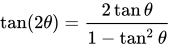
- No, it is not a coincidence. See trigonometric formulas#Double-angle formulae.
- .
- and apply that. JRSpriggs (talk) 01:53, 9 August 2026 (UTC)
- In fact, if (a, b, c) and (d, e, f) are Pythagorean triples, then so is (ad-be, ae+bd, cf) (provided ad-be>0). The angle opposite the ae+bd side will then be the sum of the angles opposite the b and e sides in the original triangles. The 7-24-25 is a special case, the "product" of the 4-3-5 triangle with itself. --RDBury (talk) 08:39, 9 August 2026 (UTC)
- I naively expected that iterating starting with would soon converge to some set of angles. Instead, this keeps jumping all over the place. Then I realized this corresponds to iterating where This map has the sole fixpoint in which is not stable, making convergence impossible. ‑‑Lambiam 10:30, 9 August 2026 (UTC)
- Thanks very much, everyone. cmɢʟee τaʟκ (please add
{{ping|cmglee}}to your reply) 11:40, 9 August 2026 (UTC)
- Thanks very much, everyone. cmɢʟee τaʟκ (please add
- I naively expected that iterating starting with would soon converge to some set of angles. Instead, this keeps jumping all over the place. Then I realized this corresponds to iterating where This map has the sole fixpoint in which is not stable, making convergence impossible. ‑‑Lambiam 10:30, 9 August 2026 (UTC)
- In fact, if (a, b, c) and (d, e, f) are Pythagorean triples, then so is (ad-be, ae+bd, cf) (provided ad-be>0). The angle opposite the ae+bd side will then be the sum of the angles opposite the b and e sides in the original triangles. The 7-24-25 is a special case, the "product" of the 4-3-5 triangle with itself. --RDBury (talk) 08:39, 9 August 2026 (UTC)