


Uniformly hyperfinite algebra
In mathematics, particularly in the theory of C*-algebras, a uniformly hyperfinite, or UHF, algebra is a C*-algebra that can be written as the closure, in the norm topology, of an increasing union of finite-dimensional full matrix algebras.
Definition
[edit]A UHF C*-algebra is the direct limit of an inductive system {An, φn} where each An is a finite-dimensional full matrix algebra and each φn : An → An+1 is a unital embedding. Suppressing the connecting maps, one can write

Classification
[edit]If

then rkn = kn + 1 for some integer r and

where Ir is the identity in the r × r matrices. The sequence ...kn|kn + 1|kn + 2... determines a formal product
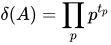
where each p is prime and tp = sup {m | pm divides kn for some n}, possibly zero or infinite. The formal product δ(A) is said to be the supernatural number corresponding to A.[1] Glimm showed that the supernatural number is a complete invariant of UHF C*-algebras.[2] In particular, there are uncountably many isomorphism classes of UHF C*-algebras.
If δ(A) is finite, then A is the full matrix algebra Mδ(A). A UHF algebra is said to be of infinite type if each tp in δ(A) is 0 or ∞.
In the language of K-theory, each supernatural number
specifies an additive subgroup of Q that is the rational numbers of the type n/m where m formally divides δ(A). This group is the K0 group of A. [1]
CAR algebra
[edit]One example of a UHF C*-algebra is the CAR algebra. It is defined as follows: let H be a separable complex Hilbert space H with orthonormal basis fn and L(H) the bounded operators on H, consider a linear map

with the property that

The CAR algebra is the C*-algebra generated by

The embedding

can be identified with the multiplicity 2 embedding

Therefore, the CAR algebra has supernatural number 2∞.[3] This identification also yields that its K0 group is the dyadic rationals.
References
[edit]- 1 2 Rørdam, M.; Larsen, F.; Laustsen, N.J. (2000). An Introduction to K-Theory for C*-Algebras. Cambridge: Cambridge University Press. ISBN 0521789443.
- ↑ Glimm, James G. (1 February 1960). "On a certain class of operator algebras" (PDF). Transactions of the American Mathematical Society. 95 (2): 318–340. doi:10.1090/S0002-9947-1960-0112057-5. Retrieved 2 March 2013.
- ↑ Davidson, Kenneth (1997). C*-Algebras by Example. Fields Institute. pp. 166, 218–219, 234. ISBN 0-8218-0599-1.