


Toeplitz matrix
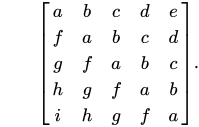
In linear algebra, a Toeplitz matrix or diagonal-constant matrix, named after Otto Toeplitz, is a matrix in which each descending diagonal from left to right is constant. For instance, the following matrix is a Toeplitz matrix:
Any matrix of the form


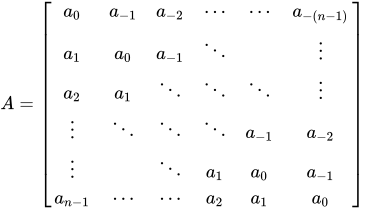
is a Toeplitz matrix. If the element of is denoted then we have



A Toeplitz matrix is not necessarily square.
Solving a Toeplitz system
[edit]A matrix equation of the form

is called a Toeplitz system if is a Toeplitz matrix. If is an Toeplitz matrix, then the system has at most only unique values, rather than . We might therefore expect that the solution of a Toeplitz system would be easier, and indeed that is the case.


Toeplitz systems can be solved by algorithms such as the Schur algorithm or the Levinson algorithm in time.[1][2] Variants of the latter have been shown to be weakly stable (i.e. they exhibit numerical stability for well-conditioned linear systems).[3] The algorithms can also be used to find the determinant of a Toeplitz matrix in time.[4]

A Toeplitz matrix can also be decomposed (i.e. factored) in time.[5] The Bareiss algorithm for an LU decomposition is stable.[6] An LU decomposition gives a quick method for solving a Toeplitz system, and also for computing the determinant. Using displacement rank we obtain method requiring ops with the use of fast matrix multiplication algorithms, where is the rank and .[7]


Properties
[edit]- An Toeplitz matrix may be defined as a matrix where , for constants . The set of Toeplitz matrices is a subspace of the vector space of matrices (under matrix addition and scalar multiplication).
- Two Toeplitz matrices may be added in time (by storing only one value of each diagonal) and multiplied in time.
- Toeplitz matrices are persymmetric. Symmetric Toeplitz matrices are both centrosymmetric and bisymmetric.
- Toeplitz matrices are also closely connected with Fourier series, because the multiplication operator by a trigonometric polynomial, compressed to a finite-dimensional space, can be represented by such a matrix. Similarly, one can represent linear convolution as multiplication by a Toeplitz matrix.
- Toeplitz matrices are asymptotically equivalent to circulant matrices as the dimension grows, a result known as the Grenander–Szegő theorem.[8] This asymptotic circulant property is the reason that the discrete Fourier transform approximately diagonalizes large Toeplitz matrices, and underlies the effectiveness of DFT-based spectral density estimation for stationary processes.
- Toeplitz matrices commute asymptotically. This means they diagonalize in the same basis when the row and column dimension tends to infinity.
- For symmetric Toeplitz matrices, there is the decomposition




- where is the lower triangular part of .


- The inverse of a nonsingular symmetric Toeplitz matrix has the representation
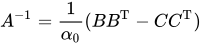
- where and are lower triangular Toeplitz matrices and is a strictly lower triangular matrix.[9]


Discrete convolution
[edit]The convolution operation can be constructed as a matrix multiplication, where one of the inputs is converted into a Toeplitz matrix. For example, the convolution of and can be formulated as:


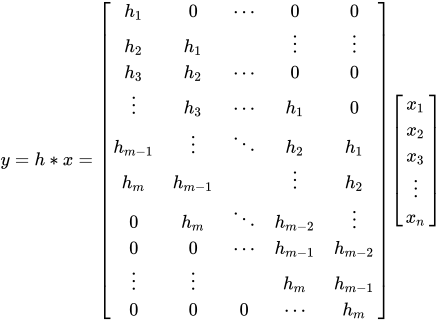
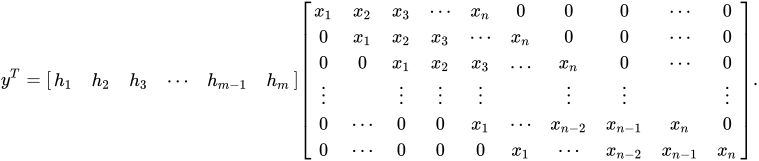
This approach can be extended to compute autocorrelation, cross-correlation, moving average etc.
Infinite Toeplitz matrix
[edit]A bi-infinite Toeplitz matrix (i.e. entries indexed by ) induces a linear operator on .


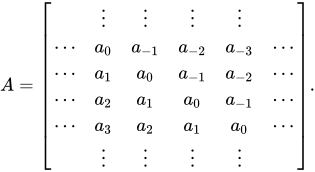
The induced operator is bounded if and only if the coefficients of the Toeplitz matrix are the Fourier coefficients of some essentially bounded function .

In such cases, is called the symbol of the Toeplitz matrix , and the spectral norm of the Toeplitz matrix coincides with the norm of its symbol. The proof can be found as Theorem 1.1 of Böttcher and Grudsky.[10]

See also
[edit]- Circulant matrix, a square Toeplitz matrix with the additional property that
- Hankel matrix, an "upside down" (i.e., row-reversed) Toeplitz matrix
- Szegő limit theorems – Determinant of large Toeplitz matrices
- Toeplitz operator

Notes
[edit]- ↑ Press et al. 2007, §2.8.2—Toeplitz matrices
- ↑ Hayes 1996, Chapter 5.2.6
- ↑ Krishna & Wang 1993
- ↑ Monahan 2011, §4.5—Toeplitz systems
- ↑ Brent 1999
- ↑ Bojanczyk et al. 1995
- ↑ Bostan, A.; Jeannerod, C.-P.; Schost, É. (2008). "Solving structured linear systems with large displacement rank". Theoretical Computer Science. 407 (1–3): 155–181. doi:10.1016/j.tcs.2008.05.014.
- ↑ Grenander, Ulf; Szegő, Gábor (1958). Toeplitz Forms and Their Applications. Berkeley, CA: University of California Press.
- ↑ Mukherjee & Maiti 1988
- ↑ Böttcher & Grudsky 2012
References
[edit]- Bojanczyk, A. W.; Brent, R. P.; de Hoog, F. R.; Sweet, D. R. (1995), "On the stability of the Bareiss and related Toeplitz factorization algorithms", SIAM Journal on Matrix Analysis and Applications, 16: 40–57, arXiv:1004.5510, doi:10.1137/S0895479891221563, S2CID 367586
- Böttcher, Albrecht; Grudsky, Sergei M. (2012), Toeplitz Matrices, Asymptotic Linear Algebra, and Functional Analysis, Birkhäuser, ISBN 978-3-0348-8395-5
- Brent, R. P. (1999), "Stability of fast algorithms for structured linear systems", in Kailath, T.; Sayed, A. H. (eds.), Fast Reliable Algorithms for Matrices with Structure, SIAM, pp. 103–116, arXiv:1005.0671, doi:10.1137/1.9781611971354.ch4, hdl:1885/40746, ISBN 978-0-89871-431-9, S2CID 13905858
- Chan, R. H.-F.; Jin, X.-Q. (2007), An Introduction to Iterative Toeplitz Solvers, SIAM, doi:10.1137/1.9780898718850, ISBN 978-0-89871-636-8
- Chandrasekeran, S.; Gu, M.; Sun, X.; Xia, J.; Zhu, J. (2007), "A superfast algorithm for Toeplitz systems of linear equations", SIAM Journal on Matrix Analysis and Applications, 29 (4): 1247–66, doi:10.1137/040617200
- Chen, W. W.; Hurvich, C. M.; Lu, Y. (2006), "On the correlation matrix of the discrete Fourier transform and the fast solution of large Toeplitz systems for long-memory time series", Journal of the American Statistical Association, 101 (474): 812–822, doi:10.1198/016214505000001069, S2CID 55893963
- Hayes, Monson H. (1996), Statistical digital signal processing and modeling, Wiley, ISBN 0-471-59431-8
- Krishna, H.; Wang, Y. (1993), "The Split Levinson Algorithm is weakly stable", SIAM Journal on Numerical Analysis, 30 (5): 1498–1508, doi:10.1137/0730078
- Monahan, J. F. (2011), Numerical Methods of Statistics, Cambridge University Press, doi:10.1017/CBO9780511977176, ISBN 978-1-139-08211-2
- Mukherjee, Bishwa Nath; Maiti, Sadhan Samar (1988), "On some properties of positive definite Toeplitz matrices and their possible applications" (PDF), Linear Algebra and Its Applications, 102: 211–240, doi:10.1016/0024-3795(88)90326-6
- Press, W. H.; Teukolsky, S. A.; Vetterling, W. T.; Flannery, B. P. (2007), Numerical Recipes: The Art of Scientific Computing (3rd ed.), Cambridge University Press, ISBN 978-0-521-88068-8
- Stewart, M. (2003), "A superfast Toeplitz solver with improved numerical stability", SIAM Journal on Matrix Analysis and Applications, 25 (3): 669–693, doi:10.1137/S089547980241791X, S2CID 15717371
- Yang, Zai; Xie, Lihua; Stoica, Petre (2016), "Vandermonde decomposition of multilevel Toeplitz matrices with application to multidimensional super-resolution", IEEE Transactions on Information Theory, 62 (6): 3685–3701, arXiv:1505.02510, doi:10.1109/TIT.2016.2553041, S2CID 6291005
Further reading
[edit]- Bareiss, E. H. (1969), "Numerical solution of linear equations with Toeplitz and vector Toeplitz matrices", Numerische Mathematik, 13 (5): 404–424, doi:10.1007/BF02163269, S2CID 121761517
- Goldreich, O.; Tal, A. (2018), "Matrix rigidity of random Toeplitz matrices", Computational Complexity, 27 (2): 305–350, doi:10.1007/s00037-016-0144-9, S2CID 253641700
- Golub, G. H.; van Loan, C. F. (1996), Matrix Computations, Johns Hopkins University Press, §4.7—Toeplitz and Related Systems, ISBN 0-8018-5413-X, OCLC 34515797
- Gray, R. M. (2005), "Toeplitz and Circulant Matrices: A Review" (PDF), Foundations and Trends in Communications and Information Theory, 2 (3), Now Publishers: 155–239, doi:10.1561/0100000006
- Noor, F.; Morgera, S. D. (1992), "Construction of a Hermitian Toeplitz matrix from an arbitrary set of eigenvalues", IEEE Transactions on Signal Processing, 40 (8): 2093–4, Bibcode:1992ITSP...40.2093N, doi:10.1109/78.149978
- Pan, Victor Y. (2001), Structured Matrices and Polynomials: unified superfast algorithms, Birkhäuser, ISBN 978-0-8176-4240-2
- Ye, Ke; Lim, Lek-Heng (2016), "Every matrix is a product of Toeplitz matrices", Foundations of Computational Mathematics, 16 (3): 577–598, arXiv:1307.5132, doi:10.1007/s10208-015-9254-z, S2CID 254166943

| National | |
|---|---|
| Other | |
