


Thom's second isotopy lemma
In mathematics, especially in differential topology, Thom's second isotopy lemma is a family version of Thom's first isotopy lemma; i.e., it states a family of maps between Whitney stratified spaces is locally trivial when it is a Thom mapping.[1] Like the first isotopy lemma, the lemma was introduced by René Thom.
(Mather 2012, § 11) gives a sketch of the proof. (Verona 1984) gives a simplified proof. Like the first isotopy lemma, the lemma also holds for the stratification with Bekka's condition (C), which is weaker than Whitney's condition (B).[2]
Thom mapping
[edit]Let be a smooth map between smooth manifolds and submanifolds such that both have differential of constant rank. Then Thom's condition is said to hold if for each sequence in X converging to a point y in Y and such that converging to a plane in the Grassmannian, we have [3]


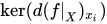


Let be Whitney stratified closed subsets and maps to some smooth manifold Z such that is a map over Z; i.e., and . Then is called a Thom mapping if the following conditions hold:[3]




- are proper.
- is a submersion on each stratum of .
- For each stratum X of S, lies in a stratum Y of and is a submersion.
- Thom's condition holds for each pair of strata of .


Then Thom's second isotopy lemma says that a Thom mapping is locally trivial over Z; i.e., each point z of Z has a neighborhood U with homeomorphisms over U such that .[3]


See also
[edit]- Thom–Mather stratified space – Way of decomposing a topological space
- Thom's first isotopy lemma – Theorem
References
[edit]- ↑ Mather 2012, Proposition 11.2.
- ↑ § 3 of Bekka, K. (1991). "C-Régularité et trivialité topologique". Singularity Theory and its Applications. Lecture Notes in Mathematics. Vol. 1462. Springer. pp. 42–62. doi:10.1007/BFb0086373. ISBN 978-3-540-53737-3.
- 1 2 3 Mather 2012, § 11.
- Mather, John (2012). "Notes on Topological Stability". Bulletin of the American Mathematical Society. 49 (4): 475–506. doi:10.1090/S0273-0979-2012-01383-6.
- Thom, R. (1969). "Ensembles et morphismes stratifiés". Bulletin of the American Mathematical Society. 75 (2): 240–284. doi:10.1090/S0002-9904-1969-12138-5.
- Verona, Andrei (1984). Stratified Mappings — Structure and Triangulability. Lecture Notes in Mathematics. Vol. 1102. Springer. doi:10.1007/BFb0101672. ISBN 978-3-540-13898-3.
 | This topology-related article is a stub. You can help Wikipedia by adding missing information. |