


Tanaka's formula
In the stochastic calculus, Tanaka's formula for the Brownian motion states that
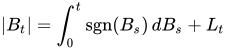
where Bt is the standard Brownian motion, sgn denotes the sign function
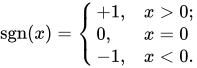
and Lt is its local time at 0 (the local time spent by B at 0 before time t) given by the L2-limit
![{\displaystyle L_{t}=\lim _{\varepsilon \downarrow 0}{\frac {1}{2\varepsilon }}|\{s\in [0,t]|B_{s}\in (-\varepsilon ,+\varepsilon )\}|.}](https://wikimedia.org/api/rest_v1/media/math/render/svg/3c71cc9a8a4cf65bd6e1664ff017b35d9272953e)
One can also extend the formula to semimartingales.
Properties
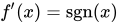
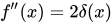
[edit]Tanaka's formula is the explicit Doob–Meyer decomposition of the submartingale |Bt| into the martingale part (the integral on the right-hand side, which is a Brownian motion[1]), and a continuous increasing process (local time). It can also be seen as the analogue of Itō's lemma for the (nonsmooth) absolute value function , with and ; see local time for a formal explanation of the Itō term.

Outline of proof
[edit]The function |x| is not C2 in x at x = 0, so we cannot apply Itō's formula directly. But if we approximate it near zero (i.e. in [−ε, ε]) by parabolas

and use Itō's formula, we can then take the limit as ε → 0, leading to Tanaka's formula.
References
[edit]- ↑ Rogers, L.G.C. "I.14". Diffusions, Markov Processes and Martingales: Volume 1, Foundations. p. 30.
- Øksendal, Bernt K. (2003). Stochastic Differential Equations: An Introduction with Applications (Sixth ed.). Berlin: Springer. ISBN 3-540-04758-1. (Example 5.3.2)
- Shiryaev, Albert N.; trans. N. Kruzhilin (1999). Essentials of stochastic finance: Facts, models, theory. Advanced Series on Statistical Science & Applied Probability No. 3. River Edge, NJ: World Scientific Publishing Co. Inc. ISBN 981-02-3605-0.