


Talk:Bernoulli's principle
Add topic| This is the talk page for discussing improvements to the Bernoulli's principle article. This is not a forum for general discussion of the subject of the article. |
Article policies
|
| Find sources: Google (books · news · scholar · free images · WP refs) · FENS · JSTOR · TWL |
Archives: 1, 2, 3, 4, 5, 6Auto-archiving period: 6 months  |
 | This  level-4 vital article is rated B-class on Wikipedia's content assessment scale. level-4 vital article is rated B-class on Wikipedia's content assessment scale.It is of interest to the following WikiProjects: | |||||||||||||
| ||||||||||||||
.jpg)

 | Caveat Over the years this article has attracted many editors who insist that Bernoulli's principle is not relevant to the lift on an airfoil. When we explore the views of these editors we discover that they think Bernoulli's principle is the Equal-transit time theory. (Everyone agrees that the Equal-transit time theory is so excessively simplified that it is incorrect.) Bernoulli's principle is a valid scientific statement that has stood the test of time since 1738. Many of us have flown inverted, or flown aircraft with upside-down airfoils, but this does NOT show that there is anything suspicious about Bernoulli's principle. —Preceding unsigned comment added by 69.1.23.134 (talk) 23:22, 27 August 2010 (UTC) |
Removed GF content in March
[edit]The equation
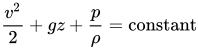
v^2/2 +gz + p/row = constant
is in terms of energy per kgm, i.e. it has been divided-through by M - but the text refers to the term gz as quote "force potential". This has no meaning, and serves only to confuse. It is really the potential energy in earth's gravity - per kg.
The term p/row, is same as (N/m^2 /kg) x m^3, which cancels to N-m/kg, so it is in fact, energy/kgm.
Since we were considering only INcompressible flow, row is constant and so dissappears to join the constant on the other side, to give
V^2/2 + gh + p = K
where p= pressure (N/m^2), g= 9.8 m/s/s, h = relative height, V = velocity m/s
It is clearer to not divide by mass, so that the equation is directly in terms of energy, i.e.
0.5.M.V^2 + M.g.h + P.Volume = k
i.e. Volume = M/row
What Bernoulli did was yet another example of the Conservation of Energy Principle.
He added k.e. (M.V^2/2) to Potential enerergy, (m.g.h) to P.Volume and states that the total will remain constant - in an isentropic, or streamlined, flow.
However, what does not so far seem to have been pointed-out, is one hideously "obvious" fact, which is - disastrously - often over looked. i.e. that in a duct of varying csa, the speed at any plane, z, along the the duct, is entirely determined by the csa at that plane. (INcompressible fluid)
An example of this is the guy who went to great effort to try to make a litre of water fall onto a fan on a vertical axis, to turn an alternator. He directed the water - or attempted-to! - with a parallel pipe, and, as I explained to him, the water cannot accelerate AND keep the same diameter - that is mathematically impossible. But I had no reply.
What happened was that air was drawn into the lower end of the pipe to effectively - but randomly - decrease its csa. This caused a drenching drowning kind of splatter onto the fan, rather than a streamlined flow, "wasting" most of the energy in oxygenating the water!
Also, it is for this reason that a turbine which works very efficiently in its designed direction of flow, Cannot - In Principle - work efficiently with the flow reversed.
It will, however - in Principle - work as a compressor - or pump - if energy is supplied to the rotor, (reverse rotation), and a suitable exit nozzle fitted to slow the flow back to the inlet speed.
Bert Vaughan — Preceding unsigned comment added by Bert Vaughan (talk • contribs)
My comments on the article structure
[edit]. Engineer Steve
I reviewed the article, except for the equations, and have these recommendations. While I see that it does cover many important points, I think more emphases is needed in some areas, especially for the common misconception of speed causing lower pressure. This may be the most wide-spread fallacy in all physics.
In fact, I suggest that you consider moving the equations section down, or at least put the Misconceptions earlier, even first after the lead, since the main misconception is so widely repeated and believed.
I’ll explain my recommendations carefully and do not plan to enter into long discussions, but if someone wants clarification, I am numbering these for easy reference.
- A - In general, I make a distinction between Bernoulli’s Principle and Bernoulli’s Equation. I consider the simplified wording, such as that second sentence, to be the Principle, but simply stated. This is a qualitative description of the *concept* - - at least the pressure/Acceleration part.
- Bernoulli’s Equation including the three terms for static, dynamic and height shows the quantitative relationship of the values/quantities. This mimics what happens to the *quantities* in the physical world. However, it does not show cause and effect – independent and dependent variables.
.
- I will also state that while all physics formulas / equations are very useful, they never show cause and effect. They only mimic the real world values and are derived from an understanding of the concepts.
. . .
- B - Also I saw talk about starting with explanations that are intuitive, which is good. However, you must know that we aren’t born with this knowledge. We learn things in our every-day lives and it best to find those kinds of things as a basis for explaining other things. Having done mentoring, teaching, STEM demos for a wide range of ‘students’ and read many You Tube comments, I’ve gathered many such starting points and analogies.
. . .
- #1 – 2nd sentence. Statement of the Principle.
I would prefer that second sentence say something like “The most common wording of Bernoulli’s Principle is. . . “ I think the part about constant height is option
Also, I see some references add that the converse of decrease in speed and increase in pressure is also part of the Principle. So you can discuss including that. Some references do this by saying that the Principle also describes “the inverse relationship of pressure and speed”. . . Then, right after that, I think it is a good idea to clearly and explicitly state that it does NOT say speed “Causes” a pressure reduction. .
I also think that the fallacy of blowing a jet of air that is below atmospheric pressure should be mentioned very early in the article because it is so prevalent and few people will read down, past the long equations section, to the misconceptions to get to that one. See #6, Misconceptions.
. . .
- #2 – There is a contradiction in the article.
Bernoulli vs. Euler.
The first Paragraph has: “. . .it was Leonhard Euler in 1752 who derived Bernoulli's equation in its usual form.[4][5]” John D. Anderson’s Historical notes also says that Euler actually derived the equations we now use with Bernoulli’s name and, also determined that pressure is isotropic and that a Pressure Gradient is the cause of fluid acceleration, just as a force causes acceleration of an ‘object’ per Newton.. Anderson Historical Note 6th ed Pg 305
However, the contradiction is in the section APPLICATIONS: “the lift forces can be calculated (to a good approximation) using Bernoulli's equations,[24] which were established by Bernoulli over a century before the first man-made wings were used for the purpose of flight.” That second one should be corrected, or omitted, since it was Euler.. AND I see no reason to mention flight in this article.
. . .
- #3 – The text under the Venturi meter image needs improvement.
It draws a relation between kinetic energy to pressure. It should mention kinetic energy and potential energy, which is pressure.
I suggest:
“The kinetic energy of speed, increases at the expense of the potential energy of fluid pressure, as shown by the difference in height of the two columns of water.” Also see my #4 about “expense”. Because everyone stresses conservation of energy, I think energies should be explicitly explained for this and other situations.
When describing various situations, I submit that the locations of these potential and kinetic energies must be made clear. I.E. Where there is low speed there is high pressure which then changes to high speed low pressure – This is potential energy being converted to kinetic energy.
It is also WITHIN a flow - also frequently stated as ‘along a streamline’.
. . .
- #4 – Within the early text it talks about conservation of energy, but doesn’t explain where the energies are located, nor where the conversion between potential and kinetic occur; as I point out for the Venturi meter image.
So, for the Venturi Meter image, rather than “kinetic energy of speed, increases at the expense of” potential energy, I recommend something like:
“The kinetic energy of speed was converted from the potential energy of fluid pressure, as shown by the difference in height of the two columns of water.”
OR
- Better yet, turn it around thus:
“The potential energy in the higher pressure region is converted into the higher kinetic energy in the accelerated region.”
OR
- “The higher kinetic energy in the accelerated region came from the higher potential energy in the slower region with the higher pressure.”
OR
- The higher potential energy of pressure in the slower region gets converted to higher kinetic energy of speed, and thus gets conserved in the accelerated, lower pressure region.
It should be stressed that “potential energy gets converted to kinetic energy” and visa-versa where appropriate. For example, when blowing, the potential energy of pressure is inside our lungs and the kinetic energy is in flow in the atmosphere. The pressure drop and the conversion between potential and kinetic energies occurs at the mouth exit. Therefore, the pressure decreases to atmospheric pressure NOT below it. This should be VERY explicitly explained since it is the common fallacy repeated over and over.
As you see, I prefer pointing out that one form of energy gets “converted to” the other, thus conserving it in another form. A roller coaster is a good way to see that the potential energy is at the top of a hill and kinetic energy is at the bottom. It’s not so clear in fluids.
. . .
- #5 - In Applications Section, the difference between explaining and calculating must be made clear. ”Explaining” is a qualitative description such as Newton’s First Law and Bernoulli’s Principle in words, of how things generally behave.
Calculating is Bernoulli’s Equation and Newton’s Second Law where actual values are derived.. In this regard, calculating lift-force in the two ways is the purpose of Eastlake’s paper. I discussed this with him. This does not explain WHY things happen, just that the lift-force can be calculated two ways.
- #6 - Misconceptions
The very first misconception shown should be the common fallacy that speed causes lower pressure, or that any fluid moving faster than some other fluid has the lower pressure.
- A moving fluid does not have a lower pressure.
- “Fast” air does not have, nor cause a lower pressure.
- If this was true, you could close a jar with just air in it and the pressure would decrease in a moving vehicle.
Bernoulli is not about speed, but Acceleration.
People who say “conservation of energy” then show some ‘blowing air’ demo, do not know where the potential and kinetic energies are. Those people never give that a thought, they just blindly parrot: “Conservation of energy.” Something I like to point out is the fact that speed is relative to your inertial frame of reference, but Acceleration is not. Relative to the ground (moving wing), the peak magnitude of the speed of air Below a wing is a Greater than that Above the wing. Yes, the speed is higher below the wing. Therefore, using speed as a reference for Bernoulli’s Principle won’t yield the same result observing from difference inertial frames and it MUST be the same. While Accelerations will be observed as the same. This is physics.
Shown in Fig 7 here:
- rxesywwbdscllwpn.quora.com/
Those are my comments from years of seeing many videos / articles with the misconceptions just getting repeated without truly understanding the physics AND reading comments, where I see how others think about these things Bernoulli’s Principle and the misconceptions are all carefully covered, along with the misconceptions, here:
-
- /kyuoyckftflurrpq.quora.com/
Regards. -- Steve -- (talk) 00:50, 15 May 2025 (UTC)
- EngineerSteve I have perused your comments but I'm not much wiser just yet. Let's have a look at your section A. You make some routine comments, and then you make a most momentous statement:
This may be the most wide-spread fallacy in all physics.
Wow, that is a big statement. However, I don't see what you mean by the word "This". Your momentous statement is about "the most wide-spread fallacy in all physics" but it looks like you clean forgot to indicate what the fallacy is; or what viewpoint is a fallacy. That is a significant oversight because it means we readers have no way of seeing what you are talking about. - You say that Bernoulli's equation "does not show cause and effect". At this point we readers are getting ready for an important revelation about how Bernoulli's equation fails to show cause and effect ... drum roll! Sadly, in the next paragraph you say "all physics formulas/equations ... never show cause and effect"! So it seems there is nothing unique about Bernoulli's equation and its failure to show cause and effect - all physics equations are like that. That makes we readers wonder why you bothered to mention cause and effect in relation to Bernoulli.
- By "cause and effect" perhaps you are referring to the fact that a force is required if a body is to undergo an acceleration - a change in either speed or direction or both. However, that is Newton's FIRST law of motion; not his second law, and certainly not Bernoulli's equation. So why are you talking about cause and effect in relation to Bernoulli's equation? Can you illustrate your point by giving an example of how one person who understands cause and effect correctly might apply Bernoulli's equation correctly, but another person who doesn't understand cause and effect correctly might apply Bernoulli's equation incorrectly?
- If we are to consider your proposed improvements to the article we need to be clear on what you are proposing, and why. Dolphin (t) 12:48, 15 May 2025 (UTC)
- RE: "This may be the most wide-spread fallacy in all physics." Sorry. My editing error. I let these comments sit and returned several times to proofread for continuity and for that kind of error, but missed that one. That sentence belongs in #6.
- "This" refers specifically the all-too common fallacy that "fast air has / causes a lower pressure." This is all over the place in the vast majority of videos and papers about Bernoulli-P. It needs to be clearly addressed by Wikipedia. There is EVEN a NASA video with an astronaut showing a demo on the Space Station where the "low pressure" jet out of his mouth causes two floating equipment cases to drift together.!. NASA Explains it incorrectly - SO be careful what you accept from NASA. I highly suspect they contract others to write some of their stuff and I have seen things thay have that are fully wrong -- some of which has been removed.
- . . .
- I talk about 'cause and effect" and equations because people frequently (usually Physics students or PhDs) jump to the Navier-Stokes equations as being the end-all and be-all, full proof that "fully explains" Bernoulli's Principle.
- Yes. Force causes Acceleration.
- Why talk about cause and effect in relation to Bernoulli's equation? Because: In Bernoulli's Equation, it is a Pressure Gradient that causes fluid Acceleration. This is directly analogous to Newton's Force and Acceleration. It is the same physics. A Pressure Gradient provides a net force on fluid.
- Understanding science / physics is understanding the cause and effect (C&E).
- . . .
- Examples:
- Someone who understands C&E: "The fluid increase in speed entering the narrow section of a Venturi tube is causd by the decreasing Pressure Gradient between the fat and narrow sections."
- Someone who understands C&E: "When blowing into the large "Bernoulli Bag" from a distance, the larger volume of entrained air around your blown jet, fills the bag much faster than just the full lung volume.
- . . .
- Someone who doesn't understand C&E: The lower pressure in the narrow Venturi section is caused by the faster speed, per Bernoulli's Principle.
- Someone who doesn't understand C&E: Blowing above a curved paper makes the paper rise because the fast air from your mouth, above the paper, has a lower pressure than the still air below the paper, which, then pushes the paper up."
- Someone who doesn't understand C&E: The low pressure of the air you blow, draws in more air to fill the large "Bernoulli Bag". [This is the long bag that one breath won't fill]
- . . .
- So, YES. Newton's First Law is the Qualitative physics. The explanation of WHY things happen - Cause & Effect.
- Newton's second law gives the relationship of values: F = MA, etc.. -- Steve -- (talk) 03:51, 17 May 2025 (UTC)
- I Moved that sentence to the end of the very first paragraph where I first mention the fallacy, so it won't confuse others. This is why doing this in text can be awkward - Discussing things by voice could quickly get this corrected. Sorry. -- Steve -- (talk) 10:38, 17 May 2025 (UTC)
- Rather than get distracted by discussions that won't lead directly to improvements in the article, I have replied on my User:Dolphin51/Sandbox3. There, I pose an engineering question requiring the application of Bernoulli's equation. I give my calculations and my answer, and I invite you to do the same. Feel free to reply on my Sandbox3. Dolphin (t) 14:43, 17 May 2025 (UTC)
- I spelled out my specific article recommendations above: "My comments on the article structure".
- I understand your interest may be on the equation, but my focus is on the physics concepts, not the equation.
- . .
- I must be honest that the way you modified the Article second sentence last year and subsequent comments showed that you are struggling with fundamental concepts. I am also surprised that it wasn't caught at first.
- . .
- I again recommend that you read this reference. It is the result of about ten years of doing STEM demos and talks with all ages:
- . .
- Since Wikipedia is where many people go for good information, I focus in the environment we are now in. This is where the Fallacy that: 'fast air causes lower pressure" (I call it Bad Bernoulli), is all over the web - even in a NASA Video - Yes a NASA video falsely "demonstrates" it.
- I am suggesting that the article needs to clearly address that problem. It has many of the correct physics concepts, but I feel it falls short on this one as I described above.
- -- Steve -- (talk) 19:17, 18 May 2025 (UTC)
- EngineerSteve I have begun reading your article “Understanding Bernoulli’s Principle Correctly” at the quora.com website you provided.
- You make the following statement
Approaching the inward sloping wall of the narrow section of the Venturi (or any surface), the air approaching the surface has inertia which pushes more and increases the pressure there. The air “running into the surface” pushes more than still air, thus increases the pressure.
- This is clearly in error. The narrow working section of a Venturi has air at low pressure and high speed. As the air approaches that narrow working section its speed increases and its pressure decreases. As the air leaves the narrow working section its speed decreases and its pressure increases. It looks like you are 100% wrong on this point. Dolphin (t) 08:47, 20 May 2025 (UTC)
- No, it is correct physics in fluids. You gloss over the word "there".
- Then, you change the subject to the narrow section.
- There are fluid fundamentals it appears that you still struggle with.
- . .
- The pressure is increased in the WIDE section of the pipe.
- I'll go through it, but this is all covered in my Quora Blogs.
- . .
- A carefully designed experiment shows this is true physics - Changing Only ONE THING as follows:
- Maintaining a constant flow rate in a constant diameter pipe; decrease the cross section of the pipe in one section and the pressure rises UPSTREAM - rises. FACT.
- . .
- Fluid approaching a surface INCREASES the pressure on the surface above ambient pressure. This increased pressure also occurs in the fluid and causes an acceleration of the fluid, depending on the angle between the original flow and surface This applies if the direction is perpendicular to the surface, or any angle with a component perpendicular toward the surface.
- Have you never felt the wind? This should be "intuitive" to you.
- .
- This Acceleration is what causes the flow near the pipe wall to change direction and follow the inward-sloping wall.
- .
- This pressure also propagates upstream.
- It is fundamental to fluids, that pressure acts in all directions and why pressure in fluid is called isotropic.
- The primary factor that causes this is the fact that the fluid has mass and, therefore, Inertia. Inertia resists acceleration - why Newton's First Law is called the Law of Inertia.
- . .
- It even is easy to see at the molecular level, provided you correctly understand the molecular level of Pressure. Remember momentum is MV. The flow speed vectorially adds that speed to the velocity of the molecules (v+x) toward the surface, therefore transferring more momentum to the surface - THUS more pressure.
- The very SAME physics applies in the pipe.
- . .
- A surface is a NEW constraint that can not be ignored as so many people do.
- ...
- These are fundamentals you should understand before trying to change the presentation of Wiki articles.
- ...
- The pressure in the narrow section is another subject. The constraint of the pipe wall changes there and must now be considered correctly.
- Regards, -- Steve -- (talk) 19:01, 21 May 2025 (UTC)
- This discussion has drifted away from improvements to the article on Bernoulli's principle, towards a general discussion on the topic. Article Talk pages are not a forum for general discussions. For this reason, I have replied to EngineerSteve on his Talk page. See my diff. Dolphin (t) 13:34, 3 June 2025 (UTC)
- Thanks. I didn't know a User Talk Page was available and move there - -
- However, I understand the purpose of Article Talk, but because that second sentence was so far off target, I had to see that it got corrected - after being up there for so long uncorrected.
- I did engage in some discussions, also providing a link to my blog to help the Talk readers understand the material better, but was reminded it was inappropriate. - So, subsequently that is why I started this section and tried my best to only address recommendations for the article, thus the title: "My comments on the article structure" of 15 May -- Steve -- (talk) 13:49, 4 June 2025 (UTC)
- In the previous edit EngineerSteve has written
because that second sentence was so far off target, I had to see that it got corrected - after being up there for so long uncorrected.
(See the diff.) The “second sentence” to which Steve refers said:Bernoulli's principle states that an increase in the speed of a parcel of fluid occurs simultaneously with a decrease in either the pressure or the height above a datum.
I have explained previously that this sentence is not incorrect although it is perhaps a little too complex for the first paragraph in the lead. (The lead is intended to be understandable by the widest possible audience.) - The sentence has now been changed to present one example of one application of Bernoulli’s principle. (See the diff.) The second sentence now says
For example, for a fluid flowing horizontally Bernoulli's principle states that an increase in the speed occurs simultaneously with a decrease in pressure.
- This example is restricted to fluid flowing horizontally but there must be no implication that Bernoulli’s principle only applies to horizontal flows. Bernoulli applies equally to fluid flows regardless of the orientation to the gravitational field. I accept that one example, confined to horizontal flows, is appropriate in the first paragraph in the lead because the lead is intended to be an introduction to the article and understandable by the widest possible audience.
- The example in the second sentence could just as correctly be confined to vertical flows because they come within the applicability of Bernoulli. In that case, the second sentence would begin “For example, for a fluid flowing vertically Bernoulli’s principle states …”
- Here is a challenge for everyone reading this Talk page: Complete the following sentence:
For example, for a fluid flowing vertically Bernoulli's principle states that an increase in the speed occurs simultaneously with … …
- Here is a hint, the response to my challenge will consist of two cases: firstly, the case of a fluid flowing vertically in a conduit such as cylindrical pipe.
- Secondly, the case of a plume of water rising or falling under the influence of gravity such as when pouring water out of a pitcher, or a stream leaking out of a small hole in a bucket of water. In this case the plume of water is entirely exposed to atmospheric pressure. (Here is another hint: In our article on Torricelli's law, in the lead it says
It was later shown to be a particular case of Bernoulli's principle.
) - I will offer my own model response to my challenge in a few days. Dolphin (t) 03:50, 5 June 2025 (UTC)
- Hi Dolphin, et al,
- Though I thought we were moving to my User Talk Page and I already replied to your previous comment over on My Talk Page, I address your vertical experiment like this, here:
- .
- First, I know this is discussing the physics, not addressing how the article is organized.
- .
- But. . . Since you insist discussing physics, I continue (sorry other folks):
- .
- The very common, simplified statement for Bernoulli's Principle that is currently the second Article sentence, CORRECTLY SAYS: "for a fluid flowing horizontally, Bernoulli's principle states that an increase in the speed occurs simultaneously with a decrease in pressure." {I added the comma}
- Switching to a vertical flow, is a different situation and has the added constraint of the vertical head pressure change due to changing elevation in a gravity field. This ALONE, WITHOUT ANY speed change, will show a pressure decrease with increasing elevation. It is common knowledge that pressure decreases as you go UP in air or under water.
- Continuing: including the speed increase will still be accompanied by a pressure decrease (to supply the Acceleration-causing Pressure Gradient).
- So, a first look at this NEW set of constraints, suggests that there is an additional pressure decrease (compared to EITHER individual constraint alone) under those new conditions (a speed increase and upward moving flow)...
- Switching to a vertical flow, is a different situation and has the added constraint of the vertical head pressure change due to changing elevation in a gravity field. This ALONE, WITHOUT ANY speed change, will show a pressure decrease with increasing elevation. It is common knowledge that pressure decreases as you go UP in air or under water.
- The very common, simplified statement for Bernoulli's Principle that is currently the second Article sentence, CORRECTLY SAYS: "for a fluid flowing horizontally, Bernoulli's principle states that an increase in the speed occurs simultaneously with a decrease in pressure." {I added the comma}
- .
- So, completing your sentence [I don't know how to make the color change]:
- "For example, for a fluid flowing upward vertically, Bernoulli's principle is that an increase in the speed occurs simultaneously with a decrease in pressure that is greater than either the speed increase, or elevation increase alone.".
- Now, I must add that IF that vertical flow is directed DOWNWARD, the pressure change will be the net difference (algebraic sum) that comes with the speed increase and elevation decrease. The pressure change depends on the amount of elevation decrease and speed increase. {pressure increase and decrease, respectively)
- "For example, for a fluid flowing upward vertically, Bernoulli's principle is that an increase in the speed occurs simultaneously with a decrease in pressure that is greater than either the speed increase, or elevation increase alone.".
- .
- So, we see that under this new, vertical flow setup, we see the gravity / height term assuming its role in Bernoulli's EQUATION.
- .
- .
- Therefore, making it a general statement for EITHER up or down flow, I believe it is correct to say:
- "For example, for a fluid flowing vertically, Bernoulli's Equation shows that an increase in the speed occurs simultaneously with a change in pressure that the net difference (algebraic sum) that comes with the speed increase and elevation change. (The amount and direction of pressure change depends on the amount and direction of elevation change and speed increase.)
- .
- I am quite confident that is the correct Physics.
- **** AND to be PERFECTLY CLEAR, I am in NO way suggesting that this be used in the Article. NOPE.
- .
- Sorry to be explaining Physics, folks. . .
- .
- SO. . . . Regarding Article Content.
- I RECOMMEND that Second sentence should remain for the horizontal ONLY flow because that is what is VERY commonly stated in zillions of places, all over the world as "Bernoulli's Principle". People come here for validation of *THAT* common usage.
- I believe the situation of elevation change is covered by the full equation for those more deeply interested in the more advances conditions.
- Regards -- Steve -- (talk) 06:23, 5 June 2025 (UTC)
- Thinking just a bit more, I can summarize that this can be flow in a pipe that is decreasing in diameter in the direction of flow.
- The first case, the pipe is directed upward in the direction of flow.
- The second case, the pipe is directed downward in the direction of flow.
- Thinking just a bit more, I can summarize that this can be flow in a pipe that is decreasing in diameter in the direction of flow.
- -- Steve -- (talk) 11:48, 5 June 2025 (UTC)
- We are presently discussing the potential for improvements to the article; not general discussion about the topic. On 2 May EngineerSteve wrote:
the most important sentence is wrong and makes no sense. It appears no one caught it since it violates all authoritative sources. The sentence is: "Bernoulli's principle states that an increase in the speed of a parcel of fluid occurs simultaneously with a decrease in either the pressure or the height above a datum." The velocity DOES NOT change with height above a datum, unless there is something like a pipe diameter change.
See the diff. - On 4 June EngineerSteve wrote
but because that second sentence was so far off target, I had to see that it got corrected - after being up there for so long uncorrected.
See the diff. - It appears we are now in agreement that the second sentence in its original form is not incorrect, does not violate any authoritative source, and is not “so far off target”. It was presenting too much information for the first paragraph in the lead, and would not have been understandable by the widest possible audience, but it was not incorrect. The situation has been improved by changing the sentence to one which gives an example of Bernoulli’s principle confined to a horizontal flow field. The new sentence is an example of one type of flow field but it is not a comprehensive statement or even a summary of Bernoulli’s principle.
- I think we are also in agreement that the original second sentence could be used later in the article where greater detail is to be found. In fact the sentiment that
an increase in the speed of a parcel of fluid occurs simultaneously with a decrease in … … the height above a datum
is already implied in the section Incompressible flow equation where it states the equation as: - This equation clearly shows that in any region of the flow field where the pressure is uniform, the speed squared v2 and the height above the datum z can vary but only in such a way that any increase (or decrease) in v2 is exactly matched by a decrease (or increase) in z. An example of this is a stream of water flowing over a waterfall – at every point in the stream the pressure is equal to atmospheric pressure; as each parcel of water gets closer to the pond at the bottom of the waterfall its height above the pond decreases and its speed increases precisely in accordance with the Bernoulli equation. Furthermore, the Bernoulli equation shows that a stream of water falling from a height z above the datum reaches exactly the same speed v as a solid object falling from the same height z. Dolphin (t) 14:10, 5 June 2025 (UTC)
- We are presently discussing the potential for improvements to the article; not general discussion about the topic. On 2 May EngineerSteve wrote:
- In the previous edit EngineerSteve has written
- This discussion has drifted away from improvements to the article on Bernoulli's principle, towards a general discussion on the topic. Article Talk pages are not a forum for general discussions. For this reason, I have replied to EngineerSteve on his Talk page. See my diff. Dolphin (t) 13:34, 3 June 2025 (UTC)
- No, it is correct physics in fluids. You gloss over the word "there".
- I spelled out my specific article recommendations above: "My comments on the article structure".
- Rather than get distracted by discussions that won't lead directly to improvements in the article, I have replied on my User:Dolphin51/Sandbox3. There, I pose an engineering question requiring the application of Bernoulli's equation. I give my calculations and my answer, and I invite you to do the same. Feel free to reply on my Sandbox3. Dolphin (t) 14:43, 17 May 2025 (UTC)
- RE: "This may be the most wide-spread fallacy in all physics." Sorry. My editing error. I let these comments sit and returned several times to proofread for continuity and for that kind of error, but missed that one. That sentence belongs in #6.
. .
- No. YOU did not discuss the article's structure.
- YOU entered: "Here is a challenge for everyone reading this Talk page: Complete the following sentence: For example, for a fluid flowing vertically Bernoulli's principle states that an increase in the speed occurs simultaneously with … …"
- THAT is what I responded to.
. I originally referred to the change that YOU made last year to the second sentence, as being way off target - YOUR change. That sentence, BEFORE you changed it was CORRECT. YOUR change was way off what Bernoulli's Principle commonly state. . YOUR VERSION was NOT providing 'too much information'. As you subsequently admitted here, it was referencing a completely different situation of Pressure change with elevation. YOU provided the image to show your thinking. . As you suggested, I went to my User talk Page and responded.
Please stop jumping around. -- Steve -- (talk) 22:32, 5 June 2025 (UTC)
- On 5th June (time 03:50) I invited interested Users to suggest an end to the sentence "For example, for a fluid flowing vertically Bernoulli's principle states that an increase in the speed occurs simultaneously with … … "
- I posed this question to see what other Users were thinking about the way the pressure in a fluid might change when flowing vertically. I have been thinking about it over recent days. My model answer is ""For example, for a fluid flowing vertically Bernoulli's principle states that an increase in the speed occurs simultaneously with a decrease in either the pressure or the elevation, or a combination of the two."
- In a fluid flowing vertically, an increase in speed with a decrease in pressure is what we observe when the diameter of a vertical pipe decreases in the direction of flow.
- In a fluid flowing vertically, an increase in speed with a decrease in elevation is what we observe in the illustration of Torricelli's law. In the lead of our article on Torricelli's law, it says
It was later shown to be a particular case of Bernoulli's principle.
- In the first case: "increase in speed with a decrease in pressure" where the diameter of a pipe decreases in the direction of flow, the situation is exactly the same as with a fluid flowing horizontally. (In this case it can be argued effectively that the change in speed is unrelated to Bernoulli's principle, and instead is completely determined by continuity of mass. Mass continuity is applicable in all flow situations including the presence of shocks whereas Bernoulli's principle is only applicable to incompressible fluids that flow without friction, no heat transfer etc.)
- I'm not advocating that a statement confined to vertical flow should be inserted into the lead. Dolphin (t) 13:03, 15 June 2025 (UTC)
Opening statement may encourage misconceptions
[edit]Checking before referring someone here for the *correct* wording of B's-Principle, I see it's still fixed after my extended discussion over Dolphin's uncorrected, drastic change over a year ago.
However, I now notice something else that concerns me. That First sentence mentions that Bernoulli's Principle
"...relates pressure, speed and height. "
I REALLY think it should say: "...relates pressure, speed change and height." [except the mention of height is usually omitted]
Saying 'speed' Seems like the common misconception that speed causes a pressure drop.
The wording is: ". . . an increase in the speed . . . "
Bernoulli's Principle is Clearly about Acceleration of a fluid (along a flow).
The speed change and pressure change accompany each other; they occur simultaneously, as the article then says.
- Technically a Lateral Pressure gradient to a flow also causes Accellerat5ion, but at this stage where we are talking about the common wording for a linear flow (or at least along a streamline), we can stay with speed change, but NOT just speed.
Notes b and c very clearly point out that a Pressure Gradient is the cause of the Acceleration. In fact, I think those notes should be explicit in the text somewhere early on in the article.
I'd also say that it should be explicit that the Principle DOES NOT assign a cause and effect. That was credited to Euler as reported By John D. Anderson, in one of is historical notes states that there is no indication that Bernoulli knew the cause, thus the description of these two things only accompanying each other. I believe it is note `3.19 HISTORICAL NOTE: BERNOULLI AND EULER—THE ORIGINS OF THEORETICAL FLUID DYNAMICS
However, we maintain the wording 'accompany' or 'simultaneous'..
I believe this is a correct exposition of the physics we accept and understand.
Sorry if that's a lot of words for a single word change. . . Regards, -- Steve -- (talk) 06:59, 14 January 2026 (UTC)
- I disagree that BP should be explained in terms of “pressure and speed change”.
- If we decide to explain BP in this way we must write “pressure change, speed change and height change.”
- It would be erroneous algebra to mix pressure, height and speed CHANGE. There are many examples of this algebraic principle in math, physics, chemistry, economics etc. Dolphin (t) 11:24, 14 January 2026 (UTC)
- Dear Steve and Dolphin51, to my opinion the second sentence in the lead already elaborates on the consequences of the BP on the relation between e.g. speed changes and pressure changes. The Euler equations (fluid dynamics) are the equations which describe the relations between flow velocity changes and associated changes in pressure and "height".
- The unique aspect of BP is that under certain conditions the Euler equations can be integrated to a Bernoulli constant relating flow speed, pressure and height. So I don't agree with the proposed change by Steve.
- Further, as already discussed before in Talk:Bernoulli's principle/Archive 6, I think we should stay away from the "cause and effect" subject in the context of BP, see e.g. Causality_(physics)#Determinism_(or,_what_causality_is_not). -- Crowsnest (talk) 13:01, 6 February 2026 (UTC)
- Mr swordfish On 24 July 2026 you wrote “BP quantifies changes in pressure, speed and height.”
- I agree with you, but this is not what EngineerSteve is advocating. His position is that BP relates “change in speed” to pressure and height. He is writing about “change in speed” but he is not mentioning change in pressure or change in height; he confines his comments to pressure and height.
- The error in this proposition is immediately visible to anyone familiar with BP as it is expressed in a math equation. Steve does not engage with math so he does not see how it is impossible to try to relate change in speed to pressure; or to relate change in speed to height above a datum. Dolphin (t) 14:44, 25 July 2026 (UTC)
Reference 8 for Weltner outdated
[edit]The original is gone from that site. Would someone please correct it because I don't know enough to correct the article for these URLs.
This is a valid Weltner free article URL: Mar 9 2026:
https://www.prirodopolis.hr/Bernoulli-Coanda%20Demo_files/Misinterpretations%20of%20Bernoullis%20Law.pdf
This requires a download step but also downloads free: https://www.researchgate.net/publication/303974495_Misinterpretations_of_Bernoulli's_Law
. . . . . . .
The Internet archive document has some Figures AND Equations missing, only place-holders:
https://web.archive.org/web/20090429040229/http://user.uni-frankfurt.de/~weltner/Mis6/mis6.html
This is an Italian site. I didn't translate it, but it may require a subscription: https://www.studocu.com/it/document/sapienza-universita-di-roma/fisica/misinterpretations-of-bernoullis-equation/77210269 Regards -- Steve -- (talk) 18:48, 9 March 2026 (UTC)
- As I mentioned privately, the problem with citing URLs on informal sites is that they die if the site owner removes them. Much better to stay with published works. Gpsanimator (talk) 19:37, 9 March 2026 (UTC)
- It's a very good reference and when that's all there is, any one is better than nothing. That's why I suggest them all. -- Steve -- (talk) 04:10, 11 March 2026 (UTC)
Lead section length
[edit]The current lead has 563 words, which is quite a bit longer than the 250 to 400 that most "featured articles" have according to MOS:LEADLENGTH.
I think the article would be improved by trimming some of the extraneous detail from the lead. My take is that most of our readers come to the article with only a vague understanding of the subject and are just looking for a simple explanation of what it is. Of course, we can still go into detail in the body of the article.
So I'm taking a whack at trimming it down. Feel free to discuss here on the talk page. Mr. Swordfish (talk) 14:48, 22 July 2026 (UTC)
- It's now at 492 words and I think it covers the basics. I'm considering removing the fourth paragraph since it doesn't really add much but I'll wait to see what other editors have to say. Mr. Swordfish (talk) 15:13, 22 July 2026 (UTC)
- Agreed. It repeats to much and switches from saying 'fluid' to saying 'air' to say the same thing. It should describe the concepts once. I recommend that it not say that it is the pressure decrease that causes an acceleration, but rather that the difference in pressure between two locations, called a "Pressure gradient" is the source of the force causing the acceleration. It does mention a "net difference", so it is like a brick with two opposing forces. I also think it is Newton's First Law that tells us that a force is the cause of acceleration. I'll try to keep an eye on it and comment in the next few days. -- Steve -- (talk) 15:17, 22 July 2026 (UTC)
- I'd prefer not to use the term gradient in the lead since many readers won't know what a gradient means. Agree that it's the better, more precise term and is the force causing the acceleration.
- I'd suggest replacing
- ...the decrease of pressure is the cause of a higher velocity.
- with
- ...pressure differences along the streamline cause the changes in the velocity.
- Other opinions? Mr. Swordfish (talk) 15:51, 22 July 2026 (UTC)
- I'm OK with leaving out "gradient" there. I prefer to see it very clear that a P-difference between two locations causes the intervening fluid to accelerate away from the higher pressure location toward the lower - WITH the P-difference providing the net force. I find that students with misconceptions, easily forget that we exist in a pressurized atmosphere with pressure pushing inward on everything. We hardly notice the air around us in every-day life. When you get outside a pipe, we have nothing but multiple pressures from all directions on a region of fluid, or a submerged 'body', So, we are dealing with net forces all the time. . . . and If possible, even more general to include a higher pressure in one location accelerates fluid toward ALL NEAR BY lower P locations - - and the converse of accelerating toward a lower P-location from all nearby higher regions. . . However, those general cases can be left for the article body. I feel strongly that the idea of Bernoulli be about Acceleration, NOT speed. I want that VERY clear.
- With so many places claiming that Bernoulli says that "faster air has a lower pressure", Wiki must be clear that is false. There is actually a NASA YouTube video with ISS astronauts 'demonstrating Bernoulli', by blowing between two floating boxes that move together, saying it proves that the fast stream out of the mouth has a pressure lower than ambient. Drives me crazy. That is Coanda around the boxes also with entrainment around the jet. Even Neil deGrasse Tyson has a "lift" video saying that. Just today, I poked the Google AI Gemini and it had a new name for this misconception "Velocity-Driven Bernoulli". Love it. Regards for now. -- Steve -- (talk) 21:38, 22 July 2026 (UTC)
- I feel strongly that the idea of Bernoulli be about Acceleration, NOT speed. I want that VERY clear.
- We do say something like that:
- Bernoulli's principle concerns itself with changes in speed and changes in pressure within a flow field.
- But it's not until almost the end of the article. Perhaps the final "misconceptions" section should be moved to earlier in the article. Or add to the lead that "faster moving air has lower pressure" is a misstatement of the BP. Mr. Swordfish (talk) 22:19, 22 July 2026 (UTC)
- I haven't read the misconceptions in a while, and I know and understand the CORRECT Principle wording, BUT in my experience with the repeated misconception, I feel Wiki must be VERY Clear about speed vs. speed CHANGES early in the article. With Destin of Smarter Every day, deGrasse Tyson and NASA repeating "Velocity-Driven Bernoulli", I believe the 'correction' needs to be kept early in the article because many people will only read so far. I DO see that is says: "there is more pressure from behind than in front. This gives a net force on the volume, accelerating it along the streamline." and I like that. I don't want to add any more words than necessary.
- Where I'm coming from, I admit, is wing-lift and the many statements that the air above a wing moves faster than the air below and, therefore, "results" in a lower pressure. This is two different flows, not changes within / along a flow - or along a streamline. IN ADDITION, speed is relative to the inertial reference frame. When viewing the "speeds" from the stationary GROUND reference, as a wing flies by, the air below the wing has a peak speed that is greater forward than the reverse speed above the wing. Speed is relative to the inertial reference of the observer, but acceleration is not; it is absolute from any reference. In addition, Bernoulli is not about speed along a surface. I explain this in my Quora Lift article.
- Lastly, I never liked saying "within a flow field". That sounds like the entire area/volume near the target object (wing). We are focusing on a streamline, OR a group of closely spaced and VERY related streamlines (near a wing). The Bad-Bernoulli is so pervasive, I would appreciate it if Wiki can be a place to minimize the misconception.
- Well, those are my thoughts. I feel that you understand enough to shorten the article, yet contain the necessary content. -- Steve -- (talk) 00:47, 23 July 2026 (UTC).
- Yes, the "bad Bernoulli" is everywhere and comes from missing a fundamental concept in physics: speed or velocity is not an invariant. i.e. velocity is entirely dependent on the (inertial) reference frame.
- For instance, for a car driving down the road is the air inside the car moving "faster" than the air outside the car, or is the air outside the car moving "faster"? And the answer is neither, it depends on the frame of reference.
- The BP is often mis-stated as "faster moving air has lower pressure" but since the speed is dependent on the reference frame this form leads to inapplicable applications of BP. However pressure and acceleration are invariant, so stating the principle in terms of pressure and acceleration is physically meaningful in a way that "speed" is not.
- Unfortunately, I'm not sure how to put this into the article or have clear cites to establish it. But the common element of the "bad Bernoulli" usually stems from the idea that "faster moving air has lower pressure". While partially true, it leads to false conclusions. I'll try to come up with a draft at some point, but it may be a while. Mr. Swordfish (talk) 13:56, 23 July 2026 (UTC)
- I don’t have any objection to moving the fourth paragraph out of the lead. It contains some useful information so it is worth retaining somewhere further down the article.
- But one comment. The fourth paragraph contains something about “If a fluid is flowing … … along a section of a streamline … … …” This is redundant because in steady flow the fluid never flows anywhere other than along a streamline. That is what a streamline is. This redundant wording may have crept in due to the false assumption that Bernoulli’s principle only applies along a streamline. A valid point made successfully somewhere else in the article is that the Bernoulli constant is uniform throughout any region of irrotational flow. Therefore we can apply Bernoulli to all points within the region, not just to points on the one streamline. Dolphin (t) 00:59, 24 July 2026 (UTC)
- EngineerSteve has written “I feel strongly that the idea of Bernoulli be about Acceleration, NOT speed. I want that VERY clear.”
- You tried that approach on this Talk page on 14 January 2026 when you started a new section titled “Opening statement may encourage misconceptions”. No-one supported you. Crowsnest and I responded to explain why we reject your ideas. No-one has written to support your ideas.
- No matter how confident you feel that your ideas are correct; and no matter how passionate you are about seeing these ideas in print, your ideas have been rejected. Not one User supported you after your 14 January post so it is not appreciated that you now raise these same matters in this new section and again attempt to have your ideas inserted in the article, especially as you have not acknowledged that your ideas have been aired on this Talk page and have been rejected. Dolphin (t) 11:32, 24 July 2026 (UTC)
- While I didn't engage in the previous discussion, Engineer Steve is basically right.
- BP quantifies changes in pressure, speed, and height. The overwhelming amount of "bad Bernoulli" lazily states that "faster moving fluid has lower pressure" and points to examples of moving fluids that have exactly the same pressure as the surrounding fluid, misapplying the BP in the process. See Q: Is It Really Caused by the Bernoulli Effect? for numerous examples.
- Even NASA is still publishing crap as of 2023.
- My take is that this article should have a short lead section, followed by a longer introductory non-mathematical qualitative explanation of the BP and what it is not, similar to what we did at Lift (force). Immediately segueing into the incompressible flow equation will cause most of our readers to quickly leave the article without much of an understanding. Of course, this is beyond the scope of the current topic of the length of the lead. In coming days I'll write a draft and present it in another talk page thread. Mr. Swordfish (talk) 13:45, 24 July 2026 (UTC)
- Swordfish (CORRECTION. WAS Doph) , While I understand your pint, In my discussions with Charles Eastlake, he made it clear that while what you say isn't completely wrong and we can move between streamlines, we can't go too far with that or we have significant differences, obviously depending on just how streamlines differ. . One of his specific points is that we CAN stray from individual streamlines to some extent, but must take care in doing so. He pointed out that a main point in one of his noted papers the air far ahead of a wing is all at the same energy - static pressure & velocity, so careful (correct typo) comparisons downstream across streamlines have some validity. In a pipe, things are fairly uniform out of the boundary layer and we are safe wandering around. However, we can't go meters away from a wing and be correct. So I recommend avoiding encouraging doing that, in general. Regards, -- Steve -- (talk) 01:11, 27 July 2026 (UTC)
- I've moved the final two paragraphs of the lead to a new "Overview" section; this reduces the word count of the lead to 269, which is in line with the suggestions in the MOS. It's also a fairly minor change.
- I'd like to see this new section fleshed out a bit, and will take a stab at it in coming days. Mr. Swordfish (talk) 14:26, 24 July 2026 (UTC)
- Comments; Except for one statement, I think the lead is now fine and there are places in the article making it clear that a greater pressure accelerates toward a lesser pressure.
- This part: "Thus the decrease of pressure is the cause of a higher velocity." seems one-sided to me. While it Clearly now points to pressure as a cause (not speed), It is the difference in pressure along the flow that provides a 'Newton net force'. So not mentioning the related 'higher pressure seems incomplete to me. In the classical Venturi the narrowing walls is a restriction that causes the upstream pressure increase, therefore, THAT "higher" pressure looks to me more like a cause of acceleration, rather than the lower pressure at the outlet of this "pressure vessel", of a fat section of pipe. . .
- Along with that, the lead's second paragraph references Newton's SECOND law as being the basis for B.P. This is the Law that gives us F=MA. A is for Acceleration. . . Then it goes on to state EXACTLY MY point, that the result of the pressures is Acceleration - - as someone says above, is not supported by anyone else.?. Looks like support to me. . .
- I'd have to go back to find it in John D. Anderson, but I clearly recall in one of his historical asides, he explicitly states that there is nothing in Bernoulli's notes suggesting he understood the cause/effect relationship, only the inverse speed pressure relationship - and that it was Euler who determined the actual CAUSE of the acceleration being a Pressure Gradient. N#1
- If I didn't say, it's OK with me not to use the term 'Pressure Gradient'. .
- Anyway, as I read this lead and overview now, I find it pretty much acceptable without any serious issues except as I state here, which I admit nay seem minor, but with all the misconceptions out there Even by NASA AND Neil deGrasse Tyson, I wanna attack the misconceptions as clearly as possible. Regards, -- Steve -- (talk) 01:55, 27 July 2026 (UTC)
Misconceptions and misapplications
[edit]I've renamed and fleshed out this section to include subsections on blowing over a piece of paper and suspending a ball in a jet of air. I've also added some pictures, one merely taken from coanda effect and two that were drawn by my friend. Those two are not perfect and I'll try to get better ones in coming days, but I think they are better than nothing so I published them.
This is still a work in progress, so more to come. Feedback welcome, of course. Mr. Swordfish (talk) 18:39, 27 July 2026 (UTC)
- I would like to add a subsection on blowing between two suspended balls but I'm having trouble coming up with good sources.
- My understanding is that just as in the two previous examples, the plume of air directed at the balls has the same pressure as the surrounding air. However, as the air flows between the balls it constricts similarly to what happens in a venturi tube. Hence lowered pressure in the region between the balls. So, while it is a consequence of BP, it doesn't happen in the way explained.
- So, if anyone knows of a good treatment of this demonstration, please post a link here. Thanks. Mr. Swordfish (talk) 20:03, 27 July 2026 (UTC)
- Hi Swordfish. . . There is a problem because I haven't seen ANYBODY (not heavily searched either) who has the between-balloons/cans correct. There is even a Texas A&M student video, obviously supported by a professor, that claims the jet is below atmospheric pressure. {What I call "Bad Bernoulli"= "Fast air CAUSES the lower pressure".}.
- I recently asked Google's Gemini AI about misconceptions and it calls this misconception "Velocity-driven Bernoulli". Weber State Professor Ron Galli (RIP) taught Bad Bernoulli. This is SO Frustrating.!.
- I describe my careful analysis of the twin balloons/cans Physics on Quora (it's Coanda), but I understand we cannot cite ourselves for Wikipedia sources. For your reference, the two balloon/can section is about 2/3 of the way down: Understanding Bernoulli's principle Correctly - https://kyuoyckftflurrpq.quora.com/
- -- Steve -- (talk) 02:30, 28 July 2026 (UTC)
- OH. I also address the levitating ball with the video by the Physics Girl Dianna's video. She uses the COMMON "Inertia says the air would go straight, but..." though it never does. I consider that a crutch that isn't true, but 'almost' explains the curved flow. I explain all that in my Quora Understanding Bernoulli article linked above. * * * AND I SEE I referred to Swordfish as Dolf twice and corrected them, Sorry, it's late) -- Steve -- (talk) 02:39, 28 July 2026 (UTC)
Equal transit time
[edit]Mr swordfish Thanks for all the refinements you have made to our article in the past day.
In your edit (July 27, 19:37) you erased the clause saying equal transit time (ETT) is valid for the flow around an object experiencing zero lift. This clause may have been a distraction from the primary theme, particularly for readers who are new to the subject, but it contains significant value for the reader who is ready for a more comprehensive understanding of the topic. Let’s restore this clause to the end of the section where it is available to those who reach that point, but can safely be ignored by those who have read enough on the topic.
To the best of my knowledge, this statement (prior to your edit) was the only document in the world that acknowledged any legitimacy to the expression ETT. It was always used in the context of something that was false, incorrect, the work of the devil etc.
Reliable published sources acknowledge the legitimacy of ETT but without using that expression. For example, the Kutta-Joukowski theorem tells us that where there is zero lift there is zero circulation and this is synonymous with ETT.
Numerous text books show a symmetric airfoil at zero angle of attack and make the point that the flow field is also symmetric about the airfoil. Saying the flow field is symmetric is synonymous with saying ETT. In the case of a cambered airfoil generating zero lift the flow field is not symmetric close to the surfaces of the airfoil but it it is indistinguishable from symmetric beyond a short distance above and below the airfoil.
In Doug McLean’s book he shows a diagram with an airfoil generating lift, and a branch cut radiating from the airfoil out through the flow. He makes the point that where there is lift there must be a branch cut, but where there is no lift there is no branch cut. No branch cut implies ETT.
For readers who are not conversant with Kutta-Joukowski or branch cuts we can provide a service by putting ETT into its correct perspective, namely that ETT can be used to describe the flow around any non-lifting body, but it cannot be used to explain the flow around any lifting body.
I will try some suitable words in the coming day or two. Dolphin (t) 01:24, 28 July 2026 (UTC)
- The main idea we need to convey is that "there is no physical principle that requires equal transit time." ETT is not a valid assumption, any more than assuming "all rocks are the same size" is a valid assumption. Granted, if you look long and hard enough you might find two rocks that are identical, but making that assumption for rocks in general is a false premise.
- In our idealized mathematical models, equal transit time implies that the lift is zero. But in the real world, given the turbulence at the boundary layer and the phenomena of vortex shedding, it's not clear to me that equal transit time ever actually happens outside of the textbook world. It's sort of like a spherical cow - a useful simplification but good luck actually finding one.
- Which is to say that the current verbiage in the article
- There is no physical principle that requires equal transit time around bodies generating lift.
- while technically correct is misleading. A better statement is
- There is no physical principle that requires equal transit time around a solid body.
- i.e. there is no a priori reason to assume equal transit time. Ever. We should be clear about that.
- Your observation:
- "To the best of my knowledge, this statement (prior to your edit) was the only document in the world that acknowledged any legitimacy to the expression ETT."
- is a very good reason not to include the statement, as per the policies at WP:V, WP:OR, and WP:SYNTH. We are on solid ground saying something like:
- According to the mathematical models, equal transit time implies that there is zero lift.
- But I'm unconvinced that we need to say that in this article. Mr. Swordfish (talk) 14:10, 28 July 2026 (UTC)
- Engineer Steve here. I suggest this discussion belongs in the lift article. -- Steve -- (talk) 20:39, 28 July 2026 (UTC)
- Mr swordfish A quick preliminary response: You have written “But in the real world, given the turbulence at the boundary layer and the phenomena of vortex shedding, it's not clear to me that equal transit time ever actually happens outside of the textbook world.”
- Your comment is addressing unsteady flow. Our article addresses steady flow. In the section “Incompressible flow equation” it is stated explicitly that BP is applicable only to steady flow. Also there are many mentions of streamlines; and streamlines are only defined in steady flow.
- Your comment is also addressing some highly irreversible processes (turbulence, boundary layer, vortex shedding.) In the “Overview” it states explicitly that BP is only applicable in isentropic flows.
- Our article is based on reliable published sources so it is not surprising that its content is describing a textbook world. BP is an important theoretical principle in classical physics; it is not an experimental technique for use in real-world investigations in turbulent and unsteady flows.
- Your analogies about rocks of equal size, and spherical cows appear to be unhelpful and I skipped over them. Dolphin (t) 00:32, 29 July 2026 (UTC)