


Realization (systems)
In systems theory, a realization of a state space model is an implementation of a given input-output behavior. That is, given an input-output relationship, a realization is a quadruple of (time-varying) matrices such that
![{\displaystyle [A(t),B(t),C(t),D(t)]}](https://wikimedia.org/api/rest_v1/media/math/render/svg/a1c55ec426914614e3d3002474a585242249efed)


with describing the input and output of the system at time .


LTI System
[edit]For a linear time-invariant system specified by a transfer matrix, , a realization is any quadruple of matrices such that .



Canonical realizations
[edit]Any given transfer function which is strictly proper can easily be transferred into state-space by the following approach (this example is for a 4-dimensional, single-input, single-output system)):
Given a transfer function, expand it to reveal all coefficients in both the numerator and denominator. This should result in the following form:
- .

The coefficients can now be inserted directly into the state-space model by the following approach:
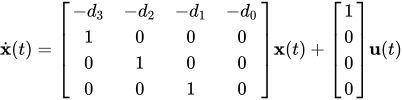
- .

This state-space realization is called controllable canonical form (also known as phase variable canonical form) because the resulting model is guaranteed to be controllable (i.e., because the control enters a chain of integrators, it has the ability to move every state).
The transfer function coefficients can also be used to construct another type of canonical form
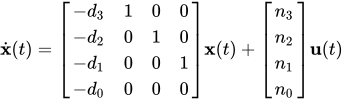
- .

This state-space realization is called observable canonical form because the resulting model is guaranteed to be observable (i.e., because the output exits from a chain of integrators, every state has an effect on the output).
General System
[edit]D = 0
[edit]If we have an input , an output , and a weighting pattern then a realization is any triple of matrices such that where is the state-transition matrix associated with the realization.[1]


![{\displaystyle [A(t),B(t),C(t)]}](https://wikimedia.org/api/rest_v1/media/math/render/svg/d578e6533045989bf62b018dfaf0b31ec9906896)


System identification
[edit]System identification techniques take the experimental data from a system and output a realization. Such techniques can utilize both input and output data (e.g. eigensystem realization algorithm) or can only include the output data (e.g. frequency domain decomposition). Typically an input-output technique would be more accurate, but the input data is not always available.
See also
[edit]
References
[edit]- ↑ Brockett, Roger W. (1970). Finite Dimensional Linear Systems. John Wiley & Sons. ISBN 978-0-471-10585-5.