


Semiparametric model
In statistics, a semiparametric model is a statistical model that has parametric and nonparametric components.
A statistical model is a parameterized family of distributions: indexed by a parameter .
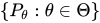

- A parametric model is a model in which the indexing parameter is a vector in -dimensional Euclidean space, for some nonnegative integer .[1] Thus, is finite-dimensional, and .
- With a nonparametric model, the set of possible values of the parameter is a subset of some space , which is not necessarily finite-dimensional. For example, we might consider the set of all distributions with mean 0. Such spaces are vector spaces with topological structure, but may not be finite-dimensional as vector spaces. Thus, for some possibly infinite-dimensional space .
- With a semiparametric model, the parameter has both a finite-dimensional component and an infinite-dimensional component (often a real-valued function defined on the real line). Thus, , where is an infinite-dimensional space.


It may appear at first that semiparametric models include nonparametric models, since they have an infinite-dimensional as well as a finite-dimensional component. However, a semiparametric model is considered to be "smaller" than a completely nonparametric model because we are often interested only in the finite-dimensional component of . That is, the infinite-dimensional component is regarded as a nuisance parameter.[2] In nonparametric models, by contrast, the primary interest is in estimating the infinite-dimensional parameter. Thus the estimation task is statistically harder in nonparametric models.
Example
[edit]A well-known example of a semiparametric model is the Cox proportional hazards model.[3] If we are interested in studying the time to an event such as death due to cancer or failure of a light bulb, the Cox model specifies the following distribution function for :


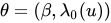
where is the covariate vector, and and are unknown parameters. . Here is finite-dimensional and is of interest; is an unknown non-negative function of time (known as the baseline hazard function) and is often a nuisance parameter. The set of possible candidates for is infinite-dimensional.


See also
[edit]Notes
[edit]- ↑ Bickel, P. J.; Klaassen, C. A. J.; Ritov, Y.; Wellner, J. A. (2006), "Semiparametrics", in Kotz, S.; et al. (eds.), Encyclopedia of Statistical Sciences, Wiley.
- ↑ Oakes, D. (2006), "Semi-parametric models", in Kotz, S.; et al. (eds.), Encyclopedia of Statistical Sciences, Wiley.
- ↑ Balakrishnan, N.; Rao, C. R. (2004). Handbook of Statistics 23: Advances in Survival Analysis. Elsevier. p. 126.
References
[edit]- Bickel, P. J.; Klaassen, C. A. J.; Ritov, Y.; Wellner, J. A. (1998), Efficient and Adaptive Estimation for Semiparametric Models, Springer
- Härdle, Wolfgang; Müller, Marlene; Sperlich, Stefan; Werwatz, Axel (2004), Nonparametric and Semiparametric Models, Springer
- Kosorok, Michael R. (2008), Introduction to Empirical Processes and Semiparametric Inference, Springer
- Tsiatis, Anastasios A. (2006), Semiparametric Theory and Missing Data, Springer
- Begun, Janet M.; Hall, W. J.; Huang, Wei-Min; Wellner, Jon A. (1983), "Information and asymptotic efficiency in parametric--nonparametric models", Annals of Statistics, 11 (1983), no. 2, 432--452